
To hedge currency risk as an investor, you offset the exchange-rate movement between the currency your assets are priced in and the currency you actually spend in. Most people do it with a currency-hedged ETF or a hedged share class of the same index, which lock in a conversion rate through forward contracts and reset it periodically. The cost shows up as a small tracking difference rather than a line-item fee, and it is usually a fraction of what the currency swings themselves can cost you in a bad year.
That last point matters more than the mechanics. A euro-based investor with a strong year in US stocks can still end the year down, because the dollar fell against the euro by roughly 11% over the course of 2026. Investors on r/ValueInvesting described exactly that experience: good individual returns, wiped out by translation. Understanding how to hedge currency risk as an investor starts with accepting that the currency is a separate bet sitting on top of the investment, and you can choose to take it or shrink it.
This guide covers what you need before you start, the six methods, a step-by-step process for sizing and placing a hedge, what it costs, and where it usually goes wrong. It is general education, not investment advice. Tax and account rules differ by country and by account type, so check what applies where you live before you act on any of it.
Table of Contents
- What You Need Before You Hedge
- Step-by-Step: How to Hedge Currency Risk as an Investor
- 1. Identify the currency risk you actually have
- 2. Decide how much currency movement you can absorb
- 3. Choose the hedge that matches your exposure
- 4. Calculate the hedge amount and currency direction
- 5. Account for costs, liquidity and tax treatment
- 6. Monitor and rebalance the hedge
- What It Costs to Hedge Currency Risk
- Which Assets to Hedge
- Common Mistakes in Currency Hedging
- Frequently Asked Questions
- Do I need to hedge currency risk if I invest only in domestic assets?
- What is the simplest way for a small investor to reduce currency risk?
- Should I hedge a foreign stock investment with the same currency?
- Does a currency hedge eliminate all exchange-rate losses?
- Are currency-hedged funds better than currency futures for beginners?
- How often should I rebalance a currency hedge?
- Conclusion
What You Need Before You Hedge

Hedging is a risk-management decision, so the useful prep is not research on exchange rates. It is a clear picture of your own exposure.
Start with your currency exposure. List every account and holding, and write down the currency each one is priced in, not the currency it trades in. This trips people up more than anything else on this page, because a US-listed ETF tracking Japanese companies can still be almost entirely yen exposure. Listing currency and underlying currency are different things.
Then note your spending currency. Most investors need to protect the currency their salary arrives in and the currency they will pay rent, food and school fees in. A hedge in the wrong base currency protects nothing you care about.
Set your time horizon and liquidity needs next. A hedge you cannot hold for the whole intended period is not a hedge, it is a trade. If you might need cash from the account within a few years, a hedged fund with a quarterly reset and a management fee is a poor fit, because you would be selling into the reset schedule rather than at a level you chose.
Finally, be honest about your risk tolerance for currency specifically. Some people are comfortable with a 10% swing they cannot influence. Others find it genuinely hard to hold a position that is down 10% for reasons unrelated to the asset itself. Both answers are fine, and they lead to different hedge ratios.
On the account side, most retail investors need very little: a brokerage that offers hedged share classes of index funds, or a choice of currency-hedged ETFs. Forwards, futures and options need a margin-enabled account and far larger sizes, which is why they stay in the advanced section below.
Step-by-Step: How to Hedge Currency Risk as an Investor
The process is the same whether you are hedging a single fund or a whole portfolio. Six steps, in this order.
1. Identify the currency risk you actually have
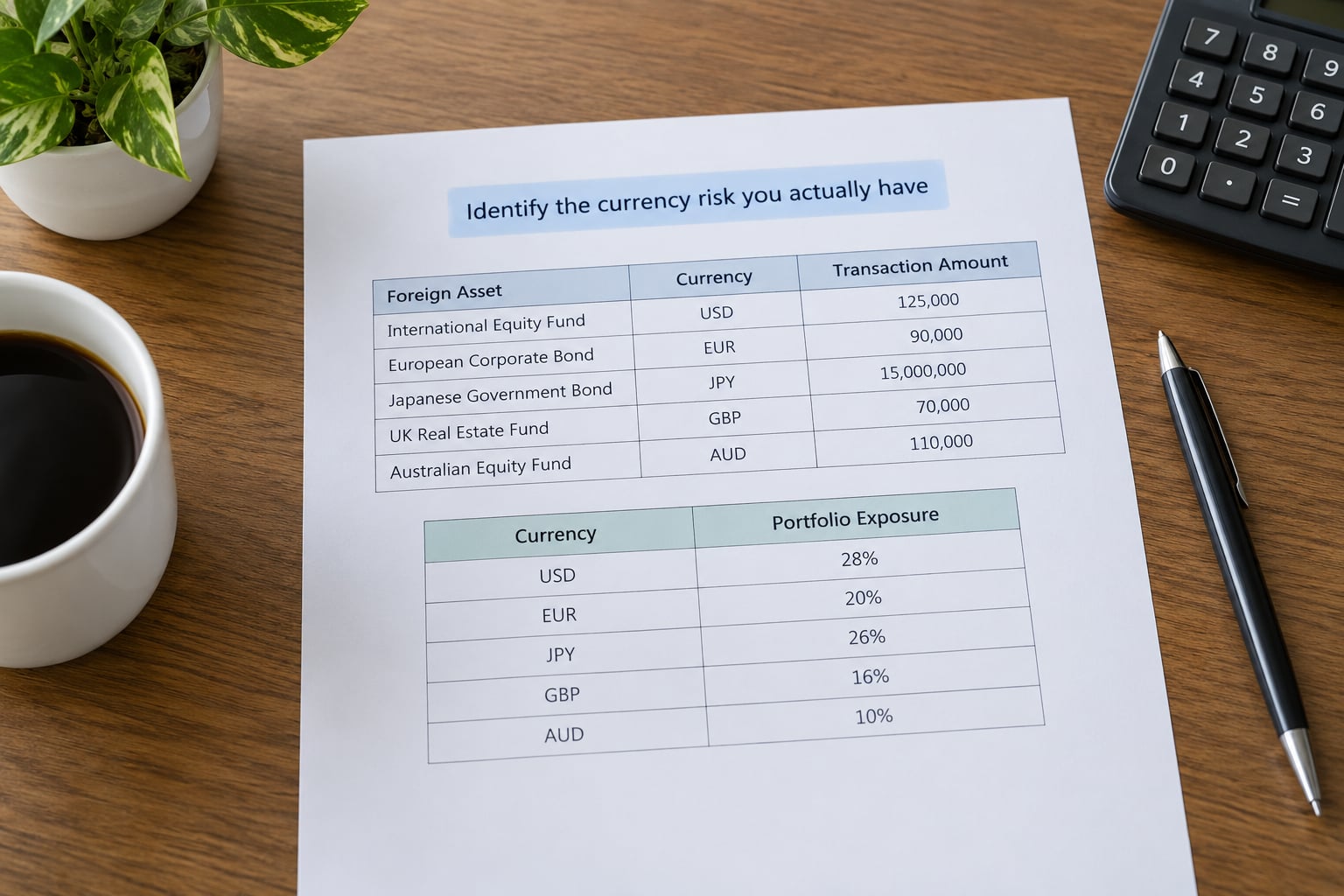
Write down three numbers: the value of your foreign-currency assets, the currency they are priced in, and your home currency. That is the raw exposure.
Then separate the categories. Transaction exposure is money you will actually convert, such as a foreign dividend you spend or an overseas property payment. Translation exposure is the reporting effect on assets you hold but do not spend. Economic exposure is indirect: your share price may move because the company earns in another currency even when it trades in yours.
Portfolio-wide, investors usually hold three kinds: foreign equities, foreign bonds, and cash held in a foreign bank account. Commodities priced in dollars are a fourth, and one that matters if you hold gold or mining shares, since most bullion trades in US dollars.
The goal of this step is a single line: how much value, in which currency, would hurt if it translated down 10%. Not your whole net worth. Just the part that hurts.
2. Decide how much currency movement you can absorb
Now set a currency-risk budget. This is a personal number, not a rule, and the inputs are your time horizon, the size of the foreign portion relative to your total, and any known future liability in that currency.
A practical way to think about it: imagine your foreign holdings lose 15% of their value purely from currency, with the underlying assets flat. Can you hold that position without selling? If yes, you can carry a smaller hedge. If the answer is no, you want closer to a full hedge on that slice.
Also separate temporary from permanent exchange-rate moves. A sharp quarterly move that reverses costs you little if you never sell. A multi-year drift in one direction is what actually changes your life outcome, and that is the one worth insuring against.
3. Choose the hedge that matches your exposure
Six methods cover almost every case. Here they are in the order most investors should consider them.
- Hedged share classes of index funds. The same portfolio, with a hedged class that sells forwards to offset currency. Minimal effort, automatic resets.
- Currency-hedged ETFs. The same idea in an exchange-traded wrapper, bought like any other ticker. Useful if you want flexible sizing or partial hedging by mixing hedged and unhedged funds.
- Partial hedging. Split the exposure, for example half hedged and half unhedged. This is the middle path many advisers recommend because it reduces regret in both directions.
- Forwards and futures. Lock a rate for a set date or size. Effective, but minimum notionals, long maturities and margin requirements keep them mostly out of reach for individuals.
- Options. Buy the right to convert at a floor price while keeping the upside. More expensive, and usually only sensible for larger balances or businesses.
- Natural hedging. Match assets to future spending in the same currency. A euro expense funded by euro rent income needs no derivative at all.
4. Calculate the hedge amount and currency direction
The direction rule is simple and worth memorising: to protect against a fall in a foreign currency, you sell that foreign currency forward. Sell euros, buy dollars; sell dollars, buy euros.
The size is the portion you decided to protect, expressed in the contract currency. A simplified version for a fund-based hedge: take the value of the foreign assets you want protected, multiply by your hedge ratio, and that is the notional you need covered.
Worked example. You hold 60,000 euros of European equities and want a 50% hedge. The protected amount is 30,000 euros, so roughly 30,000 euros of notional needs to be sold forward against your home currency. At a 100% hedge ratio it is the full 60,000. At 0% you do nothing and keep the currency bet.
Real instruments differ in the details. Futures are quoted against a currency pair with a contract multiplier, so the number of contracts is notional divided by the multiplier. Forward contract sizes vary by bank and often start in the tens of thousands of units of the foreign currency. Hedge ratios are easy to state precisely and easy to get wrong in practice, so treat the number above as a starting point and confirm the mechanics with your provider before trading.
5. Account for costs, liquidity and tax treatment
Hedging is not free. The cost has three parts: the interest rate differential between the two currencies, the roll cost of keeping the position in place, and the management fee on the fund itself.
The rate differential is the one people argue about. When you sell a low-yield currency forward for a high-yield one, you give up the interest you would have earned. That is the price of the protection, and it is largest exactly when the rate gap is widest. Over time, if the currency you hedged earns more than the one you hold, the hedge cost exceeds the currency loss it prevented. Nobody can promise otherwise.
Roll cost comes from resetting the forward before it expires. Liquidity shows up in the spread you pay when buying or selling the hedge, and in the quarter-end reset cycle that hedged funds follow. Tax treatment is the least predictable item: hedged funds often generate larger and more frequent taxable distributions than their unhedged twins because the currency gains are realised as contracts roll. That can matter a lot in a taxable account and very little in a tax-deferred one. Rules vary by country and account type, so confirm with a tax professional in your own jurisdiction.
6. Monitor and rebalance the hedge
Write your review rule down before you need it, because the moment your hedge is losing money is exactly when judgment is worst. Members of r/CFP described the opposite problem: hedged lines devaluing sharply when the dollar pulled back, and regret that switching felt inevitable at the time.
A workable schedule is a check every quarter, plus a trigger. Review when the value of the foreign assets moves more than roughly 15% from where it was when you set the hedge, when your time horizon changes, or when your income currency changes.
The rebalancing rule most people land on is deliberately boring. Split the exposure into a hedged share and an unhedged share once, set the ratio, and rebalance back to it on a fixed date. That removes currency timing from your decisions, which is the whole point, because nobody forecasts exchange rates reliably. If you want something more active, dynamic hedging means a manager adjusts the ratio programmatically as rates and volatility change; it is available in some institutional products and is not something to attempt by hand.
What It Costs to Hedge Currency Risk
The honest answer to how much it costs to hedge a currency: for a retail hedged fund, usually somewhere between a few tenths of a percent and a bit over 1% a year depending on the rate gap and the fund, and it arrives as a tracking difference rather than an invoice. Direct forwards cost more in fees but start from much larger sizes.
| Method | Typical annual cost | Minimum size | Complexity | Best for |
|---|---|---|---|---|
| Unhedged (no hedge) | Zero | Any | None | Long horizons, investors comfortable with FX swings |
| Hedged ETF or share class | Rate differential plus roughly 0.2% to 0.4% roll cost and the fund fee | Any | Low | Most retail investors with foreign holdings |
| Partial hedge (50/50) | Roughly half the fully hedged cost | Any | Low | Investors who want fewer regrets in both directions |
| Forward contract | Bid-ask spread plus the rate differential | Typically tens of thousands of units | Medium | Larger balances, known future payments |
| Futures | Spread plus the rate differential, margin funding | Contract size, often thousands of units | High | Investors experienced with margin |
| Options | Premium, which can be significant relative to notional | Contract size | High | Protecting a floor while keeping upside |
| Natural hedge | Zero, beyond the yield on the matching asset | Any | Low | Investors with income and expenses in the same currency |
One concrete comparison is worth holding onto. In 2018, the Currency Hedged MSCI ACWI beat the unhedged index by about 3.5 percentage points. In 2026, with the euro strengthening roughly 11% against the dollar, unhedged euro-based holders of US assets gave back a similar share of their return to currency. Those are the two halves of the trade-off in a single pair of numbers: protection when you need it, drag when you do not.
Which Assets to Hedge
The asset matters less than most articles admit, but two distinctions are worth making.
Foreign bonds are the strongest case for hedging. Their returns are mostly interest, and you do not want a currency move to cancel a bond’s yield. Equities are the weaker case, because the foreign revenue mix already acts as a partial natural hedge and because equity returns over decades tend to dominate short-term currency swings. Commodities are different again: gold and most industrial commodities trade in US dollars, so a gold allocation is a dollar bet whether or not the seller is American. Mining equities listed in Canada or Australia usually carry both commodity and currency exposure, which is a good reason to know what you actually own.
| Asset | Hedge? | Reason |
|---|---|---|
| Foreign government bonds | Usually yes | Yield is small, so currency can erase it |
| Foreign developed-market equities | Depends on horizon and tolerance | Currency adds volatility but rarely changes the long-run outcome |
| Emerging market equities and debt | Partial is common | High volatility in both the asset and the currency |
| Gold and dollar-priced commodities | Usually no | Dollar exposure is part of the position by design |
| Foreign property or a future overseas purchase | Yes, if it is a known amount | It is a transaction exposure, not a translation one |
| Cash in a foreign account | Depends on the account | A multi-currency deposit can be a natural hedge on its own |
Common Mistakes in Currency Hedging
Assuming listing currency removes currency risk. A fund listed in London or New York still holds assets priced in other currencies. Look at what is inside it.
Hedging in the wrong direction. Selling a currency forward protects you from that currency falling. It does nothing for you if it rises, which is the direction many investors regret hedging into.
Over-hedging. Protecting more than your exposure means you are now running a speculative currency position wearing a hedge as a disguise.
Using leverage without understanding the loss profile. Forwards and futures can produce losses larger than the margin posted. Most individuals discover this after the fact.
Treating the hedge as permanent. A hedge sized for a five-year horizon becomes a market timing bet the moment you sell early. Rebalance on a rule, not a feeling.
Confusing diversification with protection. Holding twenty countries does not diversify away currency risk when most of those currencies move with the dollar. That is one bet with twenty tickers.
Ignoring the tax drag on the hedged version. In a taxable account, the larger taxable distributions of a hedged fund can cost more than the currency movement you hedged against.
Hedging the whole portfolio when the currency matches your spending. If your income and expenses are already in the asset currency, the hedge adds cost and complexity for nothing.
Frequently Asked Questions
Do I need to hedge currency risk if I invest only in domestic assets?
Usually not. If your income, spending and assets are all in the same currency, there is no translation exposure to remove. The exception is a domestic fund or stock whose revenue comes mostly from overseas, since its price still reacts to exchange rate moves. Check the holdings rather than the listing currency before deciding there is no exposure.
What is the simplest way for a small investor to reduce currency risk?
Move the hedged share of your foreign holdings to a currency-hedged index fund or a hedged share class of a fund you already own. It needs no margin, no contract sizing and no timing decisions, and the provider handles the forwards and the quarterly reset. That makes it the practical starting point for almost anyone.
Should I hedge a foreign stock investment with the same currency?
Hedge the currency the investment is priced in, not the currency it trades in. A US-listed ETF holding Japanese companies carries yen exposure even though you buy and sell in dollars. Hedging dollars against a yen asset removes the currency effect while leaving the equity return intact, which is usually what an investor in dollars actually wants.
Does a currency hedge eliminate all exchange-rate losses?
No. Hedging reduces or offsets currency movement, but you keep full exposure to the underlying assets and any change in the hedge ratio itself. Partial hedges only cover part of the position, hedges are reset periodically rather than continuously, and costs such as the rate differential and roll cost reduce returns. Foreign exchange risk can be managed, not removed.
Are currency-hedged funds better than currency futures for beginners?
For a beginner, yes, almost always. A hedged fund or share class requires no margin, no contract sizes and no expiry, which are the three things that cause beginners real losses in futures. Futures make sense for larger balances, known future payments, or when you want a specific hedge ratio and the size to match. Start with the fund and graduate only if you have a specific reason.
How often should I rebalance a currency hedge?
Quarterly is the common rhythm because most hedged funds reset on that cycle, and it lines up with your normal portfolio review. The more useful rule is to rebalance back to a fixed hedge ratio, such as half hedged and half unhedged, rather than reacting to currency moves. Adjust the ratio itself only when your time horizon, income currency or the size of the exposure changes materially.
Conclusion
The first action is unglamorous. List your foreign-currency holdings and the currency each is priced in, decide the value you actually want protected, and pick the simplest instrument that matches your horizon and your liquidity needs. For most people that means a hedged share class or a currency-hedged ETF covering half the exposure, reviewed once a quarter.
Hedging is a trade, not a free lunch. It costs you the interest rate differential and it will feel wrong in whichever direction the currency does not move. What it buys is that a currency swing stops being the thing that decides your year, and for money you will spend in your own currency, that is usually worth a fraction of a percent a year.
This is general information about currency risk management, not investment advice. Rates, tax rules and fund terms change, and they differ by country and account type, so check the specifics with your broker and a tax professional in your jurisdiction before you trade.