
The SWIFT payment system, officially the Society for Worldwide Interbank Financial Telecommunication, is a member-owned cooperative that runs a secure messaging network for bank-to-bank payment instructions. It is not a bank and it does not move or hold your money. It tells two banks what to do; the banks move the funds themselves.
That single correction explains most of what confuses people about SWIFT: why an international transfer can take days instead of seconds, why fees appear from parties you have never heard of, and why a payment can be returned even when every detail looked correct.
Table of Contents
- What Is the SWIFT Payment System?
- How SWIFT works, in four lines
- Who Operates SWIFT and What Does It Do?
- How Does an International SWIFT Payment Work?
- What is the SWIFT payment system used for?
- SWIFT Messaging Versus Money Settlement
- What Information Appears in a SWIFT Payment Message?
- How Long Does a SWIFT Transfer Take?
- What Does a SWIFT Transfer Cost?
- How Secure and Traceable Is SWIFT?
- What you can ask for when a payment is pending
- SWIFT Compared With Other Payment Systems
- Common Misconceptions About SWIFT Payments
- Frequently Asked Questions
- Is SWIFT the same as international banking?
- Can money be sent through SWIFT outside normal banking hours?
- Does SWIFT convert currencies automatically?
- Can a SWIFT payment be canceled after it is sent?
- Is SWIFT used for cryptocurrency transfers?
- Conclusion: Check the Routing Details Before Sending
What Is the SWIFT Payment System?
What is the SWIFT payment system, in plain terms? It is a standardized messaging service used by roughly 11,000 financial institutions across more than 200 countries and territories to exchange payment orders, confirmations, securities instructions, and other regulated financial data.
Think of the postal service. The postal service does not own your parcel and it does not deliver it to your door. It moves an addressed, tracked set of instructions, and other parties actually handle the contents. SWIFT plays the same role for money: it carries the instruction, and banks carry the funds.
How SWIFT works, in four lines
- You give your bank the beneficiary name, account identifier, bank identifier code, currency, and amount.
- Your bank checks the details, applies sanctions and anti-money-laundering screening, and composes a standardized payment message.
- That message travels the SWIFT FIN network to the receiving bank, usually within seconds.
- The funds settle separately through bank accounts, then the receiving bank credits the beneficiary.
SWIFT also operates related services, including a settlement finality service called TIPS and a tracking layer for cross-border payments, both discussed further below.
Who Operates SWIFT and What Does It Do?
SWIFT is a cooperative society headquartered in Belgium and owned by the institutions that use it, with shareholder banks and market infrastructure operators holding stakes. It is not owned by a government and not controlled by any one country, which is why the question of who runs it comes up so often in political arguments.
Governance follows usage rather than geography alone. Board seats are allocated partly by shareholding, and SWIFT has historically reserved additional director seats for countries among its largest users of the network. That design is one reason the network stayed usable for members on every side of a sanctions dispute.
The organization runs several distinct businesses:
- Payment messaging, the FIN service that carries most interbank payment orders.
- Financial market messaging, used for foreign exchange, derivatives, and securities confirmations.
- Treasury and securities operations, covering custody and corporate actions messaging.
- Cross-border tracking and controls, including payment status services and fraud-screening tools sold to banks.
- Shared standards, most importantly the bank identifier code defined under ISO 9362 and the ISO 20022 structured message format.
Standards are arguably the more valuable product. A bank in one country can read a message from a bank in another without a manual translation step, which is what makes a 200-country network function at all.
How Does an International SWIFT Payment Work?
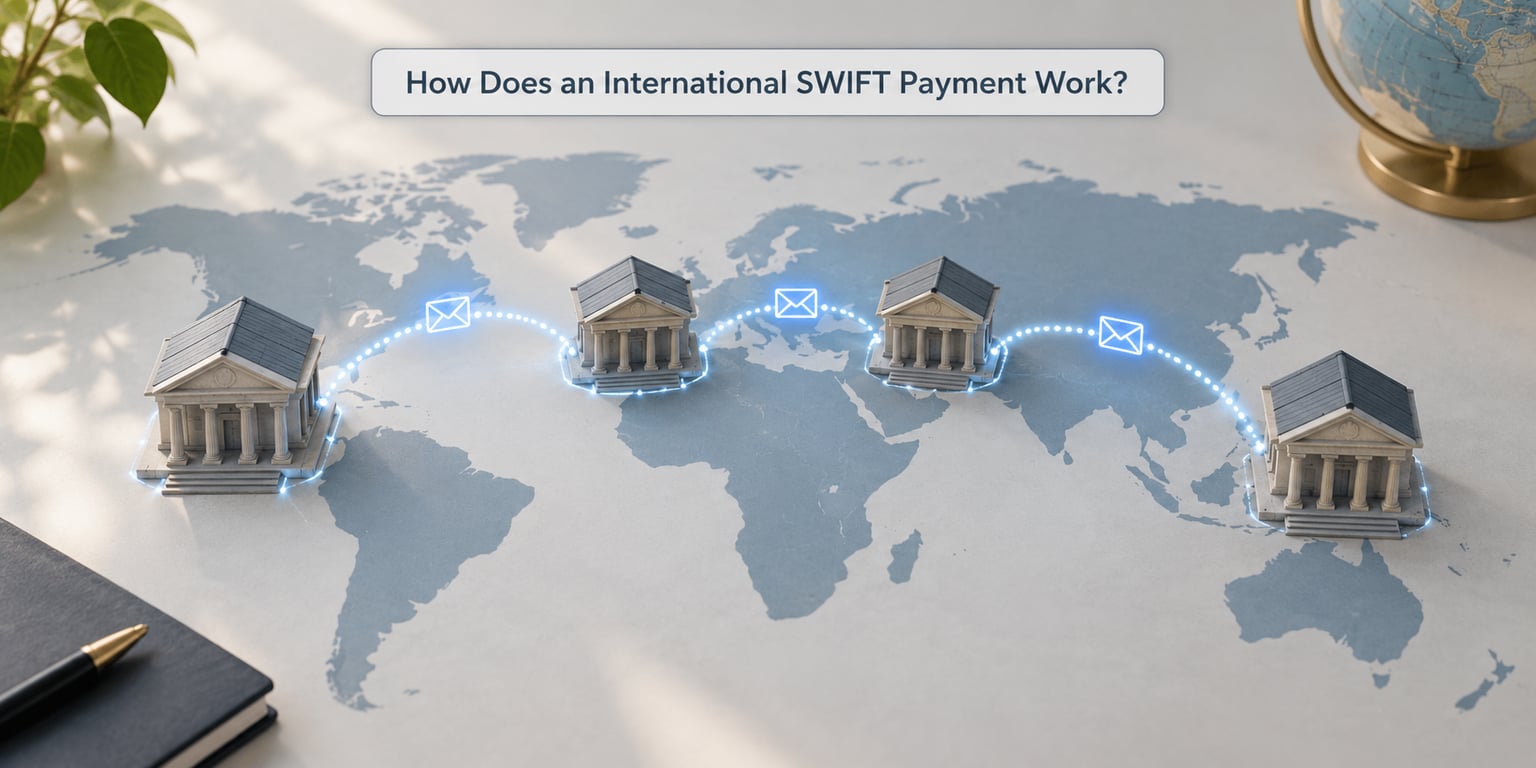
Consider a small US hardware importer paying a supplier outside Florence. The importer asks its bank to send 120,000 euros to a beneficiary account at an Italian institution. Here is the journey.
- Instruction from the customer. The importer supplies the beneficiary name, the Italian IBAN, the receiving bank BIC, the amount, the currency, the value date, and the payment purpose.
- Screening at the sending bank. The sending bank runs sanctions, AML, and internal limit checks. A mismatch between the beneficiary name and the account name is a common reason a payment is held here.
- Message creation. The bank composes a structured instruction, most often an MT103 in the legacy format or an equivalent ISO 20022 message, and sends it onto the SWIFT FIN network addressed to the receiving bank BIC.
- Network routing. The message reaches the receiving bank quickly. At this point only the instructions have arrived, not the money.
- Checks at the receiving bank. The beneficiary bank verifies the format, screens the parties again, and confirms the account exists and matches the name. A missing field here sends the payment back rather than crediting it.
- Settlement. The sending bank and receiving bank settle through their correspondent relationship, so the balance moves without any message being sent.
- Crediting. The receiving bank posts the funds to the beneficiary account, converting currency only if the account is held in a different currency from the payment.
Steps three and four are fast. Steps one, two, five, and six are where the calendar gets consumed, and they happen at banks, not at SWIFT.
What is the SWIFT payment system used for?
Almost any cross-border transaction that passes between two banks. The common categories:
- Supplier and trade payments for goods, shipping, and professional services.
- Remittances, where money moves from one household to another across a border.
- Cross-border payroll for employers paying staff or contractors abroad.
- Investment flows, including capital contributions, dividends, and returns on direct investment.
- Trade finance, such as letters of credit and documentary collections.
- Securities and treasury activity, including custody instructions and foreign exchange confirmations.
- Tuition, property, and legal settlement payments that a domestic transfer cannot reach.
- Central bank connectivity, where institutions use the network to coordinate on projects including digital currency arrangements.
A useful test: if the sender and the recipient hold accounts at different banks in different countries, a SWIFT message is almost certainly involved somewhere in the chain.
SWIFT Messaging Versus Money Settlement
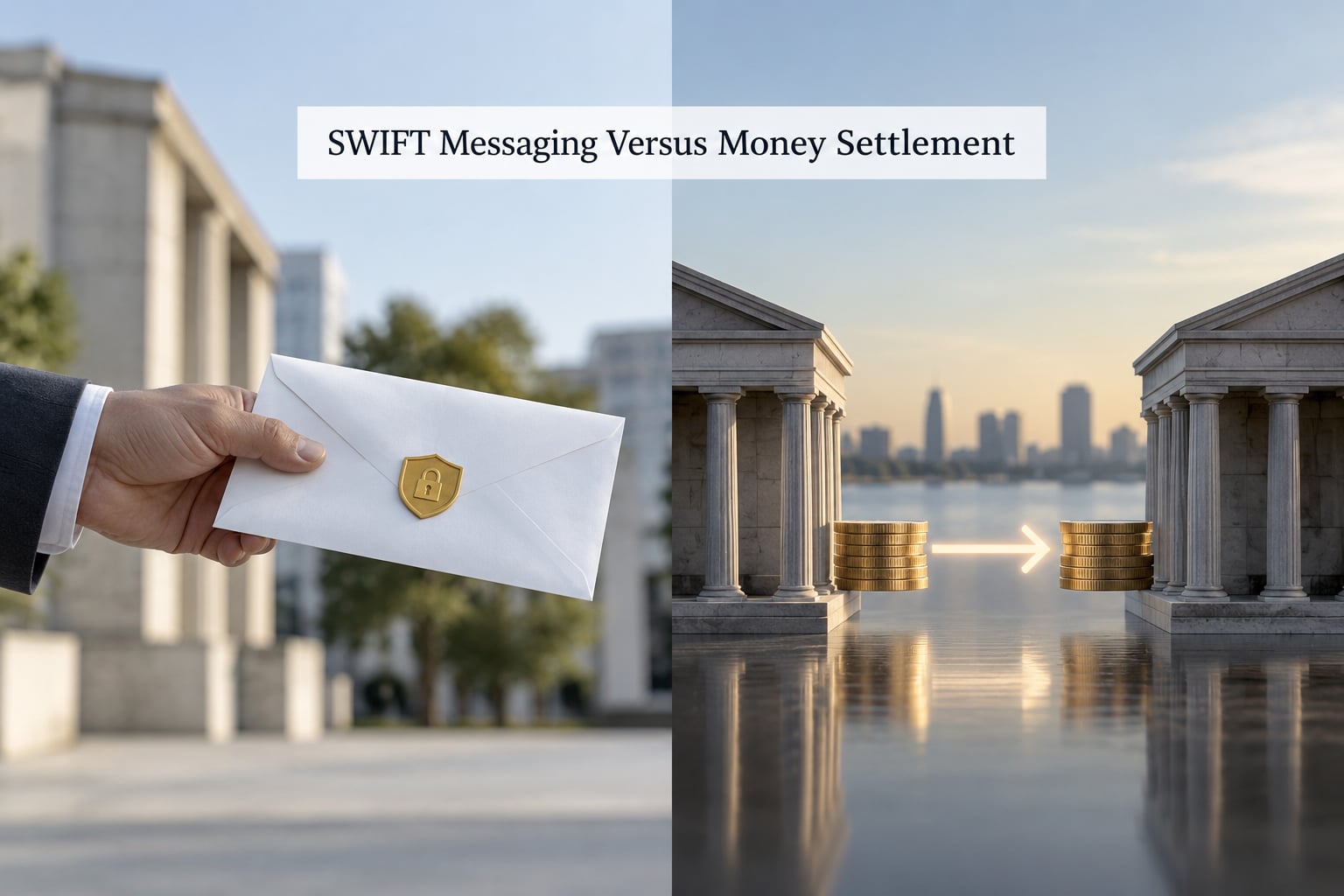
SWIFT delivers instructions. Settlement is what makes those instructions true in the ledger. Most international payments use separate mechanisms for each, which is why a message can arrive before the money or, occasionally, be reversed before settlement completes.
Settlement happens through accounts one bank holds at another, through correspondent relationships, or through a domestic clearing system in the destination country. A US dollar payment to an institution in another country often lands in that institution’s account at a US correspondent bank first, then gets credited onward.
Those accounts are often called nostro and vostro accounts. A nostro account is one a bank holds at a partner bank abroad, and it appears on the holder’s own books. A vostro account is the mirror image: the same balance from the partner bank’s perspective. Together they let two banks offset obligations without shipping cash.
SWIFT does offer a settlement finality service, TIPS, which lets a group of financial institutions settle payment obligations bilaterally on netted positions at a designated central bank. It is genuinely useful and it is not the same thing as messaging, and it does not handle every international payment. Most transfers still settle through the accounts described above.
The practical takeaway: a SWIFT confirmation tells you the message arrived. It does not, by itself, tell you the money has landed.
What Information Appears in a SWIFT Payment Message?
Payment messages follow a fixed layout so that any participating bank can read them. The most common format is the MT103 customer credit transfer, with structured ISO 20022 equivalents increasingly in use.
| Field | What it tells the receiving bank |
|---|---|
| Sending institution BIC | Who is sending the message and who to query or charge |
| Receiving institution BIC | The exact bank the instruction is addressed to |
| Beneficiary name | Who should be credited |
| Beneficiary account identifier | Which account gets the funds, as an IBAN or local account number |
| Amount and currency | How much, in which currency |
| Value date | Which business day the credit is dated |
| Charges code | Who pays the fees, expressed as a code such as shared or borne by sender |
| Ordering customer and reference | Who initiated the payment and why, for reconciliation and compliance |
| Purpose of payment | The declared category, which many corridors now require |
| UETR | A unique end-to-end reference that follows the payment across every hop |
Those identifiers are related but not interchangeable. The BIC identifies a bank, defined under ISO 9362 and traditionally shown as eight characters with an optional three-character branch suffix. The IBAN identifies an account, running up to 34 characters with a country prefix and check digits. A US ABA routing number identifies a US bank branch for domestic clearing and is nine digits. None of them can substitute for another, and a mistyped character in any one of them is a leading cause of returned payments.
How Long Does a SWIFT Transfer Take?
A transfer can often be submitted within minutes, and the message itself typically crosses the network in seconds. Delivery of the money to the beneficiary account is a different question, and one to five business days is the range most banks quote.
Factors that consume the clock:
- Bank review at the sending end, including limits, sanctions screening, and a human check if the payment is unusual.
- Compliance checks at the receiving end, which are stricter on some corridors and for some currencies than others.
- Weekends and public holidays at either end, since value dates are set on business days.
- Currency conversion, which some banks hold until a cut-off time rather than executing at a fixed rate.
- Intermediary processing, when the payment passes through a correspondent bank that applies its own cut-offs.
- Corrections, when a missing or inconsistent field sends the message back for a replacement.
No bank can promise a fixed universal delivery time, and anyone who claims a guaranteed overnight figure for every currency pair is overselling it. Faster options exist on certain corridors through the instant payment services SWIFT supports, where a payment can ride a domestic real-time rail in the destination country. Availability depends on both banks and the corridor.
If a payment has been pending longer than the quoted range, ask the sending bank for the UETR. It is the reference that lets every bank in the chain describe the same transaction.
What Does a SWIFT Transfer Cost?
There is no single price, and the fee a customer pays has almost nothing to do with SWIFT itself. Membership in the cooperative is a cost for banks, not a charge on your transfer. What you pay comes from four places.
- Sending bank fee. A flat outbound wire charge set by your own bank. Illustratively, this has ranged from around 15 to 60 dollars at large US institutions, with some banks waiving it for premium accounts or app-based transfers.
- Intermediary bank charges. Fees deducted by each correspondent bank the payment passes through, often a fixed amount per hop. In a route through one or two correspondents, this layer has commonly run in the same tens-of-dollars range.
- Receiving bank fee. A small credit or inbound handling charge taken by the beneficiary bank, which reduces the amount that lands in the account.
- Exchange-rate spread. Frequently the largest cost. If a bank converts currency for you, the rate it applies includes a margin that is not shown as a separate line item.
Treat those figures as illustrations rather than market prices. Charges vary by bank, currency pair, payment type, corridor, and the intermediary routing chosen, and they change. Ask who bears the charges before you send, because shared charges are the setting in which fees quietly disappear from the final amount.
Readers tracking cross-border costs for their own investments often find that the rate spread, not the wire fee, is what actually moves the return on an international position.
How Secure and Traceable Is SWIFT?
The network itself is built like infrastructure rather than a consumer app. Access is restricted to vetted member institutions, endpoints are authenticated, traffic between members is encrypted, and messages must conform to validated formats. Member banks are tested against the standards before they go live, and SWIFT operates a security team that monitors the network around the clock.
Those controls protect the message in transit. They do not protect you from being deceived before the message is ever created. Payment fraud in this system usually starts at the endpoint, not on the network: a compromised mailbox, a spoofed request, an insider, or an account takeover at a genuine member bank.
So is SWIFT safe to send money over? In the sense that the channel is controlled and authenticated, yes. In the sense that a fraudulent instruction cannot reach it, no. The verification burden sits with the two banks, and speed of recall depends entirely on where the payment sits in the chain.
What you can ask for when a payment is pending
- The UETR, which identifies your payment across every institution it touches.
- The status history, showing which banks have received and processed it.
- Whether a recall request has been issued, and whether the funds have already been credited.
- The charges that were deducted and where they were taken.
Recall is genuinely limited. Once a beneficiary bank credits the account, the money belongs to the beneficiary and the sender’s bank can only request a return through the beneficiary bank, which is under no obligation to agree. Earlier in the chain, a recall has a much better chance.
What SWIFT does not control: the contents of the instruction, the sender’s authority to make it, the underlying funds, or any decision to reverse a completed payment.
SWIFT Compared With Other Payment Systems
These systems are not rivals in a single category, because some carry instructions and others carry settled money. The table separates them by function.
| System | What it moves | How it is accessed | Typical use | Settlement model |
|---|---|---|---|---|
| SWIFT messaging | Payment and securities instructions | Directly by member financial institutions | International cross-border transfers, trade, remittances | Separate, through correspondent accounts or clearing systems |
| Fedwire | Actual funds | Directly by regulated US institutions | High-value domestic US transfers | Real-time gross settlement at the Federal Reserve |
| TARGET2 and T2 | Actual funds | Directly by eurozone institutions | Large euro-area payments | Real-time gross settlement at a central bank |
| SEPA | Actual funds | Through banks in participating European countries | Recurring payments and payroll inside Europe | Domestic clearing, with a pan-European scheme above a set threshold |
| Card networks | Payment instructions between merchants and acquirers | Through acquiring banks and merchants | Point-of-sale and card payments | Clearing and settlement between issuers and acquirers |
| Public cryptocurrency networks | Instructions for on-chain asset transfers | Directly by anyone running software | Transfers of on-chain assets between wallet addresses | On-chain consensus, independent of banks |
The pattern is worth noticing. Domestic systems like Fedwire and SEPA move money and settle centrally. SWIFT moves instructions, and the money follows through arrangements that vary by pair of banks. That single difference explains nearly all of the speed and cost differences people notice.
Common Misconceptions About SWIFT Payments
SWIFT is a bank. It is not. It takes no deposits, holds no customer funds, and cannot be sued for the payment of a transfer. Its product is a secure channel and a message standard.
SWIFT guarantees the money arrives. It does not. The message can arrive, be accepted, and still fail at the receiving bank because of a name mismatch or a compliance hold. Guarantees, where they exist, come from payment schemes and contracts, not from this network.
SWIFT holds all transferred money. The opposite is true. No money sits inside SWIFT at any point, which is precisely why a correspondent bank chain exists.
SWIFT moves cryptocurrency. It carries banking instructions in banking formats. The network is adjacent to digital assets rather than transferring them, and some institutions use its connectivity to coordinate central bank projects, but a wallet address is not a beneficiary account.
Every international payment is slow and expensive. Many are, but the variables are the corridor, the banks, the currency, and the fee arrangement. Faster cross-border services now operate on top of SWIFT tracking, routing some payments through domestic instant rails such as Australia’s NPP or the UK’s faster payment system, where both ends support it.
One country owns SWIFT. No. It is a Belgian-headquartered cooperative owned by its member institutions, and no single government controls the network. That is also why the sanctions question has a nuanced answer: access has been withdrawn from specific institutions in the past without the network being switched off, and in some cases later restored.
Frequently Asked Questions
Is SWIFT the same as international banking?
No. SWIFT is a messaging network that carries payment instructions between banks; the banks themselves hold the accounts and move the funds. International banking is the wider activity of holding accounts and transferring money across borders, of which SWIFT messaging is only the communication layer. You still need a bank on both sides, and SWIFT alone cannot receive, hold, or pay out your money.
Can money be sent through SWIFT outside normal banking hours?
Messages can travel at any hour, because the network operates continuously. What does not run overnight is the human and accounting work around them. Sending bank cut-off times, compliance reviews, and value dating follow each institution’s business hours, so a payment submitted late in the evening is usually picked up the next business day. Weekend and holiday timing varies by corridor rather than by network.
Does SWIFT convert currencies automatically?
No. SWIFT carries the currency code you specify and never converts anything itself. If the payment arrives in a currency the beneficiary account does not hold, the receiving bank may convert it, or it may credit a separate currency balance instead. Many sending banks offer a conversion service at their own rate, and that rate normally embeds a margin that is the largest single cost in many transfers.
Can a SWIFT payment be canceled after it is sent?
Sometimes, and it depends entirely on where the money is. If the funds have not left the sending bank, a recall is straightforward. If the payment is with a correspondent bank, a recall request must travel down the chain. Once the beneficiary bank credits the account, the sender can only request a return, and the beneficiary bank is under no obligation to approve it. Ask for the UETR before anyone promises a cancellation.
Is SWIFT used for cryptocurrency transfers?
No. The SWIFT payment system carries bank payment instructions between financial institutions, not blockchain transactions. Crypto transfers happen on separate networks that record on-chain asset movements. The two touch indirectly, because a bank on the SWIFT network may itself offer services tied to digital assets, and some institutions use SWIFT connectivity in central bank digital currency projects. It does not move coins or tokens.
Conclusion: Check the Routing Details Before Sending
SWIFT is the messaging infrastructure behind a large share of international bank transfers. It is not the institution holding your money and it is not the guarantor of your payment, and holding either idea in your head will keep producing surprises about timing, fees, and reversals.
Before you authorize a transfer, confirm the beneficiary name, the account identifier, the BIC or SWIFT code, the currency, who bears the charges, the intended value date, the stated purpose, and any limits your bank applies. Confirm them with a second channel if the request came by email, because the most expensive errors in this system happen before any message is ever sent.