How water use affects mining projects is mostly a question of who gets the water and who pays for it. A mine that draws from a river or aquifer in a water-stressed region can see its capital cost, construction schedule and permitting timeline reshaped by water rules, and a mine that wins a water allocation still carries decades of treatment and monitoring obligations after it closes.
That is why water now shows up in mining risk factors and feasibility studies rather than only in environmental reports. For an investor, it is a variable that sits upstream of production volume, unit cost and permitting odds.
Here is the short version before the detail:
- Water availability is a hard constraint. A mine cannot produce concentrate without a reliable source, and in arid jurisdictions that source is allocated, not unlimited.
- Mitigation has a price tag. Desalination, longer pipelines and higher reuse rates all add capital cost and construction time before a single tonne is sold.
- Permitting is where water bites hardest. Water rights, discharge consents and community allocation disputes are a common reason projects slip years or stop entirely.
- Water risk is asymmetric. A brownfield expansion inside an existing water balance is far easier to fund than a greenfield mine competing for the same allocation.
- The liability outlives the asset. Acid mine drainage and closure water treatment can remain a company’s problem for decades after the last shipment.
Table of Contents
- How Mining Projects Obtain and Consume Water
- Why Water Availability Can Stop or Delay a Mining Project
- How Water Use Affects Mining Costs
- What water mitigation actually costs
- Water Permits, Rights, and Environmental Review
- How Water Use Creates Environmental and Community Risk
- What Investors Should Check Before Buying a Mining Stock
- Water Use Across Major Mining Stages
- How Investors Can Assess How Water Use Affects Mining Projects
- Why Water Risks Can Change an Investment Thesis
- Frequently Asked Questions
- What does it mean when a mining company reports water withdrawal and water consumption?
- Can a mine recycle enough water to become independent of freshwater sources?
- What happens if a mining project does not receive enough water?
- How does water use affect environmental permits for a mine?
- Which mining stages generally require the most water?
- Where can investors find reliable information about a mining project’s water risk?
- Conclusion: Start With the Mine’s Water Balance
How Mining Projects Obtain and Consume Water
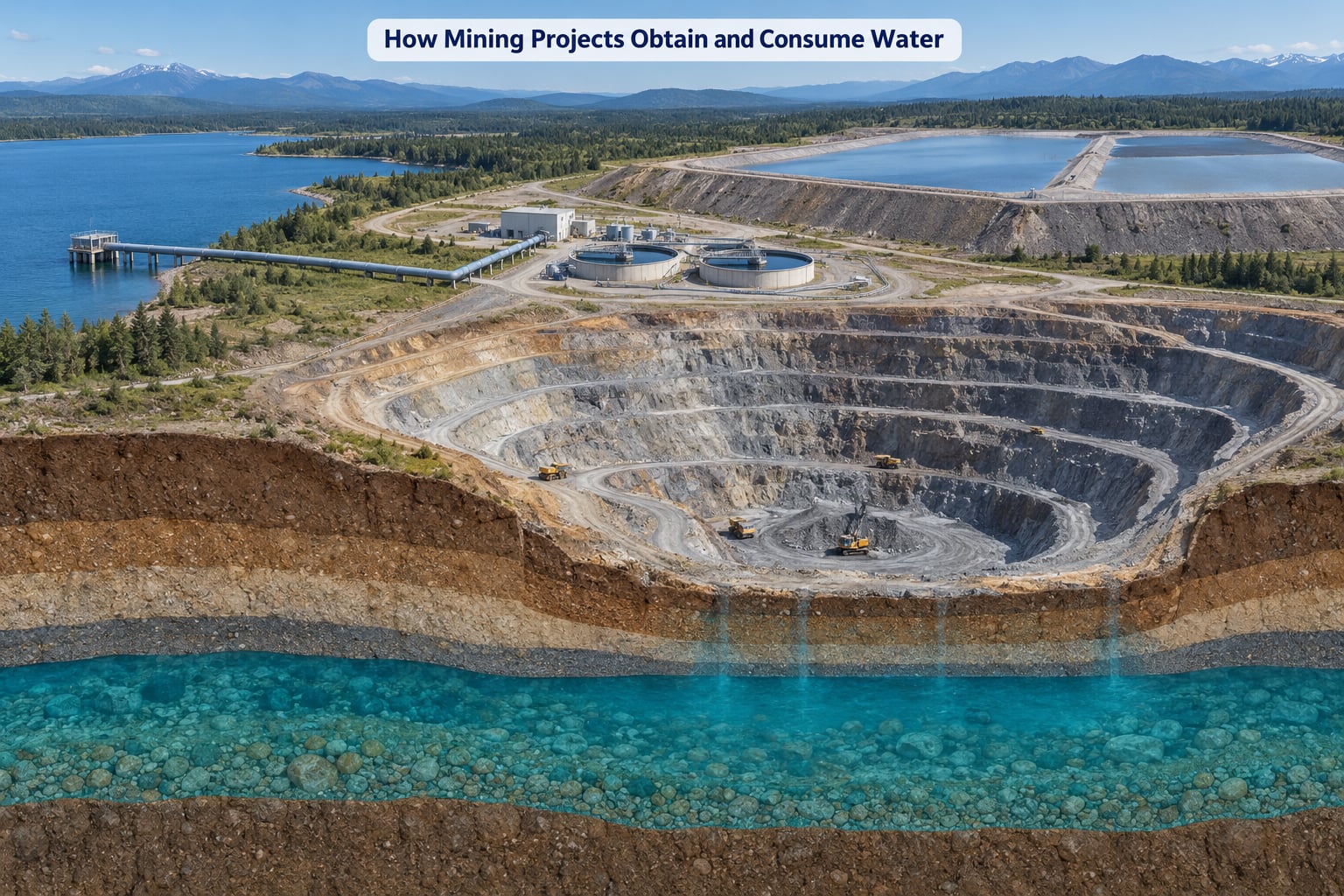
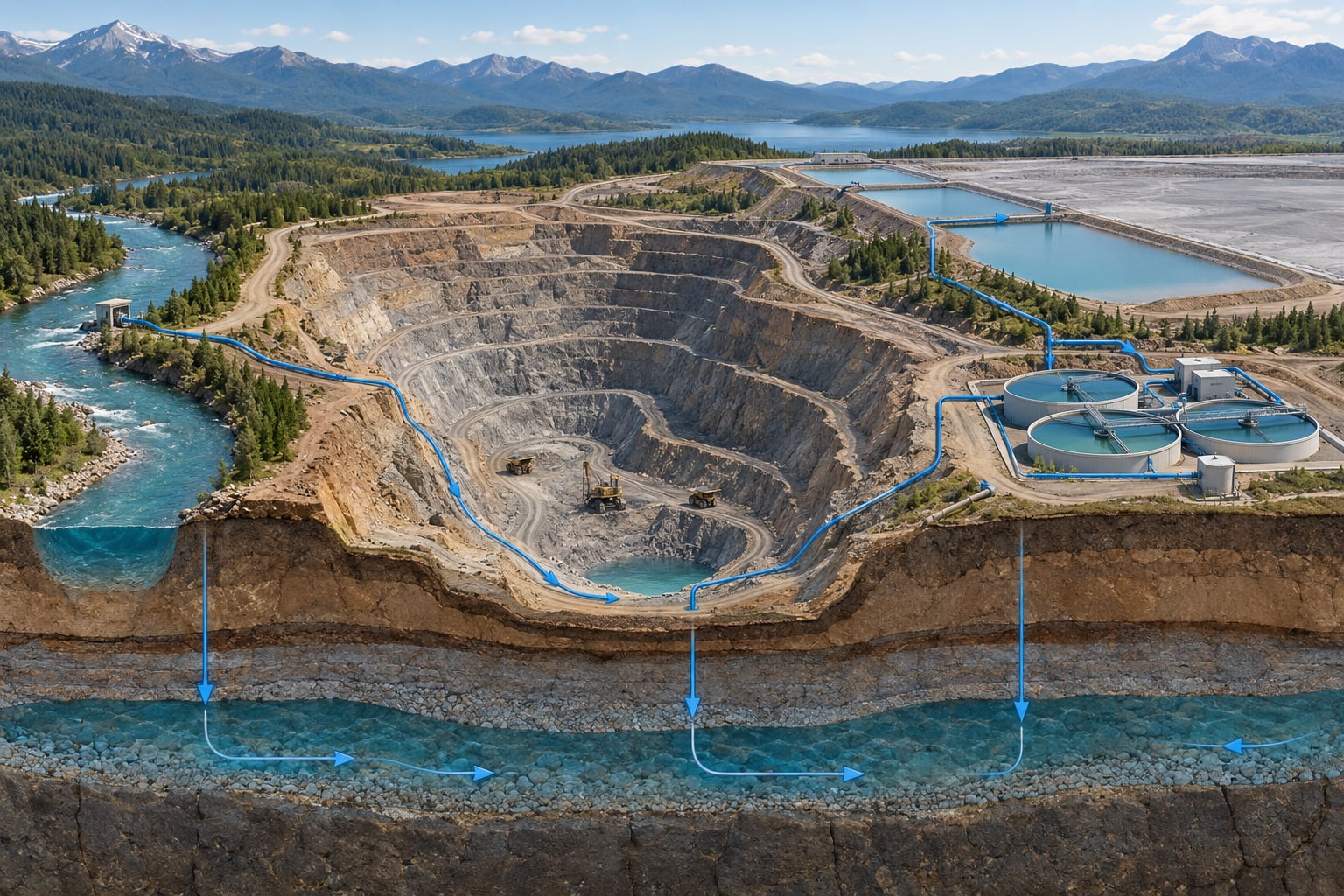
A mine’s water comes from three places, and the mix determines how much trouble the project is in. Fresh surface water from rivers, lakes and reservoirs is the cheapest and usually the most contested. Groundwater from wells and aquifers is more reliable in dry seasons but can take years to permit. Water the mine already owns, meaning recirculated process water and water recovered from tailings and pits, is the cheapest per unit and the most valuable to a company trying to cut freshwater intensity.
Freshwater intensity, the standard comparison metric, is freshwater consumed per tonne of production. It matters because two mines producing the same metal in different climates can have completely different water profiles.
Mines use water for a specific set of jobs. Dust suppression on haul roads and stockpiles is large and unglamorous. Grinding mills need water to grind ore at the right consistency. Flotation cells wash and separate valuable minerals from waste rock. Leaching pads dribble solution through low-grade ore to dissolve copper or gold. Tailings storage facilities hold the waste slurry, and the water in that slurry either stays on site for years or is released back to the catchment.
Pit dewatering is the one most readers miss. As a pit deepens, groundwater keeps flowing into it and has to be pumped out continuously for the life of the mine. That water can be reused, treated and discharged, but the pumping is not optional.
One distinction does a lot of work in every water balance: withdrawal is not consumption. Withdrawal counts water taken out of a basin, including water that is pumped and returned within a year. Consumption is water that leaves the basin permanently, carried off in product, evaporation or residue. Communities get angry about withdrawal; hydrologists worry about consumption; the number that hits project economics is usually the second one.
Why Water Availability Can Stop or Delay a Mining Project
Mining projects fail on water for five reasons, and only one of them is technical.
- Drought. A multi-year dry cycle turns a water balance that was fine on paper into a shortage at exactly the moment ramp-up needs the most water. The Atacama in northern Chile and inland Australia are where this shows up most often.
- Falling water tables. Sustained pumping from an aquifer lowers the water table, which forces neighbouring users — farmers, towns, other mines — to deepen their own wells or cut volumes.
- Competing claims. Municipal supply, agriculture and environmental flows often have legal priority over a mine’s licence, and those priorities are revised in dry years.
- Infrastructure that does not exist yet. Many projects assume a pipeline, a dam or a desalination plant that no one has built. Water supply is a construction item with a construction risk profile.
- Water rights that do not hold up. Rights that are conditional, senior to other users, or tied to a watercourse the project does not own are a thin foundation for a 20-year production plan.
Brownfield expansions are more forgiving here. An operating mine already holds permits, has a treatment plant and has a measured reuse rate, so an incremental expansion is negotiated inside an existing water balance. A greenfield project has to build that balance and win permission for it at the same time.
The latest evidence on this is sobering. MinEx Consulting data cited in 2026 found that nearly a quarter of roughly 90 analysed copper projects had stalled for environmental or social reasons, more than the share delayed by weak economics. Water is the most frequent trigger behind that stall rate.
How Water Use Affects Mining Costs
Water costs money in six separate places, and they behave differently in a project model.
- Abstraction and treatment. Licensing, pumping power and treatment chemicals all scale with volume.
- Infrastructure. Pipelines, storage ponds, desalination plants and reverse osmosis units are capital items that land in the pre-production estimate and never go away.
- Energy. Pumping water uphill and desalinating seawater are energy-hungry processes, so water and power prices move together.
- Monitoring and compliance sampling. Routine flow metering and water quality testing is a permanent operating cost, not a one-off.
- Permitting and studies. Environmental impact assessment, hydrological modelling and community consultation sit in the pre-development budget.
- Closure. Post-closure water treatment is a liability that outlives the cash flow that funded it.
That last item deserves more attention than it usually gets. Once sulfide minerals are exposed to air and water, they generate acid mine drainage, or AMD: low-pH water carrying dissolved metals. It can continue for decades after closure, which is why regulators require financial assurance, surety bonding or closure trusts sized to a water treatment plant rather than a fence and a cap.
For the equity, the transmission is simple. Higher capital cost lowers project value at a fixed commodity price, because more capital has to be recovered per tonne. Delay pushes revenue further out, which hurts more in a high discount-rate environment. And any reserve that depends on a water allocation the company may not hold is worth less than a reserve that does.
What water mitigation actually costs
The three big levers are usually tried in this order, because capital intensity climbs steeply as you move down the table.
| Strategy | Capital intensity | Lead time to deploy | Where it fits |
|---|---|---|---|
| Increase recirculation and reuse | Low to moderate | Short | Operating mines; the fastest payback lever |
| Increase process water recycling, tailings densification, dry-stack or paste systems | Moderate | Medium | Tailings-intensive operations under GISTM commitments |
| Build a desalination plant | High | Medium to long | Coastal mines with no freshwater alternative |
| Pipeline from a distant water source | High | Long | Desert mines; adds its own permitting and opposition risk |
Water Permits, Rights, and Environmental Review
Water permits decide whether a mining project reaches production on schedule, and there are several of them with different clocks.
The first is the allocation right. It says how much water the company may take and from where, and in many jurisdictions it is senior, junior or conditional depending on drought stage. It is also the instrument that communities contest, because a mine’s allocation is visible while a farm’s informal use is not.
The second is the discharge consent. It sets limits on what may be returned to a watercourse and how it is monitored, and it can require treatment standards tighter than background water quality. Revisions to those limits can force new capital spending at an operating mine.
The third is the environmental assessment. Water studies sit inside it, and a weak hydrological model is an easy target for objectors who are looking for a reason. Expect the assessment timeline to set the pace of the whole approval process rather than running alongside it.
The fourth is the regulatory direction of travel. Water allocation reform in northern Chile is the reference example for anyone tracking this: reform that pushes toward priority use for communities and ecosystems and tighter rules for new industrial rights changes the economics of every project that assumed a permissive allocation.
How Water Use Creates Environmental and Community Risk
Water is where a mine’s social licence is usually won or lost, and the objection is rarely abstract. Communities near the Boundary Waters have organised publicly around a proposed mine’s discharge risk, and groundwater competition between new large users has become a mainstream local grievance in a way that did not exist a decade ago.
The recurring themes are consistent. People want to know how much water the mine takes, who got it first, and whether the figures are independently verified rather than self-reported. They want to be involved before positions harden rather than after the environmental assessment is finished. And they question whether post-closure treatment obligations are actually funded.
That last point has a factual basis. A science-community discussion thread reports selenium concentrations remaining above aquatic-life guidelines decades after a mine was closed and reclaimed, which is exactly the long tail that regulators and communities underestimate.
Desalination, meanwhile, is not a free answer. It solves freshwater scarcity and creates its own brine and coastal footprint, and that tension shows up in every community conversation about a coastal mine.
For investors, social conflict is a production risk rather than a reputational one. Operational suspensions, court orders and revised agreements all reduce tonnes and add cost.
What Investors Should Check Before Buying a Mining Stock
Water exposure is unusually readable from public documents, and most readers never read it. These are the items worth pulling out of an annual report, sustainability report and MD&A risk factors.
- The water balance itself. Withdrawal, consumption and discharge volumes by source, site by site. Group averages hide the site that matters.
- Freshwater intensity and its trend. A stated reduction target is a management commitment; a disclosed baseline and a year-on-year change is evidence. Capstone Copper, for example, set a target to reduce freshwater consumption intensity by 2030 alongside increasing the share of desalinated and recycled water in total consumption.
- Source reliability. What share of supply comes from a single watercourse or a single aquifer, and what happens in a one-in-ten-year dry sequence.
- Permit status and expiry. Which allocations and discharge consents are held, which are pending, and which are conditional on drought stage.
- Treatment obligations and tailings commitments. The capital cost of meeting current standards, and whether the operator has committed to the Global Industry Standard for Tailings Management.
- Closure liability and financial assurance. Whether closure water treatment is funded by a trust or surety bond, and how it is sized. Tailings risk is not small: roughly 20 tailings dams have failed per decade according to a Canadian Mining Journal republication of the data.
- Community agreements. Water-sharing agreements signed before permitting milestones, and any grievance or litigation record.
- Disclosure quality. Site-level data with third-party assurance beats group percentages every time.
Water Use Across Major Mining Stages
Water demand is not flat across a project’s life, and the peak is rarely when the study assumes.
| Stage | Dominant water demand | What to watch |
|---|---|---|
| Exploration | Small, but water access can gate drilling campaigns | Drinking water and camp supply in remote dry areas |
| Construction | High: dust suppression, concrete, camp services, dewatering | Temporary water permits and community supply pressure |
| Commissioning | Peak combined demand, before the mine returns anything to the basin | Ramp-up curves assume water that has not yet been proven |
| Steady-state production | Process water, tailings, dust, dewatering, evaporation losses | Freshwater intensity against guidance; treatment cost |
| Expansion | Incremental volume from an existing balance | Whether the incremental allocation was secured |
| Closure | Treatment and monitoring rather than production | Duration and funding of AMD management |
The pattern that matters for investors is that water pressure peaks at commissioning and construction, when a project has spent the money and earned nothing yet. A shortfall there delays first revenue and turns a fixed-cost problem into a carrying-cost problem.
How Investors Can Assess How Water Use Affects Mining Projects
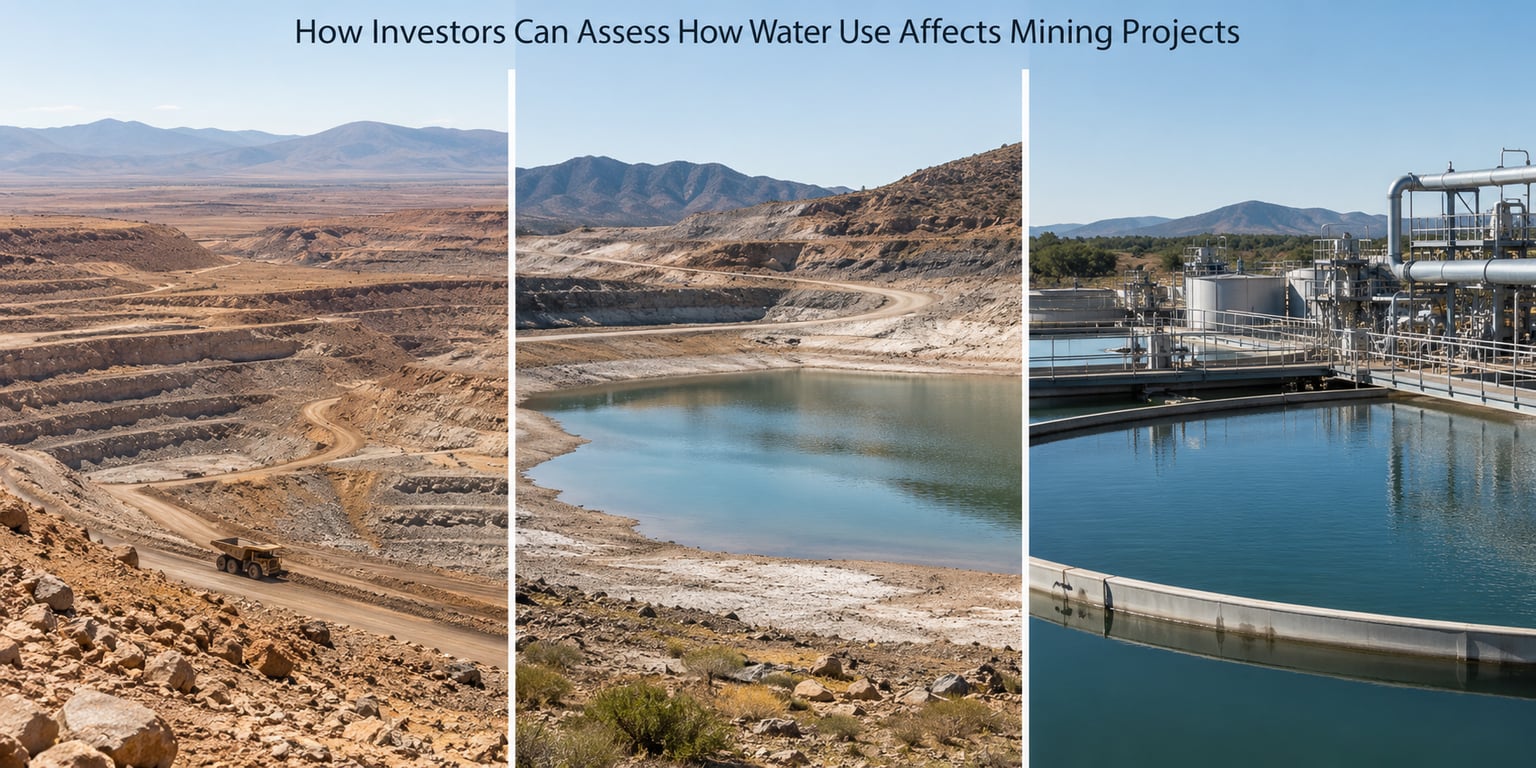
A three-level framework is enough to sort a pipeline quickly. Start with water availability: is the source an arid inland basin, a water-stressed region, or a place with reliable recycled supply? Then look at treatment intensity, since a site discharging to a sensitive watercourse or managing a large active tailings facility carries more regulatory exposure. Finish with permit status, drought exposure and infrastructure dependence.
Low exposure looks like this: diversified supply, a high recycled water proportion, all permits held and unexpired, and no single watercourse the mine cannot operate without. Coastal operations that have already proved a desalination route, such as Escondida in Chile, sit closer to this end.
Moderate exposure is a working mine with a rising freshwater intensity target, one dominant source, and an expansion that depends on water the company has applied for but does not yet hold.
High exposure is a greenfield project in an arid basin, dependent on a pipeline or desalination plant that does not exist, with a community allocation dispute unresolved and no funded closure water treatment.
The named operations make the logic concrete. Escondida built desalination capacity; Centinela has run on untreated seawater; Las Bambas operates above 95% water reuse. Each of those is a capital decision made to keep a mine running in a dry region, and each one shows up somewhere in that company’s cost base and project risk.
Why Water Risks Can Change an Investment Thesis
Water risk reaches the share price through five doors, and they compound.
Capital spending rises, which lowers returns on the project that justified the valuation. Schedule slips, which pushes first production into a different commodity price environment than the one in the feasibility study. Reserves get restricted, because a resource that cannot be watered is not a reserve in any useful sense. Closure liabilities are recognised late and large, which cuts free cash flow in the years the model assumed it would flow to shareholders. And local support erodes, which turns a permitting problem into a production problem.
The pattern I would watch in 2026 is capital shifting toward brownfield. Where existing water infrastructure already exists, incremental tonnes are cheaper and faster to approve than new ones. That favours established operators over development-stage juniors, and it is one more reason development pipelines carry more water risk than the headlines suggest.
Frequently Asked Questions
What does it mean when a mining company reports water withdrawal and water consumption?
Withdrawal is water taken out of a river, lake or aquifer, including water pumped out of a pit and later returned to the same basin within about a year. Consumption is water that leaves the basin permanently through evaporation, product carried off site or residue. Permits and community opposition usually target withdrawal, while the number that matters for a project water balance is consumption. Companies also report a reused or recycled water proportion, which is the share of supply that never left the basin at all.
Can a mine recycle enough water to become independent of freshwater sources?
Sometimes, and it is increasingly common. Escondida in Chile invested in desalination capacity, Centinela has run on untreated seawater, and Las Bambas operates above 95% water reuse. Most operations still take some freshwater for dust suppression, camp services and emergency supply, so the realistic goal is a low and falling freshwater intensity rather than zero. The trade-off is capital cost and energy use, since desalination and pumping are energy-hungry.
What happens if a mining project does not receive enough water?
Ramp-up slows or stops, and a construction project that has already spent its capital keeps carrying fixed costs without revenue. In the worst case the project never starts: MinEx Consulting data cited in the current year found nearly a quarter of roughly 90 analysed copper projects stalled for environmental or social reasons, with water among the most frequent triggers. An operating mine can also be forced to cut throughput, which shows up directly in production guidance.
How does water use affect environmental permits for a mine?
It sets the timetable. A project needs an allocation right to take water, a discharge consent to return treated water, and an environmental assessment containing hydrological studies. Each is a separate approval with its own conditions, and discharge limits can be tightened after approval, forcing additional capital spending. Water allocation reform also matters: where communities and ecosystems gain priority, new industrial rights become harder to obtain.
Which mining stages generally require the most water?
Construction and commissioning. Both need large volumes for dust suppression, concrete, camp services and pit dewatering, and neither generates revenue while they run. Steady-state production still consumes heavily through process water, tailings management and evaporation, but at a predictable rate. Exploration is small. Closure is different in kind rather than degree, because it needs water for treatment and monitoring rather than for production, often for decades.
Where can investors find reliable information about a mining project’s water risk?
Start with the annual report and sustainability report: site-level withdrawal, consumption and discharge volumes, freshwater intensity against a stated target, permit status, and closure financial assurance. Then read the MD and A risk factors, which typically name availability and quality of water explicitly. Technical reports and feasibility studies carry the water balance and capital estimates, and tailings commitments to the Global Industry Standard for Tailings Management are a useful quality signal.
Conclusion: Start With the Mine’s Water Balance
Start with the water balance. Before you judge a mining project’s schedule or cost, find its withdrawal and consumption volumes by source, its allocation rights and discharge consents, its treatment and reuse strategy, its drought contingency, and how its closure water treatment is funded.
That is where how water use affects mining projects stops being an environmental question and becomes an investment one.