A petrodollar is not a separate currency. It is an ordinary U.S. dollar that an oil-exporting nation receives when it sells crude, and the petrodollar system is the arrangement by which the world’s oil trade is priced and settled in dollars. Understanding how petrodollars work matters because that single habit of settlement shapes exchange rates, trade balances, inflation and asset prices well beyond the energy sector.
Most of the confusion around the topic comes from one word: “petro.” There is no petrodollar index, no petrodollar reserve tier and no special vault somewhere holding barrel-backed greenbacks. It is the dollar, earned through oil sales, and recycled back into American assets. Once you see the loop rather than the label, the whole arrangement becomes fairly mechanical.
Table of Contents
- Key takeaways
- What Are Petrodollars and Why Do They Matter?
- How Petrodollars Work in the Global Oil Market
- The Difference Between Oil Dollars and Petrodollars
- Why Oil Prices Affect the U.S. Dollar
- The demand channel
- The trade balance channel
- Why the link is not a mechanical rule
- How Petrodollar Cycles Affect Inflation, Growth and Investments
- What Changes If Countries Diverge From the Petrodollar System
- How Investors Can Use the Petrodollar Framework
- Frequently Asked Questions
- Are all oil purchases made with petrodollars?
- What is the difference between a petrodollar and an oil-backed currency?
- Does the United States receive a special payment for every barrel of oil?
- Can countries really replace the U.S. dollar with the yuan for oil?
- How do petrodollar cycles affect ordinary investors?
- Does the petrodollar system control the price of oil?
- Bottom Line: What to Do With This Framework
Key takeaways
- A petrodollar is a standard U.S. dollar earned from petroleum sales, not a distinct currency.
- Oil-importing countries must first acquire dollars before they can buy barrels, which creates standing demand for the currency.
- Exporters, Saudi Arabia above all, park those surpluses in U.S. Treasuries, equities and property — the recycling loop.
- That recycling keeps a steady pool of dollars available to borrow, which is why the United States can run deficits without a currency crisis.
- The arrangement is unwritten and non-exclusive, so it has eroded at the edges rather than collapsed.
What follows is the explanation I wish someone had given me before I started following crude prices alongside currency moves. It starts with what the term means, walks the money around the loop, and then gets to the part a self-directed investor actually cares about: how oil moves currencies, inflation and portfolios.
What Are Petrodollars and Why Do They Matter?
The petrodollar system is a global financial arrangement in which crude oil is priced and traded in U.S. dollars, regardless of which country is buying or which is selling. A “petrodollar” is simply a standard U.S. dollar earned by an oil-exporting nation through petroleum sales.
Four things follow from that setup, and they are the reason the topic shows up in macro analysis rather than only in energy reporting.
First, dollar demand gets a structural floor. Every importer that needs crude must hold dollars before it can transact, so oil creates a recurring requirement for a currency rather than an optional one.
Second, the United States can run trade and budget deficits that would otherwise force a currency adjustment. Fresh dollars arrive from abroad, get recycled into Treasuries, and are lent back out.
Third, inflation transmits through the energy input that nearly every other price depends on. Oil is fuel, freight and feedstock, so a crude move shows up in goods prices with a lag measured in months.
Fourth, because settlement runs through dollar clearing infrastructure and correspondent banks, whoever controls that plumbing holds a lever over who can trade. That is the geopolitical edge people usually mean when they describe the dollar as a weapon.
How Petrodollars Work in the Global Oil Market
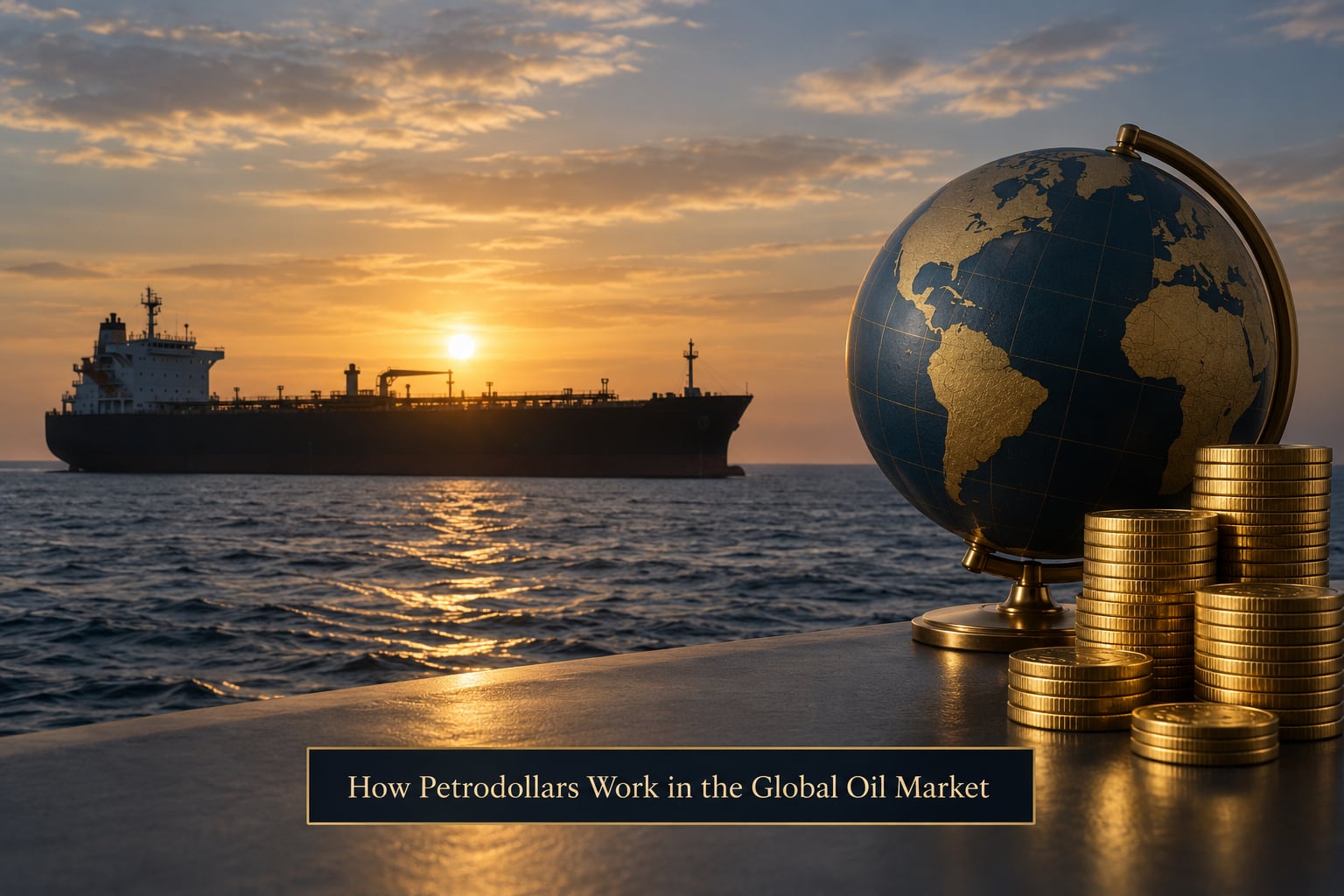
Here is the cycle in six steps. It is the same sequence whether the buyer is Japan, Germany or India, and it runs in reverse when prices fall.
- The importer needs dollars. A refinery or trading firm in an oil-importing country buys crude on terms denominated in dollars, so it must first earn, borrow or buy them in the foreign-exchange market.
- The payment clears through dollar banking. The buyer pays from a dollar account, typically through correspondent banks and a messaging network such as SWIFT, and the funds settle into the seller’s dollar holdings at a major financial centre.
- The exporting nation banks the surplus. The revenue lands as dollars in the exporter’s reserve account at a foreign or American bank. Because crude earnings exceed domestic spending needs in most cases, a large surplus accumulates.
- The central bank and finance ministry decide what to do with it. Saudi Arabia has repeatedly chosen to hold much of the surplus in U.S. Treasuries, and other Gulf exporters have done the same at times. Some goes into sovereign wealth funds.
- Sovereign wealth funds reinvest globally. Funds such as the Kuwait Investment Authority and the Abu Dhabi Investment Authority allocate across equities, property, credit and infrastructure, with a large share in dollar-denominated assets.
- The dollars come back to the U.S. as loans. Treasury issuance gives foreign buyers a liquid, low-credit-risk claim on the United States. Those funds return to American borrowers, which keeps financing costs comparatively low.
Petrodollar recycling is the name for steps four through six: exporting nations taking their dollar earnings and pouring them back into American and global assets.
The economics of step six are the part most people miss. Foreign demand for Treasuries is not charity; it is payment for a liquid, dollar-denominated store of value. The United States gets to borrow at rates shaped by that demand, and importers get a stable currency in which to price their energy bill. Both sides are better off than the alternative of bilateral barter or a gold-backed convertibility rule nobody can credibly restore at scale.
It is worth adding a note on the mechanics that get skipped in most explainers. Russia is not an OPEC member, so the yuan, rupee and gold settlement channels that grew after 2022 sit outside the original exporter arrangement entirely. Similarly, Saudi Arabia has accepted non-dollar settlement for some oil sales since 2018. The arrangement is unwritten, has no legal enforcement mechanism and was never signed as a treaty, which is exactly why it can be bent without anyone announcing a breach.
The Difference Between Oil Dollars and Petrodollars
“Oil dollars” and “petrodollars” get used interchangeably, but they describe two different layers. Oil dollars are the physical currency used to settle a specific cargo. The petrodollar system is the wider arrangement that guarantees those dollars are the ones demanded in the first place.
Three neighbouring concepts cause most of the rest of the confusion, and each gets its own label.
An oil-backed currency is a currency whose value is tied to the country’s oil production or exports. Iran, Nigeria and Kazakhstan have all experimented with such pegs, and the Gulf dinar is formally pegged to the dollar at a fixed rate. A peg is a monetary policy choice; it is not the same as participating in dollar-denominated oil settlement.
The exorbitant privilege, a term French President Valéry Giscard d’Estaing used in the 1960s, describes what the United States gets from being the currency that the world both saves and spends: cheaper borrowing, the ability to fund deficits indefinitely and sanctions capability, all at relatively low cost.
The petroyuan is the hypothetical or partial successor in which yuan-denominated contracts carry the volume instead. De-dollarisation is the broader, vaguer term for any reduction in dollar share in trade, reserves or settlement, and it is happening slowly in pieces rather than as a switch.
| Common belief | What is actually true |
|---|---|
| A petrodollar is a special currency. | It is a standard U.S. dollar that happens to originate from an oil sale. |
| There is a petrodollar price you can look up. | No such instrument exists. You would be looking at the dollar exchange rate. |
| The United States gets a cut of every barrel. | No. The United States receives ordinary commercial revenue from its own oil trade and taxes, nothing per-barrel. |
| The 1974 agreement is a signed treaty. | It was a series of arrangements and an unwritten understanding with no legal enforcement. |
| Because the U.S. prints dollars, foreigners pay for U.S. inflation. | Printing alone does not impose costs abroad. What transfers value is real purchasing power at the moment of spending or investment. |
| Countries leaving the dollar break the system overnight. | Most oil still settles in dollars. Alternatives exist at the margin and have not displaced core volume. |
Why Oil Prices Affect the U.S. Dollar
The link runs through two main channels, and it works in both directions depending on why the oil price moved.
The demand channel
When crude rises, the dollar bill needed to buy the same barrel rises with it. Importers buy more dollars, and exporters holding them bid less of their own currency for those dollars. That tends to support the dollar during a supply-driven oil spike, which is why a geopolitical supply shock often shows up as dollar strength.
The trade balance channel
For the United States, oil is a trade item. A sustained rise in the crude price widens the import bill and tends to weaken the trade balance, which pushes in the opposite direction from the demand channel. Net effect depends on how the move was caused, how much of the price gain reflects genuine scarcity versus risk premium, and how monetary policy responds.
Why the link is not a mechanical rule
Treating oil and the dollar as a fixed pair is a mistake. Three factors break the correlation most of the time.
The first is the rate channel. Central bank policy can swamp trade flows. A surprise rate hike reprices the whole dollar regardless of what crude is doing that week.
The second is safe-haven demand. During a crisis, dollars get bought as a refuge at exactly the moment oil falls on growth fears, producing a positive rather than inverse relationship.
The third is the reason for the move. A supply disruption lifts oil and the dollar together, because both respond to fear. A demand boom lifts oil while the dollar softens. Reading the cause matters more than the correlation.
How Petrodollar Cycles Affect Inflation, Growth and Investments
Oil cycles are stagflationary in one direction and disinflationary in the other, and the effects spread out from the energy complex with a lag.
When crude rises, several things tend to follow. Household budgets absorb higher fuel, heating and transport costs, so headline inflation picks up and real incomes shrink. Oil-exporting nations see fiscal windfalls that support their currencies and current accounts, while importers face weaker trade balances. Energy producers and service companies see margins widen, while airlines, shipping and transport-dependent businesses see costs squeeze them. Long bonds usually sell off as inflation expectations rebuild. Gold and other hard assets often catch a bid as an inflation hedge. Emerging-market currencies with heavy fuel import bills come under pressure, and broad equity indices face a mixed session because the energy sector’s gain can offset everything else’s loss.
When crude falls, the mirror image appears. Disinflation returns to the headline, transport and manufacturing costs fall, importers gain, and energy equity margins compress. Long-duration bonds usually rally as inflation expectations cool, and rate-sensitive growth shares tend to outperform, while energy-focused shares lag.
The historical record shows why the growth effect is not symmetrical. The oil shocks of the 1970s produced both high inflation and weak output growth, because supply was being constrained at the same time as money was loosening. That stagflation combination is the scenario that hurts most portfolios, and it is the one to keep in mind when oil spikes for geopolitical rather than demand reasons.
What Changes If Countries Diverge From the Petrodollar System
Partial divergence is already happening. Some Chinese and Indian buyers settle a portion of Gulf crude in yuan, Russian energy trade increasingly runs through yuan, rupee and gold, and Saudi Arabia has accepted non-dollar settlement for selected sales since 2018. None of that has displaced the core volume.
The obstacle is not politics so much as plumbing. A currency becomes a settlement anchor when banks outside its home country are willing to hold accounts in it, when a deep two-way market exists to hedge the exposure, and when legal enforceability sits behind the contract. Dollars clear all three conditions. Yuan settlement grows in volume but still faces capital controls and a shallower offshore market for hedging, which is why exporters routinely accept yuan and then convert or recycle it rather than holding it as a reserve.
Sanctions accelerated the conversation. When a country is cut off from dollar clearing and frozen reserves, its planners look for alternatives, and that search has pushed oil contracts into other currencies. But the same process reveals the constraint: alternatives built under stress are rarely as liquid as the incumbent.
The practical consequences of divergence are incremental rather than dramatic. Banks build non-dollar corridors. Settlement costs spread. Reserve managers diversify a little further. The dollar’s share of trade invoicing drifts down a few points over a decade, and the United States keeps borrowing at rates that are higher than they would otherwise be, but the system does not fall over in a quarter.
How Investors Can Use the Petrodollar Framework
This is background knowledge, not a strategy, and nothing here is personal investment advice. Rates, tax rules and market conditions vary by country and change over time, so treat the following as a monitoring routine rather than a recommendation.
Watch crude against the dollar index together rather than separately. A rising oil price with a falling dollar usually signals demand expansion, while both rising together points to supply stress. Watch long-dated Treasury yields against the oil price, since sustained inflation expectations show up in the yield curve faster than in headline prints. Watch the monthly reserve-coverage data on foreign holdings of Treasuries, which is the closest published proxy for how much of the recycling loop is still running. Watch sovereign wealth fund allocation statements and the big exporters’ capital expenditure plans, which say more about the next decade of recycling than any commentator.
On the diversification side, the practical use of this framework is about balance rather than prediction. Energy exposure concentrated in one part of the cycle carries real drawdown risk when crude turns. Holding a mix of assets with different inflation sensitivities, including some metals and broad commodity exposure alongside equity and fixed income, tends to smooth the path through the swings that the oil-dollar loop produces.
Know what the framework cannot tell you. It describes a slow structural arrangement, not a trading signal with a timeline. It cannot forecast the next supply shock, and it will not tell you when the dollar turns. Anyone presenting it as either a precise clock or a collapse date is overselling it.
Frequently Asked Questions
Are all oil purchases made with petrodollars?
No. The vast majority of crude and refined product sales are priced and settled in U.S. dollars, which is why a dollar earned from oil is called a petrodollar. But a growing share of trade involving Russia and selected Gulf volumes settles in yuan, rupee or other currencies, and physical spot deals can be paid in other ways. Dollar settlement remains the default, not the only option.
What is the difference between a petrodollar and an oil-backed currency?
A petrodollar is simply a U.S. dollar received from selling oil. An oil-backed currency is a national currency whose value is formally tied to oil production or exports, sometimes at a fixed rate to another currency. The first is a payment rail; the second is a monetary policy regime. Countries can have a dollar peg without participating in any special dollar arrangement.
Does the United States receive a special payment for every barrel of oil?
No. There is no per-barrel payment, levy or cut owed to the United States. The country earns ordinary commercial revenue when it sells oil, plus normal taxes, and it pays ordinary import costs when it buys oil. What the United States gains is indirect: exporters holding dollars tend to buy Treasuries, which lowers financing costs across the whole economy.
Can countries really replace the U.S. dollar with the yuan for oil?
Partially, and slowly. Yuan-denominated oil settlement is growing, but yuan capital controls, a shallower offshore hedging market and limited willingness by foreign banks to hold large yuan balances all slow it down. Exporters who accept yuan typically convert or recycle it rather than hold it as a reserve, so the volume stays smaller than the headlines suggest. Blending, not replacing, is the realistic path.
How do petrodollar cycles affect ordinary investors?
Through energy-linked inflation and through interest rates. When crude rises, headline inflation tends to rise with it, long-dated bond yields often firm, and transport-heavy sectors face margin pressure while energy producers benefit. When crude falls, the reverse tends to happen. The effect runs with a lag of months, so portfolios that assume low inflation and low yields for years can be caught off guard.
Does the petrodollar system control the price of oil?
It does not fix prices directly. Producers still compete, and supply and demand set the level. What dollar settlement does is transmit changes: it moves capital around the world fast when a disruption hits, it shapes how much oil exporters can reinvest, and it channels sanctions into trade. Claims that the arrangement sets a single global price are wrong.
Bottom Line: What to Do With This Framework
Start with the loop rather than the label: dollars in, Treasuries and assets back, borrowed cheaply. Then keep two numbers side by side this 2026, the oil price and long-dated Treasury yields, because that pairing tells you faster than any commentary whether the inflation side of the cycle is turning.
Nothing about this framework gives anyone a reliable forecast, and anyone who says otherwise is selling something. Used as background, it explains a surprising amount about currencies, rates and the assets you already own.
For further reading, look at the Federal Reserve’s international capital flows data, the IMF’s currency composition of official foreign exchange reserves, the International Energy Agency’s oil market reports and the academic work on dollar recycling published by Harvard’s Center for International Development.