
An expense ratio is the annual fee a mutual fund or ETF charges its shareholders, expressed as a percentage of the fund’s average net assets, to cover the cost of running and managing the portfolio. It is taken out of the fund’s assets automatically, every day, so no separate bill ever arrives. On a fund of 10,000 dollars, a 0.50% expense ratio costs about 50 dollars a year.
That is the whole concept. The rest of this guide covers how the number is calculated, what it pays for, what it leaves out, and how to read it when you are comparing two funds that invest in the same thing.
One note before we go further. This is the fund fee investors deal with in a brokerage account or a retirement plan. It is not the expense ratio insurers use when they describe how much of your premium pays their own costs. That second meaning shows up in search results often enough to confuse people, and the two numbers have nothing to do with each other.
Table of Contents
- What Is an Expense Ratio?
- Net expense ratio vs gross expense ratio
- What the expense ratio does not include
- Fund expense ratio vs insurance expense ratio
- What Costs Does an Expense Ratio Cover?
- How Is an Expense Ratio Calculated?
- How Do Expense Ratios Affect Investment Returns?
- Where Can I Find a Fund’s Expense Ratio?
- How Do You Compare Expense Ratios?
- Typical expense ratio ranges by fund category
- Should you add the load and the expense ratio together?
- How expense ratios stack up inside a 401(k)
- Frequently Asked Questions
- Is a 1% expense ratio bad?
- What does a 0.75% expense ratio mean in dollars?
- What is a good expense ratio to have?
- Are the management fee and the expense ratio the same thing?
- Why do I not see the expense ratio on my statement?
- Do index funds and ETFs have no expenses?
- Conclusion
What Is an Expense Ratio?
An expense ratio is a running cost, not a one-off charge. It is measured as a percentage, and the percentage applies to the money in the fund, so the dollar cost rises and falls with the balance.
Because the fund is always paying its own bills, the fee comes out of fund assets before the day’s closing price is published. What you own, the net asset value, is already net of that day’s expenses. Investors on the r/personalfinance and Bogleheads forums ask this question constantly, and the answer is consistent: you will never see a line on your brokerage statement for the expense ratio, because there is no separate transaction to report.
Two related terms come up constantly. The management fee is what the portfolio manager is paid, and it is usually the largest single item inside the expense ratio. But the expense ratio is broader: it bundles management plus administration, custody, legal, audit, distribution and trading costs into one number expressed as a percentage.
Net expense ratio vs gross expense ratio
The gross expense ratio is the fund’s expenses before any fee waivers are applied. The net expense ratio is what shareholders actually pay after temporary waivers or expense reimbursements are subtracted. On a fact sheet you will often see both on the same line.
Small funds and new funds commonly waive a portion of their expenses to attract assets, which pushes the net figure lower while the manager’s actual costs stay the same. Here is where a very low headline ratio can mislead you: check the expiration date of the waiver. On the Bogleheads forum, experienced members treat an expiring waiver as a future expense increase rather than a discount.
What the expense ratio does not include
Several costs sit outside the ratio, and beginners usually assume they are inside it. They are not.
- Front-end and back-end sales loads. A load is charged when you buy or sell shares and is separate from the annual expense ratio.
- Brokerage commissions and bid-ask spreads. Trading an ETF through a broker adds its own cost per trade.
- Advisory or wrap fees. If a portfolio is managed inside a robo-advisor account, the advisor’s percentage usually sits on top of the underlying fund fees.
- Retirement plan administrative fees. Some employer plans take a flat dollar or percentage fee for running the plan itself, which is not part of any fund’s expense ratio.
- Taxes. Capital gains distributions and interest are taxed separately, by the account type and your local rules.
This is the reason a fund’s expense ratio alone is never the full cost of owning it. It is the piece you can compare most easily across funds, not the whole bill.
Fund expense ratio vs insurance expense ratio
An insurance expense ratio measures the share of premiums an insurer spends on its own operations rather than on claims. Underwriting expenses, agent commissions and overhead are the components. It is a regulated figure that appears in statutory filings, and it has no relationship to your investment portfolio.
Search engines blur the two because the phrase is identical. If you are reading a policy document or an insurance filing, you are looking at the insurance meaning. Everything below refers to the investment meaning.
What Costs Does an Expense Ratio Cover?
The expense ratio is built from total annual operating expenses, which funds disclose in a table. The main line items are these.
| Fee component | What it pays for |
|---|---|
| Management fee | Paying the portfolio managers, analysts and research staff who pick and monitor holdings |
| Administrative fees | Fund accounting, office costs, printing, shareholder reporting and regulatory filings |
| Distribution and marketing | Often a 12b-1 fee, used to pay the brokerages and platforms that sell the fund |
| Shareholder service fees | Running the phone lines, transfer agent and record keeping behind your account |
| Custody and safekeeping | The bank or trustee physically holding the securities and settling trades |
| Accounting and audit | Independent auditors verifying the fund’s books every year |
| Legal and regulatory | Compliance filings, prospectus updates and any litigation costs |
| Trading costs and commissions | Buy and sell commissions on portfolio turnover, which is why turnover-heavy funds cost more |
Two extras are usually disclosed separately rather than folded into the headline ratio. Research expenses are sometimes paid by the manager out of pocket and waived, and a fund can report interest expense earned on its cash balances, which works in the other direction and can offset part of the cost.
Portfolio turnover explains why two funds with identical holdings can charge different ratios. A fund that trades every week pays more in commissions and spreads than one that rebalances once a quarter. Active management is expensive partly because of this.
How Is an Expense Ratio Calculated?
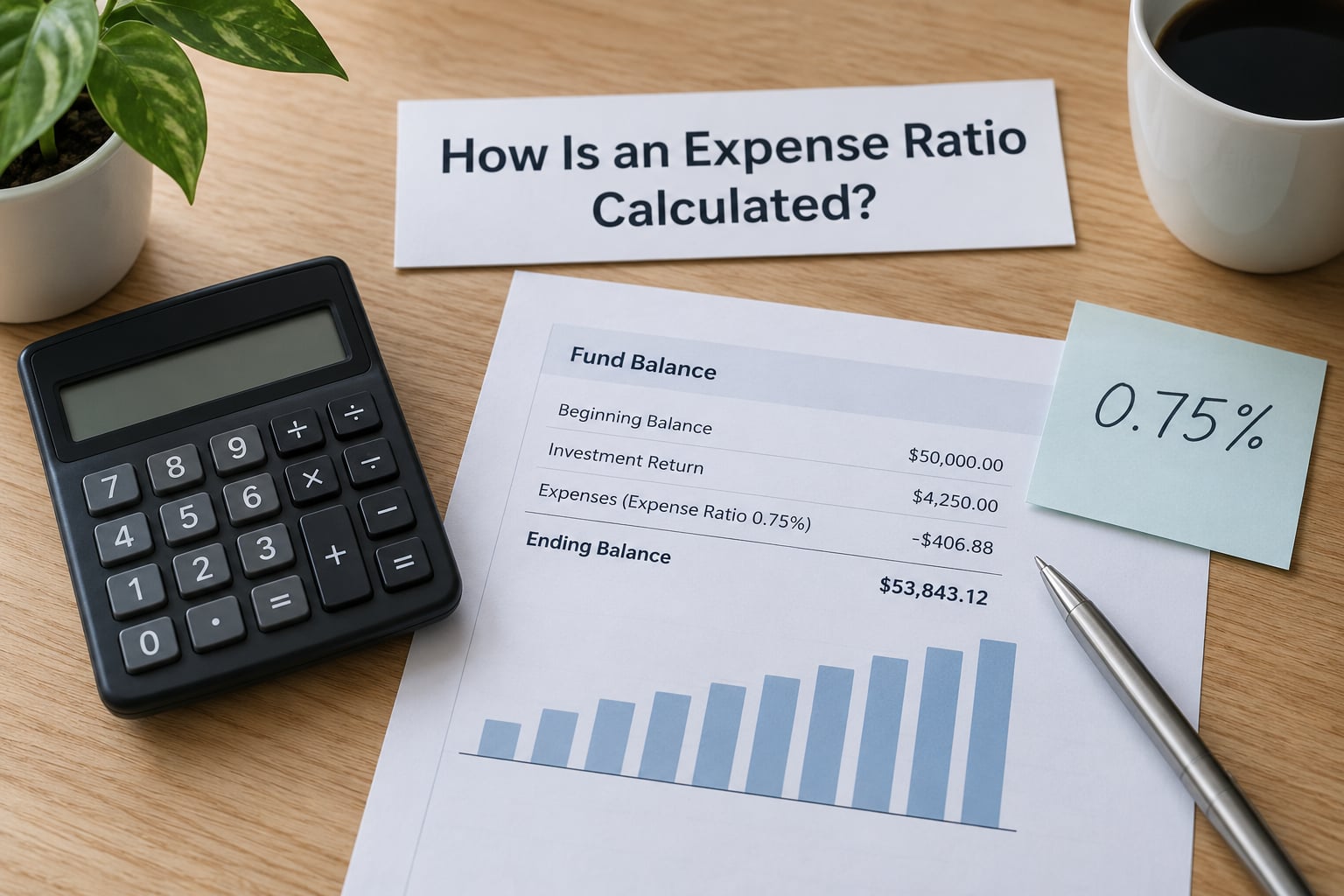
The formula is short, and it is worth having in text form so you can retype it into a spreadsheet.
Expense ratio = total annual operating expenses divided by average net assets
In plain English: divide everything the fund spent running itself last year by the average amount of money it held, then multiply by 100 to get a percentage. The SEC requires funds to show total annual operating expenses and net assets in the prospectus, which is why the inputs are always available.
| Annual operating expenses | Average net assets | Expense ratio | Annual cost on 10,000 dollars |
|---|---|---|---|
| 30 dollars | 5,000,000 dollars | 0.006 = 0.60% | 60 dollars |
| 250,000 dollars | 100,000,000 dollars | 0.0025 = 0.25% | 25 dollars |
| 1,500,000 dollars | 200,000,000 dollars | 0.0075 = 0.75% | 75 dollars |
| 30,000 dollars | 2,000,000 dollars | 0.015 = 1.50% | 150 dollars |
Note the last two rows. The small fund spends less in total, but because its assets are smaller too, it charges each shareholder more. Scale works both ways: a large fund spreads fixed costs like legal and audit across more dollars, which is a big part of why the cheapest funds in any category tend to be the biggest.
Fees are quoted in basis points in some places, which is simply a percentage in disguise. One basis point is 0.01%, so 0.25% is 25 basis points and 0.90% is 90 basis points. When you see a fee-cut headline on the news, it is usually quoted that way.
How Do Expense Ratios Affect Investment Returns?
Here is the part that gets underestimated. A fee is not a one-time subtraction; the amount you are missing stops compounding in your favor from that day forward. The longer the horizon, the wider the gap.
The table below takes 10,000 dollars invested today and assumes the portfolio earns 7% a year before fees. Actual returns vary, sometimes a lot, and no projection is guaranteed. The point is not the ending number in any row; it is the distance between the rows.
| Expense ratio | After 20 years | Fees over 20 years | After 30 years | Fees over 30 years |
|---|---|---|---|---|
| 0.03% | 38,494 dollars | 203 dollars | 75,506 dollars | 617 dollars |
| 0.25% | 36,912 dollars | 1,785 dollars | 70,897 dollars | 5,226 dollars |
| 0.75% | 33,610 dollars | 5,087 dollars | 61,669 dollars | 14,454 dollars |
| 1.50% | 29,177 dollars | 9,520 dollars | 49,841 dollars | 26,282 dollars |
Read the 1.50% column against the 0.03% column. Over 30 years on a modest balance, the difference in fees is roughly 25,000 dollars. A percentage point sounds small in a brochure. It is not small in a retirement account.
That said, the calculation above simply subtracts the fee from the return, which is how most projections do it. In practice fees are charged daily on the balance, so a market that rises in one direction most of the time gets a small break; a choppy market makes the drag slightly worse. Treat the table as a direction, not a forecast.
Where Can I Find a Fund’s Expense Ratio?
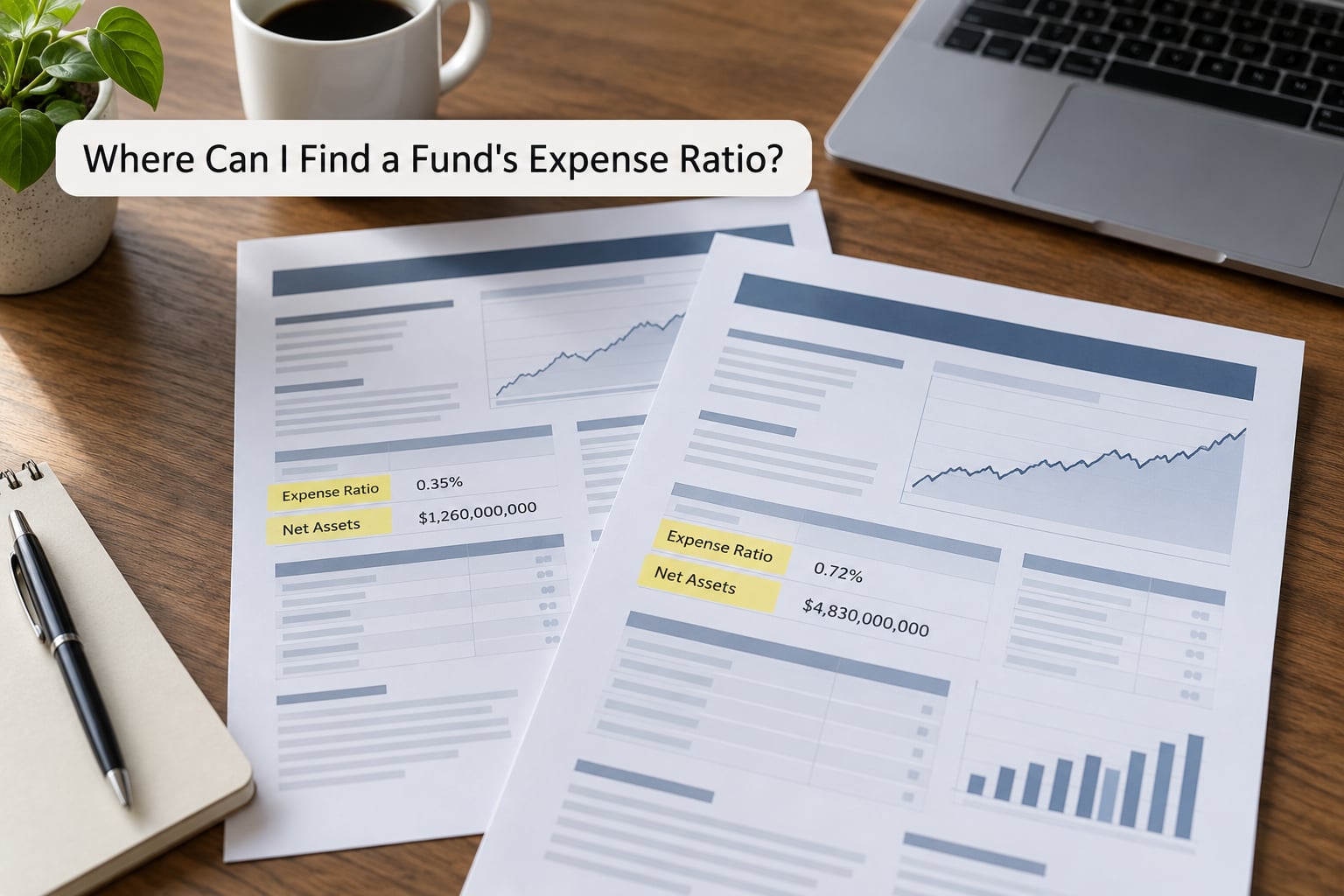
This is the step readers most often miss, and it is where forum threads pick up. The number is always published somewhere. It just is not on your statement, because no deduction happens there.
- The fund’s own website. Every issuer page lists an expense ratio next to net assets and the investment objective. This is the fastest route.
- The fund fact sheet. Usually a one or two page PDF. The fee, the load if there is one, and the waiver expiration are all on the first page.
- The prospectus and statement of additional information. The prospectus is the legal document and lists total annual operating expenses in a table with average net assets. It is long, but the fee section is near the front.
- Independent fund research databases. Morningstar-style tools let you pull the net and gross ratio, the share class, and the category average side by side. They are the best tool for comparing funds you do not yet own.
- Your retirement plan’s fee disclosure. Employer plans are required to publish plan fees, so ask for the SPD or the annual fee disclosure notice. Your plan’s investments may have ratios well above what you would choose yourself.
Four things to verify while you are looking. Confirm the share class, because the same portfolio often has an A, C and institutional class with different ratios for the identical holdings. Confirm whether the figure is net or gross. Note the date, since managers cut fees and you may be looking at an old document. And check whether a temporary waiver is in place and when it expires.
How Do You Compare Expense Ratios?
Comparison is where beginners get into trouble, because it is tempting to pick the lowest number on the screen. That works only when the two funds are doing the same job.
Start with the category, not the number. A 0.90% ratio on an actively managed international equity fund is cheap. The same 0.90% on a broad US index fund is expensive. The ranges below are typical of what US fund categories charge; they move slowly and vary year to year, and Morningstar publishes an annual US fund fee study if you want the current figures.
Typical expense ratio ranges by fund category
| Fund category | Typical expense ratio range |
|---|---|
| Broad US equity index fund | 0.02% to 0.10% |
| Active US large-cap equity | 0.60% to 0.90% |
| Active international equity | 0.70% to 1.00% |
| US bond index fund | 0.03% to 0.10% |
| Active bond fund | 0.50% to 0.70% |
| Target-date retirement fund | 0.30% to 0.60% |
| Real estate fund | 0.40% to 0.90% |
Within a category, lower is generally better, because the portfolios are doing comparable work. Across categories, the number means nothing on its own.
Should you add the load and the expense ratio together?
Yes, when you are comparing funds with different share classes or different purchase paths. A fund with a 5% front-end load and a 0.20% expense ratio is cheaper for a long-term holder than a no-load fund at 0.60%, because the load is charged once and the expense ratio is charged forever. The load only wins for short holding periods.
That question comes up a lot on money.stackexchange because fund fact sheets print the load, the expense ratio and sometimes a 12b-1 fee right next to each other, and readers reasonably assume they add up cleanly. They do not, exactly. They are separate charges with different time horizons, so compare them on the time period you actually plan to hold.
| Charge | How it is charged | Usually in the expense ratio? |
|---|---|---|
| Expense ratio | Percentage of assets, daily | Yes, this is the expense ratio |
| Front-end load | One-time percentage at purchase | No |
| Back-end load | Deducted from proceeds on sale, often declining over holding years | No |
| Brokerage commission | Per trade, and only for ETFs bought through a broker | No |
| 12b-1 fee | Percentage of assets, daily, for distribution and marketing | Yes, it sits inside the ratio |
| Advisory or wrap fee | Percentage of your account, billed separately | No |
The 12b-1 fee is the one that trips people up. It is a distribution and marketing charge, capped by SEC rules, and it is disclosed inside the expense ratio rather than next to it. A fund with a large 12b-1 fee is quietly paying to be sold, which is one reason that structure has been shrinking in the industry.
How expense ratios stack up inside a 401(k)
A workplace plan is where fees are hardest to see, because the deductions do not appear anywhere and the choices may have been made before you joined. A common post on r/personalfinance described a newly acquired company’s plan carrying more than 2% once the fund ratios and the plan’s own administrative charges were combined.
Two kinds of cost stack there. Each investment inside the plan has its own expense ratio, and the plan itself may charge an annual administrative fee, sometimes flat dollars, sometimes a percentage of your balance. You cannot change the plan fee. You often can change the investment choices, if the plan offers index funds alongside the target-date fund.
As for whether a small fee difference is worth switching over: Bogleheads members generally say no unless the balance is large, because the switch can trigger capital gains taxes and moving money has its own small annoyances. If the gap is 15 basis points on a 5,000-dollar balance, that is 7.50 dollars a year, and it is not worth a taxable event. On a six-figure balance, the same gap is a real number and the calculation changes.
Frequently Asked Questions
Is a 1% expense ratio bad?
It depends on the category. One percent is high for a broad index equity or bond fund, where the range typically runs from a few basis points to a tenth of a percent, and unremarkable for an actively managed international or specialty fund, where that is close to the middle of the range. Judge it against comparable funds, and check whether the share class and any temporary waiver distort the figure.
What does a 0.75% expense ratio mean in dollars?
On a balance of 10,000 dollars, a 0.75% expense ratio costs about 75 dollars a year. On 100,000 dollars it is roughly 750 dollars a year, and the cost scales with whatever the balance happens to be. Since the fee is deducted from fund assets every day rather than billed, that dollar amount is already reflected in the fund’s net asset value by the time you look at your balance.
What is a good expense ratio to have?
There is no universal threshold, which is the honest answer. A broad US equity index fund in the 0.02% to 0.10% range is low-cost by current standards. Active funds run higher because trading, research and analyst time cost real money. Compare your fund against funds in its own category, then decide whether the strategy is worth the difference. Be wary of any very low figure resting on a temporary fee waiver.
Are the management fee and the expense ratio the same thing?
No. The management fee is the pay for the people choosing and monitoring the portfolio, and it is usually the largest item inside the expense ratio. The expense ratio is the total: management plus administration, custody, accounting, audit, legal, shareholder service and distribution costs, expressed as a percentage of average net assets. That is why a fund’s disclosed management fee and its expense ratio rarely match each other.
Why do I not see the expense ratio on my statement?
Because no cash leaves your account. The fund deducts its expenses from fund assets each trading day, and the published net asset value is already reduced by them. Your brokerage statement shows your share count and the value of those shares, so the fee is embedded in the price rather than shown as a line item. To see it, look at the fund’s expense ratio on its fact sheet or issuer page.
Do index funds and ETFs have no expenses?
No. Both still have operating costs, including administration, custody, trading and distribution. Index funds are usually cheaper than actively managed funds because they hold an index rather than paying analysts to pick securities, and ETFs are usually cheaper than comparable mutual funds because they trade intraday and carry lower distribution costs. None of them is free, and the expense ratio is still the first number to check.
Conclusion
Here is the short version of what to do. Find the net expense ratio for the fund you own, on the issuer page or the fact sheet, and write it down next to the fund’s category. Find two or three comparable funds in that category and compare their ratios, making sure you are reading the same share class and the same date.
Then look at what sits outside the number, the load, the brokerage commissions, the advisory fee if you have one, and any administrative fee in a workplace plan. Judge the ratio against the strategy and diversification it buys you, not against the lowest figure on a screen. A 0.90% actively managed international fund and a 0.05% index fund are not competing on the same question.
Fees and rules vary by country and by state, and they change over time, so check the current disclosure for the specific fund you are considering. This is general information rather than individual investment advice.