If you are trying to work out how to invest a lump sum vs monthly, the honest answer is this: putting the whole amount in today has won roughly two-thirds of the time over long periods, because markets drift upward and cash sitting on the sideline earns nothing. Spreading it out is still the right call when the money is needed within a few years, your reserve is thin, or a 20% drop would make you sell. Neither method guarantees a better result, and the schedule matters less than the mix you buy and whether you stay invested.
This is general information, not personalised advice. Tax and account rules change and differ by country, so check the current details with your provider and your government before you act.
Table of Contents
- How to Invest a Lump Sum vs Monthly at a Glance
- The Difference Between Lump-Sum and Monthly Investing
- What lump sum investing actually means
- What dollar cost averaging actually means
- The same money, two schedules
- Returns and Compounding: Which Approach Can Benefit More?
- Market Risk and Timing: How to Invest a Lump Sum vs Monthly
- Cash Flow and Flexibility
- Fees, Taxes, and Account Type
- Which Should You Choose?
- Frequently Asked Questions
- Is a lump sum better than monthly investing?
- What is the smartest thing to do with a lump sum of money?
- How much will 100 a month be worth in 30 years?
- How long should I spread out a lump sum?
- Does monthly investing stop me from losing money?
- How much emergency savings should I have before investing a windfall?
- Conclusion
How to Invest a Lump Sum vs Monthly at a Glance
| Factor | Lump sum | Monthly investing |
|---|---|---|
| When capital goes to work | Immediately | Spread across months or quarters |
| Time in the market | Full amount, all the way through | Builds up as contributions arrive |
| Return opportunity | Captures the market’s upward drift | Leaves part of the money idle |
| Downside exposure | Full amount hit by an early decline | Less exposed early, more exposed later |
| Regret risk | High if the market drops right after | Lower at first, but regret if markets climb |
| Cash-flow flexibility | Nothing left to schedule | Each contribution stays redirectable |
| Cost | Fewest transactions | More trades, but usually tiny per-trade fees |
| Best fit | Long horizon, funded reserve, steady temperament | Income arriving gradually or a near-term goal |
Read that table as a description of two different jobs, not a scoreboard. One method optimises for expected return over decades. The other optimises for surviving the next three years without touching the money.
The Difference Between Lump-Sum and Monthly Investing
What lump sum investing actually means
Lump sum investing means deploying a large balance of cash into the market in a single decision. You might be buying a total market index fund, a S&P 500 index fund, or a balanced target-date fund, all in one go.
Windfalls create most lump sums: a bonus, an inheritance, a tax refund, a property sale, a matured deposit, a court settlement. The defining feature is that the money already exists and is sitting somewhere doing nothing.
What dollar cost averaging actually means
Dollar cost averaging, or DCA, means investing the same total amount in regular instalments, most often monthly. You buy more shares when prices are lower and fewer when prices are higher, which lowers your average cost per share compared with buying everything on a single date.
That averaging is a real mathematical effect. What it cannot do is put money to work before the instalment arrives.
The same money, two schedules
Take a 30,000 USD balance. The lump sum investor puts all 30,000 in on day one. The monthly investor puts in 2,500 USD on the same day and again every month for a year, which also totals 30,000 USD.
Both end the first year with the same amount invested and a very similar balance. The gap opens later, and it opens because of compounding time rather than any difference in what they bought.
Here is what those two schedules look like at an assumed average annual return of 6% with dividends reinvested, before fees and tax. These are illustrations of the arithmetic, not predictions.
| Point in time | Lump sum of 30,000 USD | 2,500 USD monthly over 12 months |
|---|---|---|
| Total contributed | 30,000 USD | 30,000 USD |
| After 1 year | about 31,800 USD | about 30,840 USD |
| After 20 years | about 96,200 USD | about 93,300 USD |
| After 30 years | about 172,300 USD | about 167,100 USD |
The lump sum finishes roughly 3% ahead at the 30-year mark in this illustration. That is much narrower than the folklore suggests, and it reverses entirely if markets are flat or falling over that stretch. The point is not that phasing in is expensive. It is that it has a cost, and that cost is only avoided when the market rises.
Returns and Compounding: Which Approach Can Benefit More?
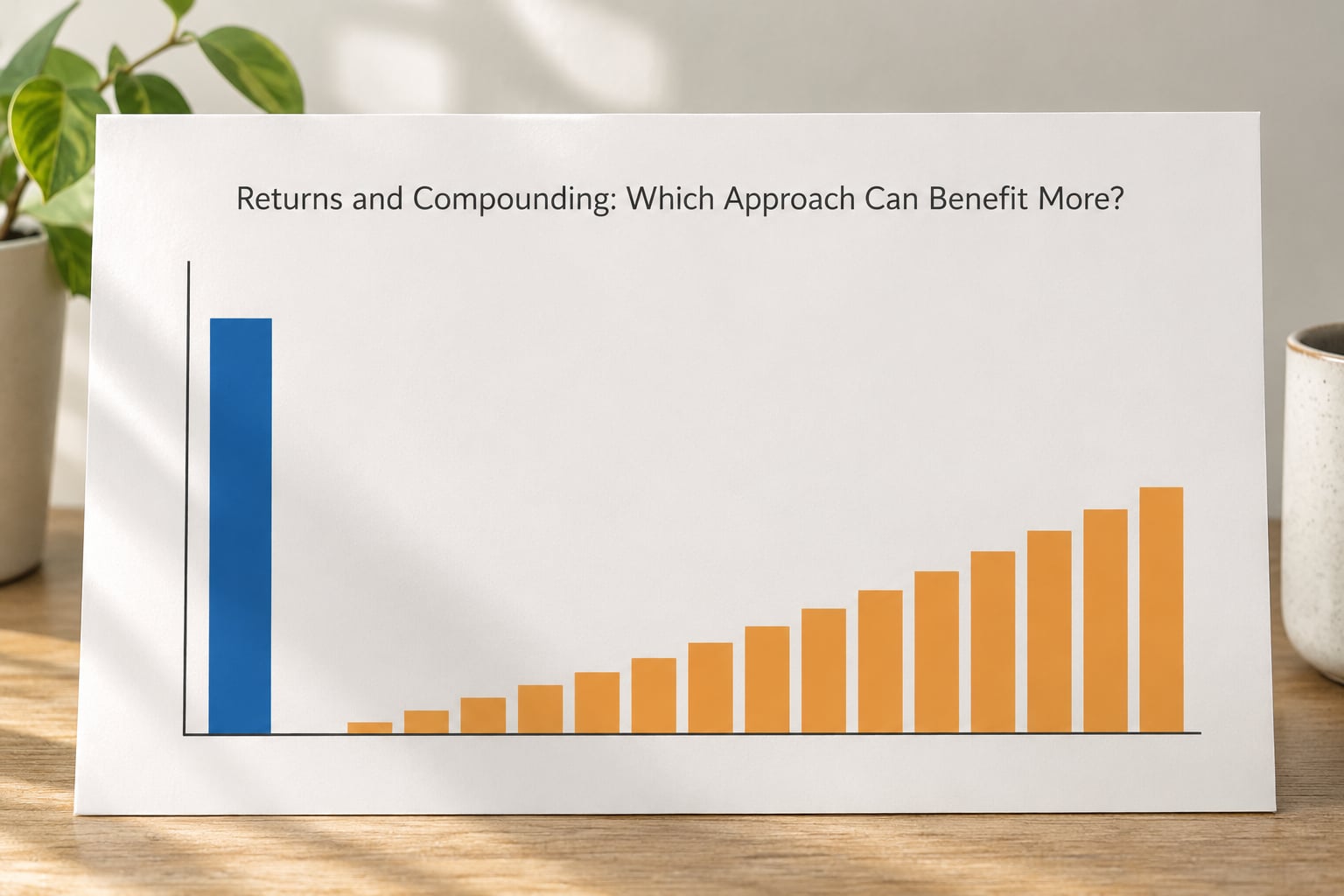
Lump sum investing can benefit more, for a mechanical reason: the entire balance is exposed to the market’s return for the whole period rather than a fraction of it.
Compounding rewards duration. A balance that is 100% invested earns its return on 100% of itself every year, then earns again on the growth. Money held in a savings account while you wait for the next instalment earns the savings rate, which in most years sits well below the long-run return of a diversified equity fund. That gap is the opportunity cost, sometimes called cash drag.
The honest caveat matters here. The evidence usually cited for lump sums, from Vanguard’s cost-averaging research and Morningstar’s rolling-period data, is back-tested. It relies on the historical accident that broad equity markets rose on average over the sampling periods. Past performance is not a guide to future results, and in some countries or some decades, the answer flips.
Long-run return studies also assume dividends are reinvested and ignore taxes and fees. A taxable account with annual selling can end up well behind the headline figure even when the schedule was perfect.
Market Risk and Timing: How to Invest a Lump Sum vs Monthly
Each method carries a different regret profile, and that is the part most comparisons skip.
Deploy everything on one bad day and the portfolio can be 20% lower a month later. Investors who have never held a large balance through a drawdown describe that first dip as the moment they realise they are gambling with something real. On a 30,000 USD balance, a 20% decline is 6,000 USD of paper loss before it recovers.
Spread the same money over a year and the pain of the entry point is averaged out. You buy more shares cheaply during the drop, which is exactly what dollar cost averaging is for. The cost is that you only have part of the money working while the market is doing the recovering.
The sequence-of-returns risk matters most when the money has a deadline. Someone drawing down a retirement balance over the next four years cares about the order of returns far more than someone saving for a date decades out. A big decline right before withdrawal is the genuinely dangerous case, and phasing in is a blunt but real protection against it.
Three questions settle most of this. How much emergency savings do you already have? How many years before the money is needed? If the portfolio fell 20% next month, would you sell everything or leave it alone? A yes to selling means you hold too much equity for either schedule, and the schedule is the wrong problem to be solving.
Cash Flow and Flexibility
Monthly contributions fit a salary-shaped life. The money arrives in a predictable rhythm, a pre-authorised contribution does the work, and the decision is made once rather than re-litigated every time a headline lands.
That predictability is not a small thing. Several threads on r/Bogleheads and r/personalfinance make the same point from different angles: once the money has gone in as one sum, most people stop watching the account, while the monthly habit keeps people in the market through bad headlines. For a lot of investors the automatic habit is worth more than the arithmetic difference.
Several things argue for holding part of the balance back. A large expense in the next 18 months, a variable income, a business where revenue swings quarter to quarter, credit card or student debt at high rates, or a house deposit with a fixed date. In those cases the money has competing claims and the honest move is to buy time rather than pretend the timeline is longer than it is.
Small monthly amounts also deserve credit for what they do. A 2,500 USD monthly contribution becomes a habit you can maintain for years without thinking about it, and it scales with your income. If you are not in a position to deploy 30,000 USD, a monthly contribution is not the compromise option, it is simply the plan that fits.
Fees, Taxes, and Account Type
The schedule matters less than the vehicle carrying it, and less than that than the mix inside it.
Where the money goes beats when it goes in. A broad index fund carrying a low expense ratio, or a balanced target-date fund matched to your retirement date, will almost always do more for the final balance than any cleverness about deployment timing. Pick the allocation first, then set the schedule around it.
On costs, splitting a balance into instalments means more transactions, but at a typical index fund the per-trade cost is small. The things worth checking are the fund’s ongoing expense ratio, any account or trade minimums, and whether your provider supports fractional purchases. Small balances split across a dozen tiny instalments are the case where the mechanics start to cost more than the strategy is worth.
Account type changes the arithmetic for long-term holders. A tax-deferred account such as a 401(k) or an IRA/RRSP shelters growth and withdrawals, while a taxable brokerage account exposes gains to tax as they are realised. Both have contribution limits that apply on top of annual limits. Rules, rates and thresholds differ by country and change over time, so confirm the current treatment before you commit a large balance.
Which Should You Choose?
Favour a lump sum when the money is already in your hands, your emergency reserve is fully funded, the horizon runs ten years or more, and you have watched a portfolio fall without selling.
Favour monthly investing when the cash arrives gradually, when a near-term expense competes for it, when the balance is small enough that per-trade minimums matter, or when spreading it out genuinely lowers the odds of you bailing at the worst moment.
The middle path is worth knowing about, because it is what a lot of people actually do. Invest half now, then deploy the rest in three equal tranches over the following three months. You capture most of the market’s drift, you cap the damage if the first week goes badly, and you give yourself a written schedule rather than a series of fresh decisions. Keep the schedule written down. A plan you decide to review monthly is not a plan.
If you already invest monthly, do not overthink the switch. Adding a new balance straight into the same fund you already contribute to keeps things simple, and the ongoing contributions still do their job.
Frequently Asked Questions
Is a lump sum better than monthly investing?
Historically, yes. Studies from Vanguard and Morningstar find that investing a balance immediately beat spreading it over three to twelve months roughly two-thirds of the time, because markets rise on average and idle cash earns less. That record comes from back-tested data, not a guarantee, and it reverses when markets fall over the period. Monthly investing is still the better fit when your reserve is thin or the money is needed soon.
What is the smartest thing to do with a lump sum of money?
Four steps in order. First, keep enough cash to cover several months of essential expenses before you invest anything. Second, clear high-interest debt, since paying off credit card balances reliably beats most portfolios. Third, choose an allocation you will not abandon in a downturn. Fourth, deploy the remainder, all at once if your horizon is long and your temperament is steady, or across three to six months if you need the reassurance.
How much will 100 a month be worth in 30 years?
Assuming reinvested dividends, no fees or tax, and money contributed at the end of each month: 100 a month totals 36,000 USD over 30 years. At an average 3% annual return that becomes roughly 58,300 USD. At 5%, about 83,200 USD. At 7%, about 122,000 USD. At 9%, around 183,000 USD. The spread is entirely about the return you earn, which is why cost and diversification matter more than the amount you start with.
How long should I spread out a lump sum?
Three to six months is the range most advisors and experienced forum participants land on. Under three months barely reduces the regret, since a sharp drop can still catch most of your balance. Beyond six months you are simply holding cash out of the market for longer than the historical evidence supports. Six to twelve months becomes defensible when you have a near-term expense competing for the money or you are genuinely unsure you would hold your nerve through a fall.
Does monthly investing stop me from losing money?
No. It changes the shape of the risk, not its existence. Averaging over a year means a decline early on hurts only the portion you have already deployed, and you buy more shares cheaply on the way down. But every instalment you eventually place is exposed, and a sustained fall still ends with a portfolio below what you put in. Nothing about the schedule protects you from a genuine bear market.
How much emergency savings should I have before investing a windfall?
Most guidance points to three to six months of essential expenses, though six to twelve is safer if your income is variable or you are self-employed. Count rent, food, utilities, insurance and minimum debt payments, not your normal spending. If the windfall is large, you can hold your reserve inside it rather than as a separate pile: keep the needed portion in cash and invest only the remainder.
Conclusion
How to invest a lump sum vs monthly comes down to a trade between expected return and peace of mind. Put the whole balance in today if the reserve is funded, the horizon is long and you would hold a falling portfolio without selling. Phase it over three to six months if the money has a near-term claim on it or you know you would panic.
Start by confirming your emergency reserve, then list every near-term expense that competes for the balance. Compare costs and tax treatment across account types, choose an allocation you can sit with, and pick the schedule you would actually follow through a bad quarter rather than the one that sounds best.