Junk silver coins are priced off the silver spot price and nothing else. The whole formula fits in one line: melt value = face value × 0.715 × silver spot price. Every 1.00 dollar of face value in 90% silver coin holds about 0.715 troy ounces, so a seller prices the metal first and adds or subtracts a premium second. How junk silver coins are priced comes down to that arithmetic, plus whatever the market will bear for condition and demand.
Below is the framework I use to check any quote: identify the coin, work out the fine silver in it, multiply by the spot price of the day, then compare the ask or bid against that melt number. It takes about a minute and it tells you instantly whether a deal is ordinary or padded.
Figures throughout are illustrative reference points drawn from typical US ranges and dated to 2026 budgeting, not promises. Silver moves, and the premiums on top of melt move faster.
Table of Contents
- Typical Junk Silver Pricing: Sizes, Types, and Premiums
- What Affects the Price
- How Junk Silver Coins Are Priced: Calculating Spot and Melt Value
- Why the 0.715 factor exists
- Face value to troy ounces, in one list
- How junk silver coins are priced at three spot levels
- Adjusting for purity
- Why Coins Sell Above Melt Value
- Dealer Buying Price vs Retail Price
- How to Estimate a Fair Junk Silver Coin Price
- Step 1: identify what you actually hold
- Step 2: get today’s spot
- Step 3: calculate melt
- Step 4: convert a quoted face multiple into a premium
- Step 5: compare three real offers
- Step 6: check for coins worth pulling
- Ways to Save
- Frequently Asked Questions
- How much silver is in 1 dollar of junk silver?
- How much is 1 lb of junk silver worth?
- What are people paying for junk silver coins?
- Why is junk silver selling below melt value?
- Who pays the best for junk silver?
- How much should I pay over melt for junk silver?
- Conclusion
Typical Junk Silver Pricing: Sizes, Types, and Premiums
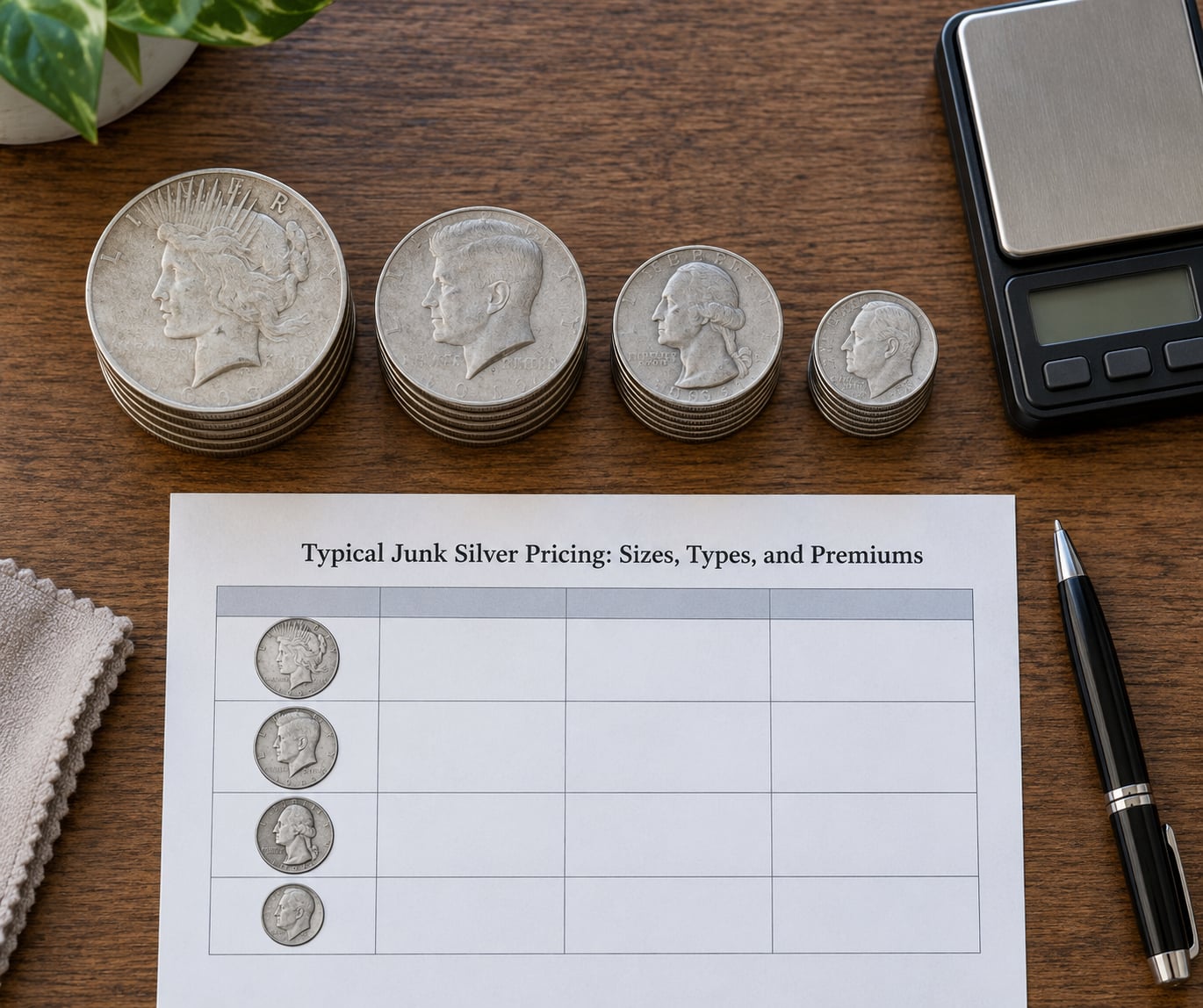
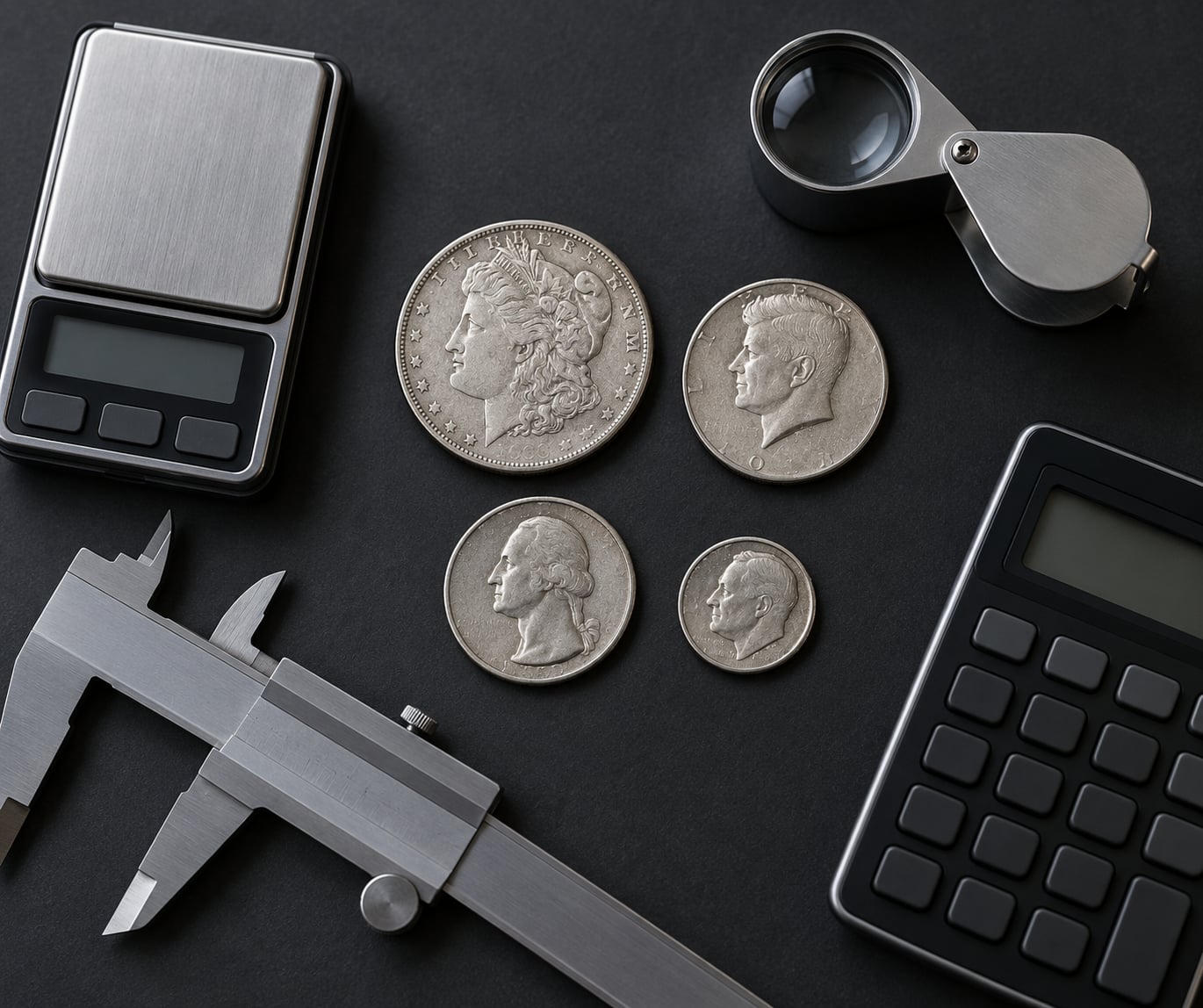
Every junk silver coin carries its silver content on a schedule set by denomination, so the price per coin is just that content times spot. The table below is the one I keep by the phone. Weight figures are mint specifications; the 0.715 factor used for pricing accounts for wear on coins that have been in circulation.
| Coin | Weight | Fineness | Fine silver (troy oz) | Melt at 30 per oz | Melt at 60 per oz | Melt at 90 per oz |
|---|---|---|---|---|---|---|
| Silver dime (1916-1964) | 2.50 g | 90% | 0.0723 | 2.17 | 4.34 | 6.51 |
| Silver quarter (1932-1964) | 6.50 g | 90% | 0.1808 | 5.42 | 10.85 | 16.27 |
| Silver half dollar (1916-1964) | 12.50 g | 90% | 0.3617 | 10.85 | 21.70 | 32.55 |
| Silver dollar (1878-1964) | 26.73 g | 90% | 0.7734 | 23.20 | 46.40 | 69.61 |
| Kennedy half (1965-1970, 40%) | 12.50 g | 40% | 0.1608 | 4.82 | 9.65 | 14.47 |
| War nickel (1942-1945, 35%) | 5.00 g | 35% | 0.0563 | 1.69 | 3.38 | 5.06 |
Two coins that get priced wrongly constantly are the last two rows. A 1965 through 1970 Kennedy half holds about 0.1608 troy ounces, not the 0.3617 of a pre-1965 half, and a 1942-1945 war nickel holds about 0.0563, not the 0.0703 of a 1920s nickel. Multiply the wrong number by spot and you are off by more than half.
Typical premiums in normal markets: junk silver bought from a dealer runs about 3% to 8% over melt, and dimes and quarters often sit at the thinner end while halves carry slightly more because each coin has more silver to sort. Silver dollars usually price above the 0.715 math because buyers want them as coins. Those ranges are typical US figures and they move with the market.
What Affects the Price
Silver content sets the floor; everything else decides where the coin lands above it. Read the list below in order of how much it usually moves the number.
- Silver spot price. About 90% of a junk silver coin’s value is a direct read of spot. A move of one dollar per ounce adds 0.715 dollars to every dollar of face value.
- Weight and fineness. 90%, 40%, and 35% coins use different conversion factors. Purity errors are the most common pricing mistake I see.
- Dealer spread. The gap between what a dealer pays and what they charge is often wider than the premium itself.
- Date and mint mark. Common dates in worn condition get priced as metal. Scarce dates and mint marks do not.
- Condition and eye appeal. Bright, problem-free pieces draw buyers that a bag of dark, scratched coins does not.
- Demand from non-investors. Collectors, new stackers, and survivalist buyers all pull on the same supply at once.
- Location. Shops in tourist areas bid lower than shops near a refinery or a bullion firm.
- Sales tax. In states that treat bullion purchases as taxable, the register price runs above melt by a few percent before anyone buys.
- Melt pricing or coin pricing. A dealer can quote your coin two ways, and the difference between the two quotes is often most of the value.
Rarity matters less than people expect for junk. A worn 1921 Morgan dollar and a worn 1964 quarter hold nearly identical silver; the gap between them is what a collector will pay, not what the metal is worth.
How Junk Silver Coins Are Priced: Calculating Spot and Melt Value
Here is the calculation in plain text so it can be copied into any calculator: melt value = face value × 0.715 × spot price. Face value is the number stamped on the coins, spot price is the current price of one troy ounce of silver, and the result is the metal value of the coin before any premium.
Why the 0.715 factor exists
A full dollar of face value struck at mint weight holds 0.7234 troy ounces. Nobody sells you coins that have never been pocketed, so the industry prices on 0.715, a standard wear allowance that survived decades of use. It is a convention, not a measurement, and it is the reason every junk silver calculator on the internet runs the same math.
Face value to troy ounces, in one list
- 1 dollar face = 0.715 troy ounces
- 10 dollars face = 7.15 troy ounces
- 100 dollars face = 71.5 troy ounces
- 1,000 dollars face = 715 troy ounces
That last line is why sellers talk about a 1,000 dollar face bag instead of a coin count. One bag is a fixed, checkable amount of silver, and the price is 715 multiplied by spot before anyone argues about premium.
How junk silver coins are priced at three spot levels
Say spot is running at 30, 60, and 90 per ounce so you can see the shape of the number. The per-dollar melt is 21.45, 42.90, and 64.35 respectively, and everything scales from there.
| Coin or bag | At 30 per oz | At 60 per oz | At 90 per oz |
|---|---|---|---|
| 1 dollar face (10 dimes) | 21.45 | 42.90 | 64.35 |
| 10 dollars face | 214.50 | 429.00 | 643.50 |
| 100 dollars face | 2,145.00 | 4,290.00 | 6,435.00 |
| 1,000 dollars face | 21,450.00 | 42,900.00 | 64,350.00 |
| One half dollar | 10.85 | 21.70 | 32.55 |
| One silver dollar | 23.20 | 46.40 | 69.61 |
The sensitivity is worth remembering on its own: every one dollar move in spot shifts a 1,000 dollar face bag by 715 dollars. A move in one dollar face shifts by 71.50. That is the whole reason junk silver pricing tracks spot so tightly.
Adjusting for purity
For 40% halves, divide the 90% melt by 2.25. For 35% war nickels, multiply the 90% result by 0.35 divided by 0.90. A 1967 Kennedy half is worth about 9.65 at a 60 per ounce spot, not 21.70, and a dealer who quotes you the 90% number on a mixed bag is either confused or working in your favor.
Why Coins Sell Above Melt Value
Some premiums are real, some are just margin, and telling them apart matters more than the number of dollars involved.
- Key dates and scarce mint marks. A low-mintage date in decent condition can be worth multiples of its metal. Once a coin is priced on that basis, the melt formula stops applying.
- Silver dollars as collectibles. Morgan and Peace dollars have their own demand, and dealers pay a coin price for attractive examples rather than a metal price.
- Condition. Bright surfaces and clean fields draw buyers over dull, scratched metal of identical weight.
- Eye appeal and problems. Cleaned, holed, or harshly cleaned coins get discounted, sometimes by 20% or more against similar examples.
- Convenience and packaging. Coins sold in graded, listed sets carry a premium over the same coins loose, because the buyer gets a defined item.
- Dealer margin. Some of the gap is just the price of doing the sorting, weighing, and resale that the buyer would otherwise do.
- Thin market pressure. When nobody is buying, sellers compete for the same few buyers and the premium compresses toward melt.
A premium is justified when you can name what the extra money buys: a scarce date, a specific grade, a set, or your own convenience. It is not justified when the seller simply quotes a round number above melt and describes the coins as common.
Dealer Buying Price vs Retail Price
Retail and bid are not the same number and never were. The dealer sits in the middle, and their spread is where the business lives. National buyers of 90% coin commonly pay 95% to 98% of melt; other metals sit lower, because handling cost per ounce of value is higher.
| Metal | Typical dealer payout as a share of melt |
|---|---|
| 90% silver coins | 95% to 98% |
| Sterling silver | 80% to 90% |
| Scrap gold, 8-10K | 85% to 92% |
| Melted silver bars | Close to 100% |
Local coin shops often quote lower than that. In one regional report a shop was offering around 65% of melt while national buyers were paying 95% to 98%, and other sellers have posted offers near 88% of melt on the same week of the same year. That spread exists because a local shop carries risk and labor the national buyer pushes onto a refinery.
So why do dealers sometimes bid below melt? Because a bag has to be counted, weighed, and shipped, and the buyer needs a margin for coins that turn out to be clad, worn past the standard, or damaged. When volume is low, that margin grows and junk silver can trade under melt for weeks at a time. Stackers on silver forums describe it plainly: the material is fine, the buyers are not there.
How to Estimate a Fair Junk Silver Coin Price
Six steps, and the same sequence works whether you are at a coin show, at a local shop, or on a dealer website.
Step 1: identify what you actually hold
Pre-1965 coins with no mint mark are 90% silver. Anything dated 1965 or later on a half dollar is 40% until 1970, 1942 to 1945 nickels are 35%, and every quarter from 1965 on and dime from 1965 on is clad with a copper core. A brownish edge on a coin dated before 1965 is a decent clue, and a magnet does nothing for silver, so a magnet only rules out iron.
Step 2: get today’s spot
Check a live silver price page, not a number from a blog post. Spot moves intraday, and a quote two days old can be several percent off the deal in front of you.
Step 3: calculate melt
Face value times 0.715 times spot. For a mixed bag, add the denominations: 10 dimes per dollar, 4 quarters per dollar, 2 halves per dollar, and dollars at their own 0.7734 factor.
Step 4: convert a quoted face multiple into a premium
Dealers often quote per dollar of face rather than per ounce. Take the quote, divide it by 0.715 times spot, and you have the melt multiple. Example: a quote of 23 dollars per dollar of face at a 60 per ounce spot equals 23 against a 42.90 melt, or about 54% of melt, which is well under spot. The same 23 dollar quote at a 30 per ounce spot equals 23 against 21.45, roughly 7% over melt. Face multiples go stale fast; percentages do not.
Step 5: compare three real offers
A national bullion dealer, a local shop, and a refiner or recycler will not give the same number, and the difference is your negotiating range. Take the highest bid when you are selling and the lowest ask among comparable sellers when you are buying.
Step 6: check for coins worth pulling
Before a bag goes in the pile, flip through it for silver dollars, better dates, and anything obviously unclean. A bag described as common 90% is priced as common 90%.
Ways to Save
Every one of these has a real effect on the total you pay or net back.
- Buy common dates. Worn, unremarkable coins carry the thinnest premium because nobody is bidding for them.
- Compare before you commit. Three quotes take one phone call and take minutes off the ask.
- Buy in thinner markets. Premiums compress when interest rates rise and physical demand cools, which is often when the spread is friendliest.
- Skip graded, listed, or specialty pieces. You pay for the holder and the promise, not the silver.
- Sort the 40% and 35% coins out of the 90% pile. Otherwise a low-purity coin gets priced at 90% and you are charged for silver that is not there.
- Budget for the round trip. Insurance, safe deposit fees, and the resale spread are part of your cost, not extras.
- Know the resale friction before you buy. Selling 100 dollars of face in small pieces usually gets worse terms than selling in a single lot.
One more: do not melt it. Refiners charge to process, assay, and return metal, and the coins themselves usually trade above the raw melt, so melting converts a liquid asset into a loss and a stub of metal.
Frequently Asked Questions
How much silver is in 1 dollar of junk silver?
About 0.715 troy ounces of fine silver, by the industry standard that prices circulated 90% coin. Mint weight would be 0.7234 ounces, and the difference is the wear allowance built into the 0.715 figure. That is why 10 dollars of face holds 7.15 ounces and a 1,000 dollar face bag holds 715 ounces.
How much is 1 lb of junk silver worth?
A pound of pre-1965 coin weighs about 453 grams, and 90% of that is 408 grams of silver, roughly 13.1 troy ounces. At a spot of 60 per ounce that is close to 788 in metal, which corresponds to about 18 dollars of face value. Actual melt is a shade lower because not every coin in the pound is pure 90%.
What are people paying for junk silver coins?
Retail buyers of 90% coin typically pay 3% to 8% over melt in normal markets, and sellers usually receive 95% to 98% of melt from a national dealer. Local coin shops can quote far lower, and regional answers in forums have run from about 65% to near 90% of melt. The spread between those numbers is the deal you are shopping for.
Why is junk silver selling below melt value?
Melt is a theoretical number, while a real sale needs a buyer in the room. When demand is thin and refiners are not soliciting, dealers widen their margin and junk silver can trade below melt for stretches of weeks. Stackers have described the material as increasingly illiquid over short periods. It is a demand problem, not a silver problem.
Who pays the best for junk silver?
In most cases a national bullion dealer or refiner pays the most for large lots of common 90% coin, because volume lets them sort and ship efficiently. A recycler pays more than a shop when the volume is genuinely industrial. Local coin shops pay least per ounce but they are the only buyers who will take a small mixed bag without an assay first.
How much should I pay over melt for junk silver?
Three to eight percent over melt is the normal band for common circulated 90% coin, and dimes and quarters sit at the lower end. Anything much above that should come with a stated reason: a scarce date, a certified grade, or a defined set. If the seller cannot explain the premium in one sentence, treat it as margin rather than value.
Conclusion
How junk silver coins are priced comes down to one line of arithmetic and one judgment call. The arithmetic is face value times 0.715 times spot, adjusted for 40% and 35% coins and for coins that are collectible rather than metal.
The judgment call is the premium. Start with today’s spot, calculate melt for the exact coin in your hand, then convert whatever the seller quoted into a percentage of melt. If that percentage sits inside the normal band and the seller can tell you why, you are looking at a fair deal. If it does not, walk to the next quote.