
What are Treasury inflation-protected securities? They are U.S. Treasury bonds whose principal rises and falls with the Consumer Price Index for All Urban Consumers (CPI-U), published monthly by the Bureau of Labor Statistics. You receive a fixed coupon rate twice a year on that inflation-adjusted principal, and at maturity you get back whichever is larger: the adjusted principal or the amount you originally paid.
That last part surprises people. A TIPS is not a growth investment. Its job is narrower: to keep a known amount of cash worth roughly what it was worth when you bought it, no matter what inflation does along the way.
What follows is a plain-English walk through the mechanics, the returns, the tax bill and the parts that hurt. This is general information, not advice about your money. Rules, rates and index values change, so check current figures with the Treasury or a tax professional before you act.
Table of Contents
- What Are Treasury Inflation-Protected Securities?
- How TIPS Adjust for Inflation
- How the CPI-U index ratio turns inflation into principal
- The three-month indexation lag
- What Determines a TIPS Return?
- Why Do TIPS Prices Fall When Inflation Falls?
- What Are the Main Types of TIPS?
- How Are New TIPS Priced at Auction?
- What Happens When TIPS Mature?
- Are TIPS Taxable?
- What Are the Risks and Limitations of TIPS?
- How Do Investors Use TIPS?
- What is a TIPS ladder and how does it work?
- What Should You Check Before Buying TIPS?
- Frequently Asked Questions
- Are TIPS taxable?
- How much do you get when TIPS mature?
- Do TIPS lose money during deflation?
- Are TIPS better than regular Treasury bonds?
- Can I buy TIPS through an index fund?
- Conclusion
What Are Treasury Inflation-Protected Securities?

Treasury inflation-protected securities, usually shortened to TIPS, were first issued in 1997 by the U.S. Department of the Treasury. They are direct obligations of the federal government, backed by the full faith and credit of the United States, which is the same credit standing as any other Treasury security you can buy.
The inflation link runs through one index and one index only: the CPI-U. The Bureau of Labor Statistics measures it every month, and the Treasury uses that published number to adjust principal twice a year.
Three characteristics define the security. The coupon rate is fixed when the bond is auctioned and never changes. The principal is indexed, so it tracks cumulative CPI-U since issuance. And the maturity date never moves, which is why a TIPS always has a known end point even while its principal is shifting.
There is a fourth rule that sits underneath all three, and it is the one that makes TIPS feel conservative: at maturity you receive the greater of your inflation-adjusted principal or your original principal. If prices fall, your coupon keeps coming, but you are not left with less than you put in, provided you held the bond all the way to maturity and never sold it.
Also worth knowing: the CPI-U is a national, basket-based measure. It is not your personal cost of living. If your spending is concentrated in housing, medical care or education, the headline number may track your own inflation better or worse in any given year.
How TIPS Adjust for Inflation
The mechanism has four moving parts: the stated principal you see on the certificate, the index ratio, the adjusted principal, and the fixed coupon applied to it. Here is the order in which they operate.
How the CPI-U index ratio turns inflation into principal
The Treasury divides today’s CPI-U figure by the CPI-U figure from the base period recorded on your bond. That quotient is the index ratio. A ratio of 1.09 means the price level has risen about 9 percent since issuance, so your adjusted principal is 1.09 times your stated principal.
Then the coupon applies to the adjusted principal, not the stated principal. And the whole calculation repeats every six months.
Say you buy one bond with 1,000 of par value at an auction where the fixed coupon is set at 1.75 percent. Three years and three semiannual adjustments later, cumulative CPI-U growth implies an index ratio of 1.09, so the adjusted principal is 1,090. The annual interest on that adjusted principal is 19.07, not 17.50, and the interest is paid in two installments a year.
At maturity the Treasury pays the final coupon plus the greater of 1,090 or your original 1,000. If inflation had turned negative over that stretch and the index ratio had fallen to 0.97, you would still receive 1,000. The floor holds.
The three-month indexation lag
Each adjustment uses the CPI-U reading from three months before the adjustment date. That delay exists because the Bureau of Labor Statistics needs time to collect and publish its data, not because of anything to do with the bond.
This is the single most misunderstood feature of TIPS, and it explains a lot of disappointed investors. When inflation accelerates sharply, the printed number your bond reacts to is already history by three months. The adjustment arrives later, and smaller, than the inflation rate people read in the news the same week.
So a TIPS can lose ground against the inflation you personally experienced while formally being protected against it. The protection is real, but it is measured against a backward-looking national index with a delay.
What Determines a TIPS Return?
Three components, and people usually only talk about the first one.
Coupon income. The fixed rate set at auction, paid twice a year on whatever the principal happens to be at that moment. If principal has grown, your coupon income grows with it.
Indexed principal growth. The cumulative rise in CPI-U over the life of the bond. This is the inflation hedge doing its job, arriving with the three-month lag attached.
Changes in market interest rates. A TIPS is a bond with a maturity date, and bonds trade on yields. If real yields rise after you buy, the market price of your existing TIPS falls, because new issues pay more for the same adjusted cash flows. Longer maturities move more.
Put together, a TIPS does not pay you a fixed number of dollars at maturity. The coupon is fixed, but the principal that coupon applies to is not, and the market value of the security along the way depends on real rates that move for reasons that have nothing to do with inflation.
One more nuance matters if you are pricing a purchase: the market cares about unexpected inflation, not inflation you already know about. By the time inflation is visibly running hot, nominal Treasury yields have usually already climbed to reflect it. That is why an inflation scare can leave nominal bonds priced as though inflation is high and TIPS relatively attractive on a real-yield basis, rather than the reverse.
Why Do TIPS Prices Fall When Inflation Falls?
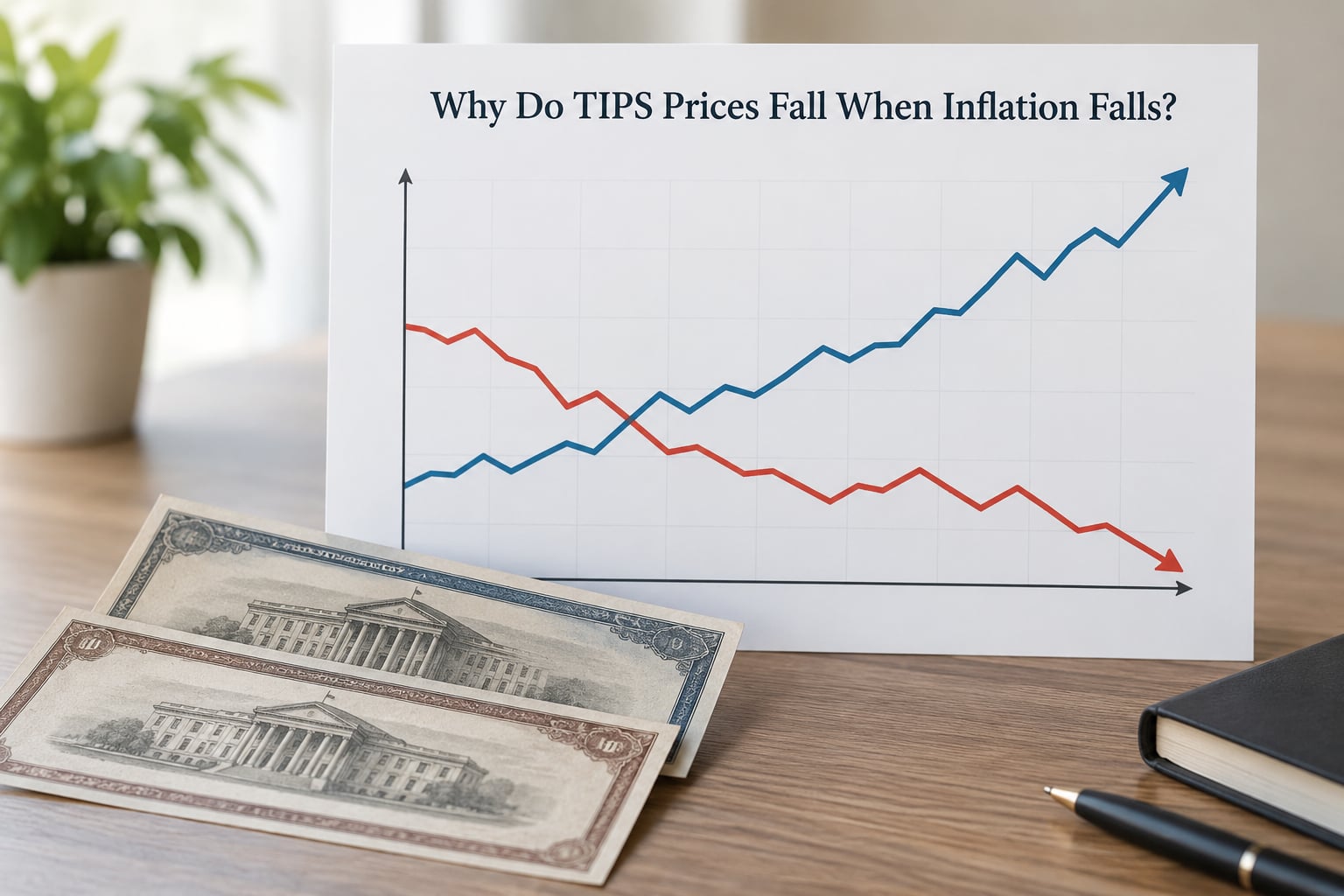
Because a TIPS price is set by real interest rates, and real rates can rise for reasons that have nothing to do with inflation at all. Lower inflation removes the reason you might have expected the bond to rally, and if the market decides it wants a higher return for inflation risk it will not accept today, the price goes the other way.
Think of it as two separate forces. The indexation force adds principal when CPI-U rises, and subtracts when it falls. The interest-rate force pushes the market price up when real yields fall and down when they rise. During periods when both move together, like a fast inflation spike that also drives real yields higher, the second force can easily overpower the first.
This is exactly why TIPS fell hard in 2022 while inflation was running at its highest level in a generation. The long-duration TIPS funds posted double-digit losses, with the longest-maturity products down far more than the inflation-indexed mid-range funds. Nominal long bonds lost money in the same year for the same underlying reason.
Retirees who bought individual TIPS and held them reported the same thing in forum threads: a startling paper loss on a bond that cannot actually lose principal at maturity. The two facts coexist, and that gap is where most of the discomfort with this asset lives.
What Are the Main Types of TIPS?
The Treasury issues TIPS at three standard maturities: 5-year, 10-year and 30-year. That choice matters more than it sounds, because it sets how sensitive the bond is to real-rate moves.
5-year TIPS carry the least duration. Their prices wobble least when real yields move, and they work best for money you may need within a few years rather than a few decades.
10-year TIPS sit in the middle, and they are the most commonly issued maturity by auction volume. A 10-year TIPS behaves reasonably like a medium-term savings commitment if you hold it to maturity.
30-year TIPS are the long end. They lock in a real return over decades and pay the highest real yields, but they also swing hardest when real rates move. If you sell one a year after buying, the price you receive bears little relationship to the inflation adjustment you have accumulated.
The Treasury also reopens existing issues, so the same CUSIP can return to auction months after its first sale. Buyers who want a specific maturity can buy whenever it reopens, though the real yield will differ from the original auction.
On top of that sit fund vehicles: broad TIPS index funds, short-duration TIPS funds, long-duration TIPS funds, and fixed-maturity TIPS funds that hold individual bonds to their maturity dates instead of trading them. Fixed-maturity funds exist as a middle path for people who want individual-bond behaviour without maintaining the ladder themselves. A fixed-maturity fund still has its own fee and its own pace of returning your money, so it is not identical to holding bonds to the date.
How Are New TIPS Priced at Auction?
New TIPS are auctioned at 100 dollars of par value. Bidders submit either a real yield they are willing to accept or a price, and the Treasury clears them at a single real yield based on what it receives. Interest accrues from the issue date, and settlement includes any accrued interest if you buy in the secondary market later.
If the auction settles above par, you are paying more than face value for a below-average coupon. If it settles below par, you pay less than face for a coupon that looks better than the headline rate suggests. Neither is a bargain or a trap; it simply reflects where real rates sat on that day’s auction.
The purchase decision comes down to what you actually believe. Buy the coupon income and the indexation if you need the purchasing-power floor over a known horizon. Be honest about the real yield: a TIPS bought at a 1.9 percent real yield is locking in 1.9 percent plus whatever CPI-U does, and that is the whole return, not a starting point on the way to more.
You can bid at TreasuryDirect directly, or go through a brokerage that handles TIPS auctions on your behalf. Plenty of investors simply buy individual TIPS at auction through their brokerage because they prefer the coupon cash flows routing into their own account over managing them on the TreasuryDirect side. Direct purchase costs nothing and avoids a fund fee, but the account side carries operational friction that people complain about for years.
What Happens When TIPS Mature?
Maturity is simple: you receive the final coupon payment plus the greater of the inflation-adjusted principal and your original principal. The Treasury does not reassess anything at maturity, and there is no market price to check.
The maturity date itself is fixed from the day of issuance and never moves, even as the principal adjusts upward. Do not confuse that date with the dates on which principal was last recalculated. A 10-year TIPS bought in one year still matures in the same month ten years later.
That fixed date is the point of holding an individual TIPS. Sold before maturity, you take whatever the market gives you, which can be well below both your adjusted principal and what you paid. Held to maturity, you take the contractual amount.
Are TIPS Taxable?
At the federal level, yes, on both parts. The semiannual interest is taxed as ordinary income, and the yearly inflation adjustment to principal is taxed as income in the year it happens, even though you receive no cash for it. This is the phantom income problem, and it catches new investors every year.
State and local tax treatment is different. TIPS interest is exempt from state and local income taxes in the overwhelming majority of states, which is a meaningful edge over most taxable bond funds.
There is a partial offset for deflationary years: a decrease in the adjusted principal can offset phantom income reported earlier, subject to rules and holding periods that your accountant should confirm.
The practical answer that comes up most often on investing forums is to hold TIPS inside tax-advantaged accounts where the deferral or exemption does the work for you. The catch is that buying individual bonds inside those accounts is harder, which is one reason people use funds.
What Are the Risks and Limitations of TIPS?
TIPS earn their reputation for steadiness, and the list of drawbacks is longer than most explanations admit.
Real-rate risk. The market price of an existing TIPS moves with real interest rates. Buy a long-maturity TIPS in a low-real-yield environment and sell it after yields rise, and you take a real loss despite inflation protection working exactly as designed.
The three-month lag. Protection is measured against a delayed national index, so TIPS can trail the inflation rate you personally felt, especially during fast moves.
Deflation. Principal can shrink when CPI-U falls, and your coupon income shrinks with it, because the coupon applies to the smaller principal. The maturity floor protects the original amount, not the interest earned along the way.
Tax drag. Inflation you never receive in cash is still taxed, and in a high bracket that cuts the real return meaningfully.
Duration. Long TIPS behave like long bonds. Fund investors felt this in 2022, when several TIPS ETFs lost money outright in a year of high inflation.
Index mismatch. CPI-U measures a national basket. If your own spending skews toward housing, health care or education, your lived inflation can diverge from the index for years.
None of these make TIPS a poor instrument. They make them a specific one, and holding them for a purpose they do not fit is how people end up unhappy with them.
How Do Investors Use TIPS?
The honest answer is that TIPS are a tool for a specific job, and people who use them well are usually matching them to something real.
Medium-term savings goals. A first-home deposit, a car purchase or a planned large expense five to ten years out has a known dollar cost. A ladder of TIPS maturing around that date tells you in advance what that money will buy.
Income in retirement. Because the coupon grows with principal, a retiree can treat inflation adjustments as a partial raise without touching the principal. That is the classic inflation-adjusted income use, and it works best with longer bonds held to maturity.
Portfolio ballast. TIPS have less equity correlation than bonds do, which matters in a rate shock. They also fell hard in 2022, so the diversification is partial, not total.
A hedge against unexpected inflation. This is the academically cleanest reason. Holding TIPS because inflation is visibly spiking means you are chasing a move nominal yields have already priced in.
What is a TIPS ladder and how does it work?
A TIPS ladder is a portfolio of individual bonds with staggered maturity dates, typically one bond each year across a range of years. Each year, one bond matures and returns adjusted principal plus its final coupon, and that cash either funds a planned expense or is reinvested into a new bond at that year’s real yield.
The benefit is predictability. You know roughly which year each dollar comes back, so you are exposed to real-rate moves only on the shortest rung rather than on the whole portfolio. The cost is administrative attention and the fact that every year you buy a new rung at whatever real yield exists then, which may be worse than the rung before it.
Funds solve the administration problem. A broad TIPS index fund gives you continuous exposure with a small fee, at the cost of never knowing what a specific dollar will be worth on a specific date. A fixed-maturity TIPS fund gives each dollar a known maturity year while keeping the ladder automated.
There are situations where TIPS are simply the wrong instrument, and saying so is part of understanding them. Short-horizon money usually belongs in cash or short nominals. Long-horizon growth belongs in assets with higher expected returns, not inflation-indexed bonds. And investors who cannot hold to maturity are not getting the one guarantee the structure is built on.
What Should You Check Before Buying TIPS?
Before you commit money, work through this list.
Maturity date. Match it to when you need the money. Nothing else on the list matters if the date is wrong.
Real yield. Look at the real yield you are locking in, not the inflation adjustment you hope to collect. Confirm the current figure with TreasuryDirect, since rates move.
Duration and length. Know how much the price can move if real yields shift. Longer is more reward and more volatility.
Auction date versus secondary market. Auctions settle at a single real yield for everyone. Secondary purchases can settle above or below par and include accrued interest.
Coupon floor. When a new issue auctions at a real yield below 0.125 percent, the coupon is set at that floor rather than at the auctioned rate, and investors are compensated at maturity instead. Check whether that applies to what you are buying.
After-tax return. Work out the real yield net of federal tax on both the coupon and the phantom income, and check whether your state exempts it.
Account type. If the bond sits in a taxable account, the tax drag applies immediately.
Index basis. Confirm which reference period and index ratio apply to the bond you are holding, not a generic illustration.
Portfolio fit. Decide what share of your holdings this is meant to be, and whether your existing funds already provide that exposure.
Do you intend to hold to maturity? If the honest answer is no, a shorter bond or a different instrument fits better.
Frequently Asked Questions
Are TIPS taxable?
Yes, at the federal level TIPS are taxed on two components. The semiannual interest is taxed as ordinary income, and the annual inflation adjustment to principal is taxed as income in the year it accrues, even though no cash is paid out until maturity. That adjustment is commonly called phantom income. Interest is generally exempt from state and local income taxes. Holding TIPS in tax-advantaged accounts can defer or eliminate this drag.
How much do you get when TIPS mature?
At maturity you receive the final coupon payment plus whichever is greater: your inflation-adjusted principal or the amount you originally paid. The coupon rate never changes, but it is applied to adjusted principal, so interest payments rise when CPI-U rises. Because the maturity date is fixed at issuance and the principal floor is contractual, an individual TIPS held to maturity cannot return less than your original principal in dollars.
Do TIPS lose money during deflation?
An individual TIPS held to maturity does not lose principal, because the Treasury pays the greater of adjusted principal or your original amount. But deflation is not free. When CPI-U falls, the adjusted principal falls, and the fixed coupon applies to that smaller number, so your interest income shrinks too. Sold before maturity, you are exposed to real-rate moves regardless of the index, and deflation often arrives alongside rising real yields that pressure the market price.
Are TIPS better than regular Treasury bonds?
Neither is better as a default. Nominal Treasuries win when you want a known dollar amount at a known date, because a fixed coupon does not shrink when inflation falls and no tax is owed on unrealized inflation adjustments. TIPS win when your goal is to preserve or grow purchasing power over a long horizon, because principal and interest rise with CPI-U. Long-duration TIPS funds lost more than comparable nominal bond funds in 2022, which is the argument against them in plain numbers.
Can I buy TIPS through an index fund?
Yes. Broad TIPS index funds and ETFs hold a range of maturities and trade like any other fund, which is the usual route inside retirement accounts. Short-duration and long-duration funds target different goals, and fixed-maturity TIPS funds hold individual bonds until they mature, giving each dollar a known year. Every fund charges an expense ratio and can show losses in a rate shock, unlike an individual bond held to maturity.
Conclusion
What are Treasury inflation-protected securities? U.S. Treasury bonds that index their principal to the CPI-U, pay a fixed coupon twice a year on the adjusted amount, and guarantee at maturity that you receive the greater of adjusted or original principal.
What they do not do is guarantee a good return in every year, track your personal cost of living, or protect you from real-rate moves if you sell before maturity. Before you buy anything, compare the maturity date against the date you need the money, check the real yield you are locking in, work out the after-tax return, and be honest about whether you intend to hold to maturity. If those four answers line up, TIPS do a job almost nothing else in the U.S. bond market can do.