Dollar cost averaging is an investing strategy where you put the same amount of money into an asset at regular intervals, whatever the price happens to be. Every purchase buys more shares when the price is low and fewer when it is high, which smooths your average cost per share and takes the timing decision out of the equation.
Most people meet the strategy before they meet the name. A payroll deduction into a workplace retirement plan is dollar cost averaging. So is buying the same broad index fund on the first of every month, or adding a fixed amount of gold each quarter. At its core it is a habit for removing the hardest question in investing: when do I buy?
The rest of this guide covers the mechanics, the honest comparison against investing everything at once, the assets it suits and the ones it does not, and the quiet costs that eat into the average price. It is general information rather than personal investment advice, and nothing here promises a result. Rules, tax treatment and account options differ by country and by state, so confirm the details where you live.
Table of Contents
- What Is Dollar Cost Averaging?
- Dollar cost averaging is the opposite of market timing
- Average cost per share is the number people watch
- How Does Dollar Cost Averaging Work?
- Why Do Investors Use Dollar Cost Averaging?
- What Assets Can You Dollar Cost Average?
- How Does Dollar Cost Averaging Differ From Lump-Sum Investing?
- What Is a Reasonable Dollar Cost Averaging Plan?
- What Are the Risks and Limitations of Dollar Cost Averaging?
- Fees, spreads and taxes quietly eat the advantage
- Common mistakes worth naming
- Dollar Cost Averaging Example: Buying During Market Volatility
- How to Set Up an Automatic Dollar Cost Averaging Strategy
- Frequently Asked Questions
- Is dollar cost averaging better than investing a lump sum?
- How often should I dollar cost average my investments?
- Does dollar cost averaging guarantee a lower average purchase price?
- Can I dollar cost average into individual shares and commodities?
- What is the difference between dollar cost averaging and averaging down?
- Should I stop dollar cost averaging during a market downturn?
- The Bottom Line
What Is Dollar Cost Averaging?
What is dollar cost averaging, in one line: investing a fixed amount at fixed intervals so your average purchase price is spread across whatever prices the market hands you.
Three things have to stay fixed for the strategy to be DCA at all. The amount, the interval, and the rule that you buy regardless of price. Raise the amount every time the market climbs and you are no longer averaging, you are chasing.
Dollar cost averaging is the opposite of market timing
Market timing means deciding when to buy based on a forecast. Dollar cost averaging means the forecast is irrelevant. That single change is why the strategy appeals to people who watched the market climb year after year, decided the index was “too high” to start, and then watched it keep going.
Time out of the market has a measurable cost. Cash earns a savings rate while equities and metals move; if the market rises 8 percent while your money sits, you gave up that growth before any fee or tax. Averaging removes that exposure, and with it most of the reason to stare at a chart.
Average cost per share is the number people watch
Your cost basis is the total amount you have paid. Your average cost per share is that total divided by the number of shares you own, and it is the number that visibly falls when the price dips. It is satisfying, and it is also a rough proxy rather than a promise, since it says nothing about the price on the day you need the money.
How Does Dollar Cost Averaging Work?
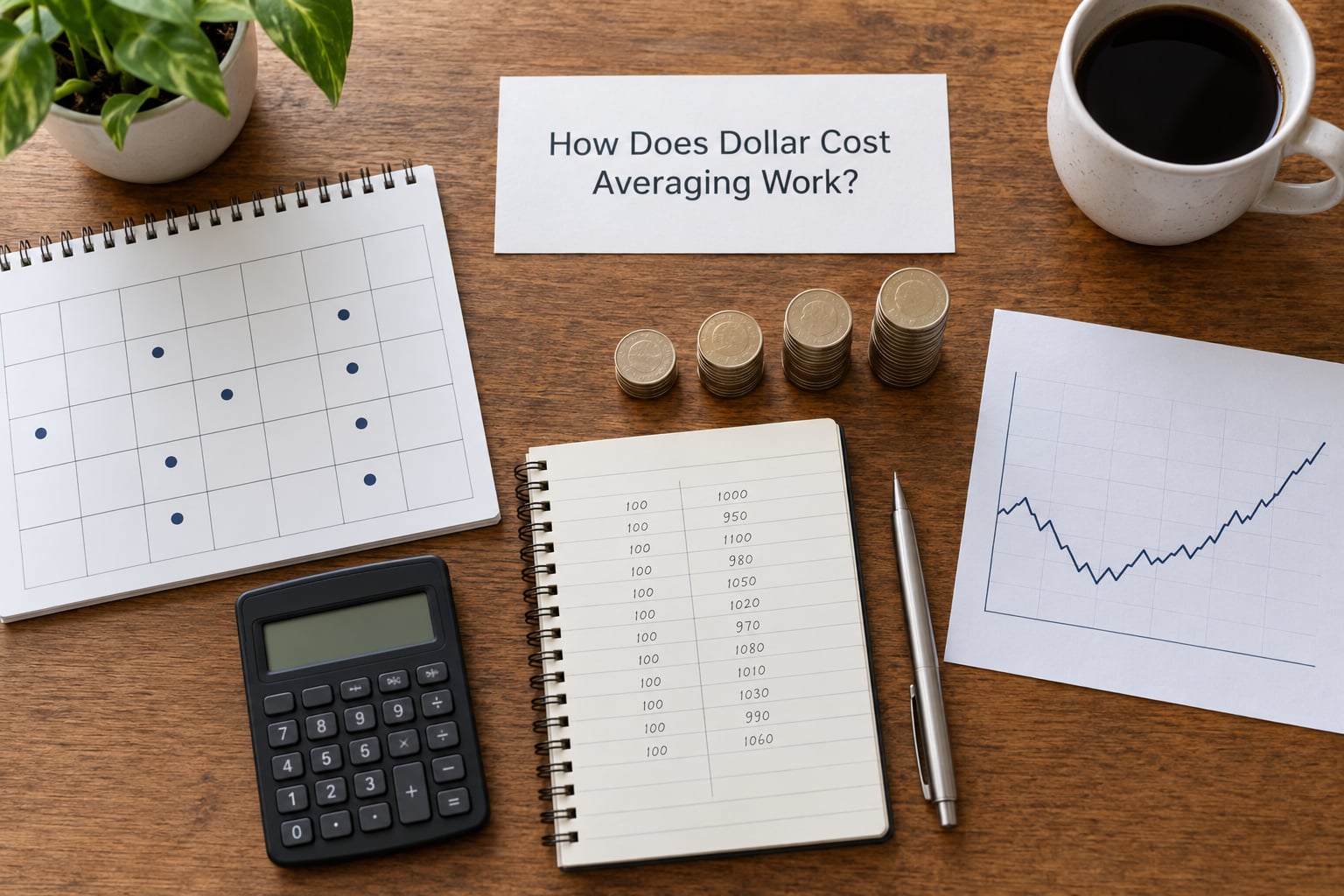
Working out dollar cost averaging mechanics comes down to four parts, and the more of them you automate, the better it works.
- A fixed amount. 500 USD every month, or 200 USD every second Friday. The number matters far less than keeping it.
- A fixed interval. Monthly is the default because payroll arrives monthly. Weekly buyers accumulate more units and pay slightly more in spread and commission.
- A fixed rule. Buy on schedule whatever the price. Some people add one guardrail: keep buying through drawdowns, pause only if a job or a tax bill makes the payment impossible.
- A variable share count. A cheap month buys more shares, an expensive month buys fewer. That is the whole trick.
Two practical details catch beginners. Most brokers now offer fractional shares, so a small monthly amount can still buy part of a share rather than forcing you to wait for enough cash for a whole one. And the order executes at the price on your scheduled day, so pick a date and stick to it.
Why Do Investors Use Dollar Cost Averaging?
The reasons are less about arithmetic than people expect, and more about behaviour.
It automates the decision. Once the transfer is scheduled, the question stops coming up. On investing forums the debate is loud, with regulars pointing to research showing lump sum usually wins and the same posters averaging anyway, purely because the schedule keeps them hands-off during a crash.
It fits income instead of windfalls. Most people receive money gradually. A salary, pension, or retirement account contribution is a recurring series, so averaging is the natural shape rather than a compromise.
It keeps you invested through the ugly parts. The main way accounts are destroyed is not bad picks, it is selling at the bottom. A fixed commitment removes the decision that usually happens at the worst possible moment.
It makes rebalancing boring. Directing new contributions toward whichever holding has lagged is a slow, mechanical way to keep a portfolio near its target weights.
What Assets Can You Dollar Cost Average?
You can average into anything priced daily, but the mechanics and the costs differ sharply by asset.
| Asset | How averaging behaves | Watch out for |
|---|---|---|
| Broad equity index funds and ETFs | The classic case. Prices move enough to make averaging visible, and fees are usually the lowest of any option. | Expense ratio and bid-ask spread, paid on every single purchase |
| Individual company shares | Works mechanically, but you are averaging a single business, not a market. | Concentration risk, which averaging does not reduce |
| Bonds and bond funds | Smoother prices mean less averaging effect; the point is income and interest-rate exposure. | Duration risk in a rising-rate period |
| Gold and silver | Meaningful price swings mean averaging visibly lowers the average ounce cost, which is why it is popular here. | Dealer premiums, storage, and no yield while you hold |
| Commodity and futures-based funds | Averaging is fine; the fund’s roll schedule is the bigger cost. | Contango and backwardation drag |
| Crypto | The highest volatility of anything on this list, so the schedule matters most and the drawdowns hurt most. | Exchange fees, custody risk, and tax complexity |
For physical metals, the friction is bigger than most screens suggest. Dealer spreads on small purchases can eat a meaningful slice of each contribution, so a modest monthly amount into a single metal is often more expensive than the same amount into a low-cost fund.
How Does Dollar Cost Averaging Differ From Lump-Sum Investing?
Lump-sum investing means deploying the entire available amount at once. Both approaches end with the same asset; they differ in timing, risk, and the returns each one tends to produce.
| Criterion | Dollar cost averaging | Lump sum |
|---|---|---|
| Timing | Spread across months | One day |
| Cash at risk | Only each installment | The whole amount immediately |
| Average price if markets rise | Worse, you buy more units at higher prices | Better, all units bought at the lowest price |
| Average price if markets fall then recover | Usually better | Usually worse |
| Emotional load | Low, the schedule is the decision | High, the decision lands once |
| Typical fit | Salary, monthly surplus, an unsettled windfall | An old account balance, a large inheritance you can leave invested for a decade |
Be clear about the evidence. Vanguard research and Financial Planning Association studies commonly cited in this space found lump sum beat a three-month averaging schedule roughly two-thirds of the time over long periods, because markets rise more often than they fall. Averaging therefore has a lower expected return in the historical record, not a higher one.
The counter-argument is equally documented: the expected gap is modest, while the cost of panic selling during a drawdown is large. Research from firms including Vanguard and Charles Schwab generally finds that time out of the market hurts more than a slightly mistimed entry.
Which is why a hybrid is common. Investors on forums often split a windfall, put part in immediately, and average the remainder over six to twelve months. It gives up some of the lump-sum edge while shrinking the amount exposed to a bad entry date. Some readers ask whether famous investors do the same; Berkshire Hathaway’s long-running habit of sitting on a large cash pile rather than deploying on any schedule is the opposite behaviour.
What Is a Reasonable Dollar Cost Averaging Plan?
A plan that survives contact with a bad year is a plan with five parts, and the order matters.
- Cash buffer first. Enough to cover a few months of expenses before any money goes into markets. Averaging a salary you cannot afford to invest is a fast way to abandon the schedule.
- Amount tied to a horizon. Money you need within a few years does not belong in anything volatile. Money you will not touch for a decade or more is where averaging earns its place.
- Frequency that matches your pay. Monthly suits nearly everyone. Weekly or biweekly buys slightly more units but adds more spreads and commissions.
- Account type matched to the goal. A workplace plan or a tax-advantaged retirement account usually comes first, with a taxable brokerage account for anything that does not fit those limits. Tax rules vary, so check the current treatment where you live.
- A small, fixed list of holdings. Averaging three or four broad funds is a plan. Averaging nine random positions every month is not, and it turns a simple habit into bookkeeping.
Then set a review date. Twice a year is plenty. Change the contribution amount or the holdings because something in your life changed, not because a quarter looked interesting.
What Are the Risks and Limitations of Dollar Cost Averaging?
It does not prevent losses. If the asset declines for years, your average cost keeps falling while its value keeps shrinking. A falling average price is not the same as a good outcome.
It usually lags lump sum. Over long historical periods, investing the whole amount at once won more often than not. Averaging gives up some expected return in exchange for the timing comfort.
It depends on contributions continuing. A schedule that stops after six months has barely made a dent. Regularity, not cleverness, is what compounds.
It does not replace diversification. Averaging into one company is still betting on one company. It handles timing risk, not selection or concentration risk.
It needs the money to last. Averaging a portfolio you plan to sell in two years mostly produces sequence-of-returns risk rather than any averaging benefit.
Fees, spreads and taxes quietly eat the advantage
Every recurring purchase carries a cost. Expense ratios are charged on assets, commissions and bid-ask spreads are charged per trade, and on physical metals a dealer premium can be several percent of the purchase. That is why most beginners start with one broad index fund rather than anything held in a safe or a vault.
Taxable accounts add one specific trap. The wash-sale rule can disallow a loss when you sell a holding within about 30 days of buying it in the same account, so a long run of purchases followed by a quick sale can create a tax bill the arithmetic never showed. Account types and thresholds change, so verify current rules with a tax professional.
Common mistakes worth naming
- Front-loading contributions in a long bull market, then calling it averaging.
- Purchasing heavily during a crash “to average down”, which is a much riskier move than a fixed schedule.
- Stopping the schedule in a downturn, which sells low and gives up exactly the purchases that make averaging useful.
- Spreading each installment across many overlapping funds instead of adding to one simple holding.
- Judging the strategy by average cost per share rather than by the value of the account on a given date.
- Changing the investment because of news instead of because the plan says to review.
Dollar Cost Averaging Example: Buying During Market Volatility
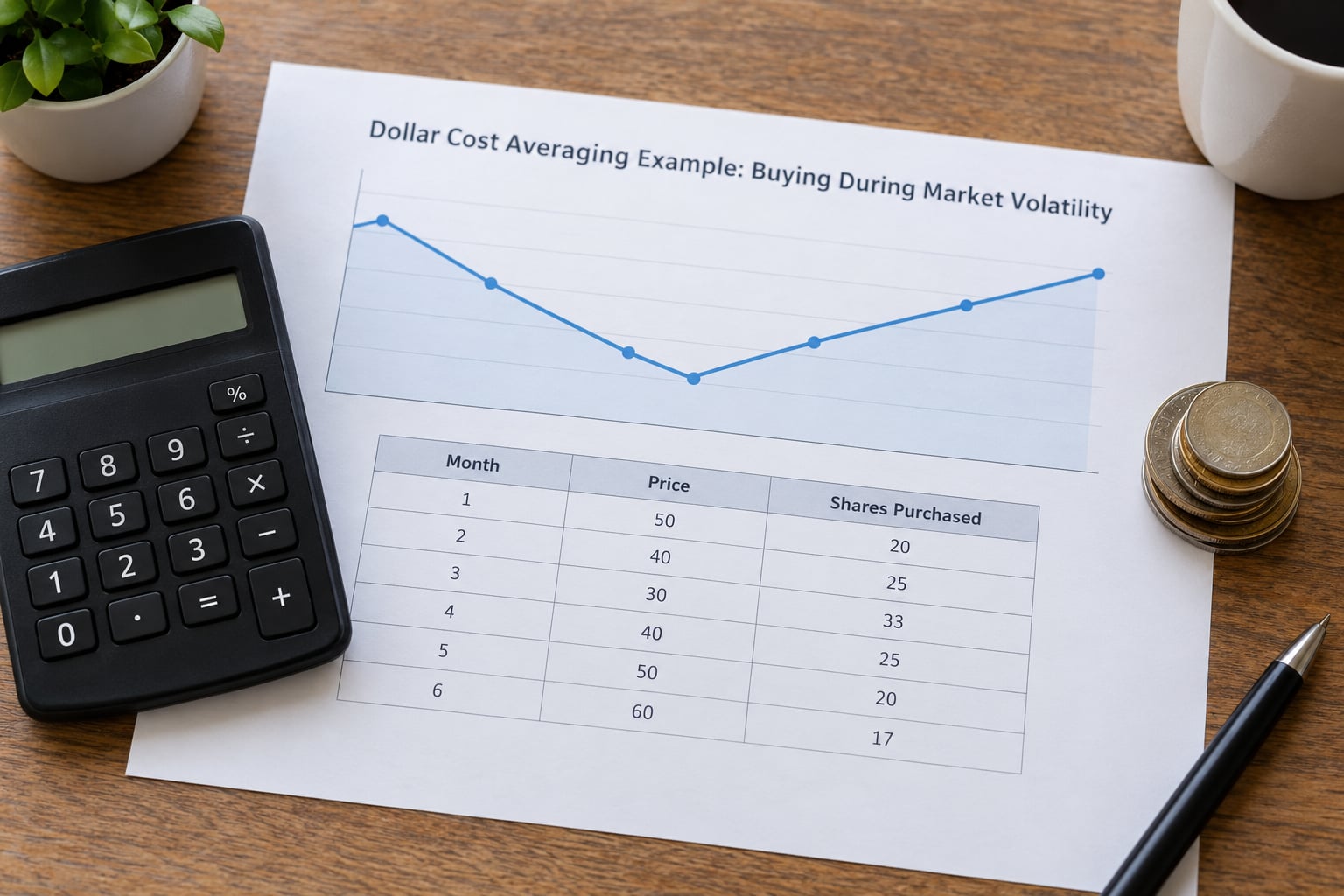
Here is a purely hypothetical six-month schedule. The investor contributes 500 USD on the same day each month into a single broad index fund. Prices fall, then recover.
| Month | Price per share (USD) | Amount (USD) | Shares bought | Running average cost |
|---|---|---|---|---|
| 1 | 50.00 | 500 | 10.000 | 50.00 |
| 2 | 40.00 | 500 | 12.500 | 44.44 |
| 3 | 30.00 | 500 | 16.667 | 38.30 |
| 4 | 35.00 | 500 | 14.286 | 37.42 |
| 5 | 45.00 | 500 | 11.111 | 38.72 |
| 6 | 50.00 | 500 | 10.000 | 40.23 |
Total paid: 3,000 USD. Total shares: 74.564. Average cost per share: 3,000 divided by 74.564, which is 40.23 USD.
At the final price of 50 USD the position is worth 3,728 USD, a gain of 728 USD on 3,000 USD contributed, or about 24 percent. The average cost of 40.23 is well below the 50 price at which the last installment was bought, which is the visible benefit of the whole exercise.
Now the lump sum. Someone with all 3,000 USD on day one bought 60 shares at 50. On the same final day that position is worth exactly 3,000 USD. Averaging won here by 728 USD.
What this example does not prove is that averaging is better. Markets that rise longer and more often than they fall are the normal case, and in those the lump sum wins, as the Vanguard research cited above found roughly two-thirds of the time. What the example shows is narrower and still useful: when prices dip and then recover, a fixed schedule buys more units cheaply and finishes ahead of someone who committed everything on the worst possible morning.
How to Set Up an Automatic Dollar Cost Averaging Strategy
Setting this up takes about half an hour and then almost no attention at all.
- Write down the goal and the date. A retirement fund for 2026 plus twenty is a plan. “Stocks” is not.
- Move your emergency savings first. It sits outside your investing account for a reason.
- Open the account that matches the goal. Employer plan, tax-advantaged retirement account, or taxable brokerage, depending on what you are eligible for.
- Pick one broad, low-cost holding. A market index fund or ETF keeps the number of decisions low.
- Set the amount and the date. An amount you can keep paying in a bad year beats a larger one you will abandon.
- Automate the transfer and the purchase. Most brokers let you schedule recurring transfers and recurring buys, including fractional shares. Set it once and check that the first purchase actually went through.
- Review twice a year. Adjust for a change in income or goal, not for market noise.
If a large sum arrives at once, do not force it through the schedule. Take the cash out of the market’s hands for the next six months rather than the next decade, and average the remainder.
Frequently Asked Questions
Is dollar cost averaging better than investing a lump sum?
Not on returns alone. Vanguard and Financial Planning Association research has found that investing a lump sum beat three months of averaging roughly two-thirds of the time, because markets rise more often than they fall. Averaging wins in the minority of cases where a dip precedes a recovery, and its real advantage is behavioural: it removes the decision to deploy a large sum and reduces the chance of selling during a drawdown.
How often should I dollar cost average my investments?
Monthly is the sensible default because most income arrives monthly. Weekly or biweekly schedules buy slightly more shares but add extra spreads and commissions on every purchase. Daily scheduling rarely helps and adds cost. The frequency matters much less than keeping the amount steady and the schedule running for years.
Does dollar cost averaging guarantee a lower average purchase price?
No. Averaging lowers the average price only relative to what you would have paid by buying at the final price in the period. If the asset declines throughout, your average cost falls while the value of the position keeps shrinking. A falling average cost per share is not evidence that the strategy is working.
Can I dollar cost average into individual shares and commodities?
Mechanically yes, since both are priced daily. Averaging a single company concentrates risk rather than spreading it, so the discipline you gain on timing is offset by selection risk. Commodities and metals fit the mechanic well because their prices swing, but physical metals carry dealer premiums and storage costs, and futures-based funds carry roll costs that have nothing to do with your schedule.
What is the difference between dollar cost averaging and averaging down?
Dollar cost averaging is scheduled in advance: you decide the amount and the date, then buy whatever the price is. Averaging down is a reaction: something you already own has fallen, so you add to it specifically to lower your cost basis. The first is a plan, the second is a response to a loss and can turn one bad position into a very large one.
Should I stop dollar cost averaging during a market downturn?
Usually no. Pausing when prices fall means missing the purchases that make the strategy work, and selling to fund the pause turns a plan into a market timing decision. The right time to pause is when your income changes or your emergency savings are at risk, not when the screen looks frightening.
The Bottom Line
Dollar cost averaging is worth understanding because it is probably already happening to you through a payroll deduction. Start with one small automatic purchase of a broad, low-cost holding on a date you can remember, keep it running for years, and revisit it twice a year.
Past performance does not guarantee future results, and rules and rates change. Nothing here is investment, tax or legal advice; check current specifics with a qualified professional before you commit money.