Gold is considered an inflation hedge because its supply barely grows, it carries no counterparty risk, and its dollar price tends to rise when the currency that prices it loses value or when the real return on bonds turns negative. That is the honest one-line answer, and it is also incomplete. Gold does not rise with every consumer price report, and plenty of investors have held it through long flat or falling stretches.
The useful version of the idea is about decades, not quarters. Below I walk through what an inflation hedge actually means, the five mechanisms that link inflation to gold, the historical record including the years it failed, and how investors express the position in practice.
Table of Contents
- What Does It Mean for Gold to Be an Inflation Hedge?
- Three different kinds of inflation, three different gold reactions
- Why Gold Is Considered an Inflation Hedge
- 1. Limited supply that cannot answer new demand
- 2. No counterparty risk and acceptance everywhere
- 3. It is priced in dollars, so currency debasement lifts it
- 4. Falling real interest rates cut the opportunity cost
- 5. Safe-haven demand and portfolio rebalancing
- The counterview: gold produces nothing
- How Gold Performs When Inflation Rises
- Where Gold Works as an Inflation Hedge—and Where It Does Not
- How Investors Use Gold Against Inflation
- The Main Takeaway for Investors
- Frequently Asked Questions
- Is gold always a good inflation hedge?
- Why is gold better than cash during high inflation?
- Is gold a better inflation hedge than bonds or TIPS?
- What type of inflation is most likely to support gold prices?
- How can investors measure gold’s inflation protection?
- Should investors buy physical gold or gold ETFs?
What Does It Mean for Gold to Be an Inflation Hedge?
An inflation hedge is an asset you hold because it is expected to keep or rise in purchasing power while the general price level climbs. The test is simple: did the asset buy more of what you normally consume at the end of the period than at the start?
That requires separating two returns that are constantly confused. A nominal return is what your money grew by in dollar terms. A real return is what it grew by after inflation, and it is the only one that touches your standard of living. Cash sitting in a savings account can show a positive nominal return and a negative real return at the same time, which is why holding money under a mattress is a hedge against nothing except a bank failure.
The third piece is the real interest rate, which is the nominal rate minus expected inflation. It is the price of holding money rather than investing it, and it is the single variable that matters most to gold. Gold produces no coupon and no dividend, so when real rates are high, holding it costs you something in foregone yield. When real rates are negative, holding it starts to look like a paid option.
Three different kinds of inflation, three different gold reactions
Most confusion about the gold and inflation link comes from treating inflation as one thing. It is at least three, and gold responds to each differently.
- Consumer price inflation is what the Bureau of Labor Statistics measures with the CPI. This is the number most people mean, and gold’s relationship to it is real but noisy and slow.
- Asset price inflation is rising prices for equities, property, or bonds themselves. When nominal bond yields climb because prices are rising, that environment has historically been one of the tougher ones for non-yielding assets.
- Monetary inflation is growth in the money supply relative to the goods and services available. This is the kind that, when it persists, tends to show up in currency debasement and in a rising gold price.
Once you separate them, the odd years make sense. A period of high CPI driven by energy and supply shortages is not the same environment as one driven by aggressive money creation, and gold does not treat them the same way.
Why Gold Is Considered an Inflation Hedge
Five mechanisms do most of the work. They operate over different timeframes, which is why the short-run relationship is messy and the long-run relationship is not.
1. Limited supply that cannot answer new demand
Everything above ground has been mined, and every year mine production adds to a stock that is roughly two centuries of accumulated output. New demand for gold as money does not have to wait for a new mine, because the existing stock above ground is available and reusable. That is unusual. Oil, wheat, and copper respond to price by producing more next year; gold cannot produce more gold, so the pressure shows up in the price of the existing metal instead.
When the money supply expands and more of that money is held as savings, the same fixed pile of gold has to serve a larger monetary role. That is the basic argument economists make about long-run gold and money growth, and it is why gold is treated as a scarce asset rather than a commodity like any other.
2. No counterparty risk and acceptance everywhere
A bank deposit, a bond, and a money market fund are all promises from someone else. Gold in your hand is not a promise, and that difference matters most in exactly the situations where inflation tends to run high, because financial stress and monetary stress tend to arrive together.
Beyond that, gold is fungible and universally accepted. A bar held in Zurich, a coin held in Istanbul, and a holding in New York all price off the same global market. No government sets its official exchange rate, and no single issuer controls the float. In a country where the currency has lost confidence, that portability is often the whole argument.
3. It is priced in dollars, so currency debasement lifts it
Gold is quoted in US dollars on global exchanges like the LBMA benchmark, so the dollar price is really the dollar’s value times gold’s value in a neutral currency. If you believe the dollar is being eroded by money creation or by policy, the arithmetic does the work for you. The dollar leg of the price is doing something to your return even when the market for gold is flat.
Look at the longest record we have. In August 1971, at Bretton Woods, the official gold price was fixed at 35 dollars an ounce while Americans were legally forbidden to own the metal. Within about a decade and a half the January 1980 peak reached 850 dollars an ounce, which is roughly 3,300 dollars in 2026 purchasing power, while a 1971 dollar had shrunk to something on the order of 12 or 13 cents of today’s money. The hedge worked, spectacularly, in one of the hardest currency debasements in modern history.
4. Falling real interest rates cut the opportunity cost
Gold pays you nothing. That is a feature when real yields are negative and a bug when they are positive. When policy rates sit well above expected inflation, you can hold Treasury bills, collect a real yield, and lose nothing in purchasing power. Gold competes against that yield, so the case for holding it weakens on arithmetic alone.
When inflation expectations climb faster than nominal rates, the sign flips. Real yields turn negative, cash starts losing value in real terms, and an asset with no yield looks far more attractive by comparison. Most of the sharpest gold advances of the past two decades followed periods of aggressive easing and falling real rates, not simply high CPI prints.
5. Safe-haven demand and portfolio rebalancing
Some inflation is anticipated, and anticipated inflation is already in nominal rates and wages. The dangerous kind is the surprise, and surprise inflation tends to arrive alongside stress in financial markets. When stocks and bonds fall together, the usual 60/40 diversification stops working, and investors sell what they can to raise cash. Gold is one of the few things that reliably gets bought in that moment.
There is a rebalancing channel too. In a portfolio that targets a fixed weight, an asset that has run up gets trimmed back to target, which mechanically creates a small buyer. That flow is not dramatic, but it is steady, and it operates regardless of what the CPI says that month.
The counterview: gold produces nothing
The standard bear argument, most associated with Warren Buffett and Charlie Munger, is that gold is unproductive. A business generates cash, a bond pays coupons, gold pays nothing. You hold it because you believe someone else will pay more later, and that is a bet on other people’s behaviour rather than on your own work. Buffett has also made the sharper version: in a world where a company borrows at low rates and buys gold with the proceeds, the shareholders of productive companies are the ones arbitraging the debasement, not the ones stockpiling bullion.
That objection is coherent, and it is why gold is generally framed as insurance rather than as a return engine. The strongest reply comes from the debasement side, and Peter Schiff makes it explicitly: if monetary policy keeps expanding faster than real growth, the asset that is not a claim on a government printing more of the currency should be the one that holds its value. Both views can be true at once, which is exactly why the sensible position is a sizing decision rather than a conviction one.
How Gold Performs When Inflation Rises
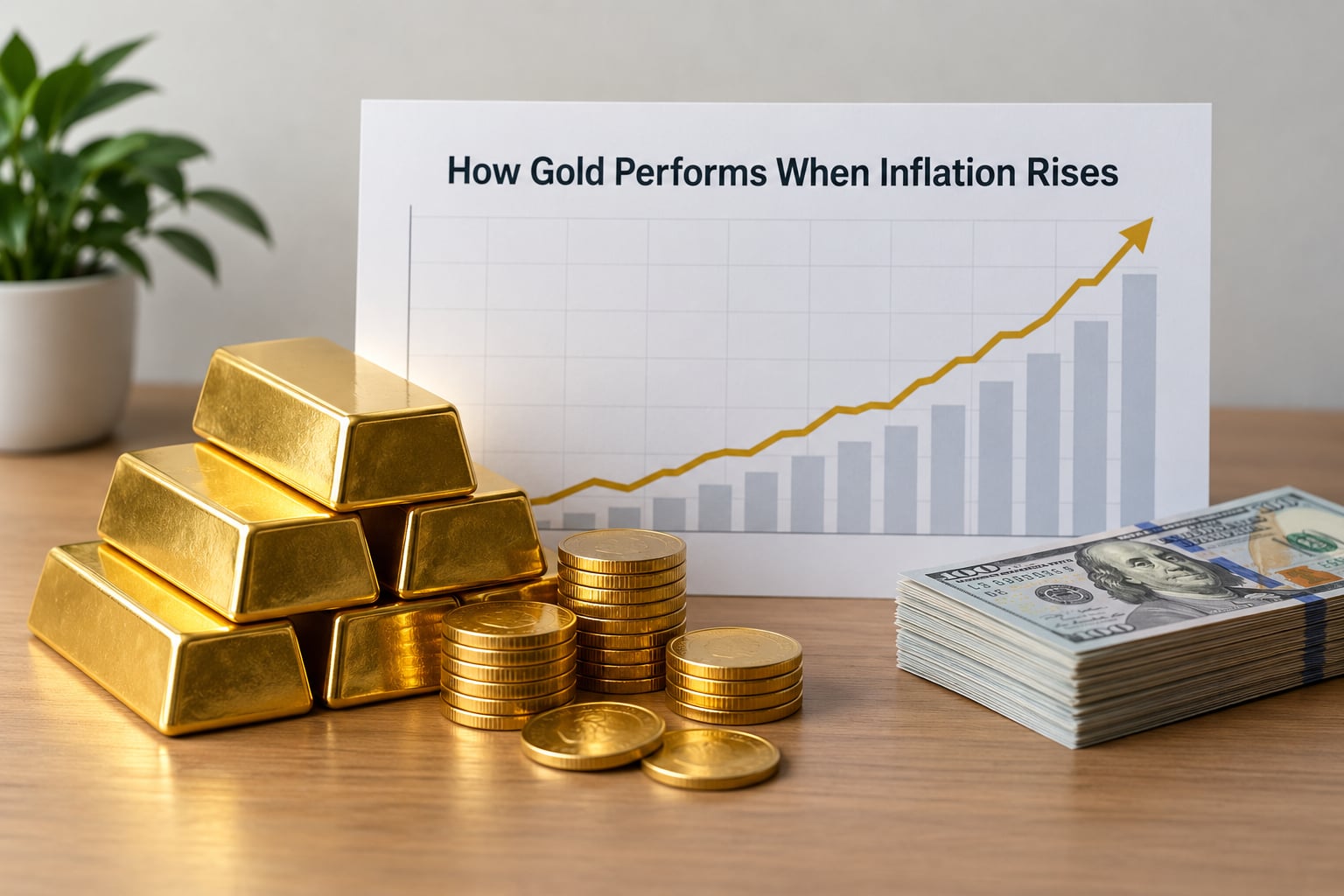
Gold’s response to inflation depends less on the inflation number than on what is causing it, how fast it is accelerating, and what real interest rates do alongside it. The table below maps the environments investors actually argue about.
| Environment | What pushes gold | What presses on gold | Likely gold response |
|---|---|---|---|
| Monetary debasement with negative real rates | Falling real yields, currency distrust, central bank buying | Little, until rates respond | Strong rise over months to years |
| Supply-driven inflation, high CPI, tight policy | Safe-haven buying during stress | Real rates stay high, cash pays a real yield | Flat, choppy, sometimes down |
| Inflation falling as policy tightens | Debasement narrative still intact | Real rates rise, opportunity cost climbs | Sustained decline |
| Disinflation with falling rates | Lower real yields, rate cut expectations | Less demand for insurance | Grind higher |
| Risk-on rally with growth intact | Little | Money moves into assets that produce income | Lags badly |
| Financial crisis or geopolitical shock | Safe-haven demand, margin calls liquidated elsewhere | Forced selling in the first days | Sharp rise after an initial dip |
The relationship is measurably positive but modest, and the way analysts measure it changes the sign. Arkadiusz Sieron’s widely cited work on the relationship between gold and US inflation put the correlation of the gold price level with the CPI level at about minus 0.41, while the correlation between their year-on-year changes was about plus 0.44. Read plainly: gold’s price level and the price level have drifted apart over long stretches, but in the years when gold rose fastest, inflation was usually also rising or accelerating.
That is the honest core of the whole argument. Gold is not a thermometer you can check monthly. It is a long-duration claim on the value of money, and the reading on a single print tells you very little.
Recent years show how quickly the environment can change. Gold ran to records well above 5,500 dollars an ounce in early 2026 on central bank buying, geopolitical stress, and rate-cut expectations, then pulled back hard through the year as policy rates stayed high and real yields turned positive again. A pullback in a non-yielding asset is not proof that the long-run case is broken. It is a reminder that rates matter as much as CPI.
Where Gold Works as an Inflation Hedge—and Where It Does Not
Gold earns its place in a portfolio under a specific set of conditions, and it goes quiet under a different set. Knowing which one you are in is more useful than any historical average.
It works best when the currency is being eroded. Turkey is the cleanest modern case study. Over the decade from the early 2010s into the mid-2020s, the lira lost a large multiple of its value against the euro while lira-denominated gold savings held up remarkably well, and Turkish households turned physical gold into a store of wealth that banks and local assets could not match. Weimar Germany is the older version of the same story, and Zimbabwe in the 2000s is the extreme case, where money was effectively unusable and gold functioned as the unit that had not broken.
It also works when real yields are negative, when a financial system is under stress, and when households have started doubting the currency they are paid in. In each of those, the buyer is not making a forecast about inflation. They are buying an asset that cannot be devalued by a printing press.
It does not work so well when real rates are climbing, when growth is strong enough that the central bank can raise rates without choking the economy, and when investors are busy chasing assets that produce income. The 1980s are the canonical failure. Inflation stayed high for most of the early part of that decade, and gold still fell roughly 38 percent over the ten years as the Federal Reserve drove inflation down with punishing rates. High inflation plus rising real rates is the worst of both worlds for a non-yielding asset.
More recent history repeats the pattern. In 2022 US inflation above 9 percent, gold finished the year roughly flat, because the rate hikes needed to fight that inflation raised the opportunity cost of holding it. The hedge did not fail. The conditions that make it work were absent.
Psychology matters too. The volatility is the real cost that holders pay, and it is why some savers describe physical gold as a form of psychological protection rather than a strategy. Anyone who cannot sit through a multi-year flat stretch is likely to sell at the wrong moment, and that is a better reason to keep the allocation small than to avoid it entirely.
How Investors Use Gold Against Inflation
Nobody needs gold to be their largest position. The standard reference point is the World Gold Council’s range of roughly 2 to 10 percent of a diversified portfolio, with total precious metals, silver included, generally kept at or below about 15 percent. That is a guideline from a body with an obvious interest in the answer, so treat it as a starting range to think about rather than a rule.
Sizing comes down to three questions. How long is your horizon, since the hedge is weakest over one to three years and works on a decade-plus view. How exposed are you to currency debasement, which is the condition where the protection is strongest. And how much volatility are you willing to tolerate, because a position that makes you sell is not protection at all.
Staging purchases over time rather than committing in one go is the most common piece of practical advice, and it suits an asset with no yield and no cash flow. Rebalancing on a schedule keeps the position from growing into something outsized after a strong run.
The vehicle you choose changes the cost, the liquidity, and the tax treatment. Nothing here is a recommendation; it is a description of what each route costs you.
| Vehicle | Main costs | Liquidity and handling | Trade-off |
|---|---|---|---|
| Physical bullion | Dealer spreads, storage, insurance, assay fees | Instant, but you pay the spread on both sides | No issuer risk, fully private, but the most expensive per ounce |
| Gold ETF or trust | Management fee, bid-ask spread, brokerage | Instant, priced near the fix | Cheap and easy, but you hold a claim on a custodian and pay no yield |
| Futures and options | Margin, financing, roll cost | Instant, but requires active management | Leverage magnifies both directions; roll cost can eat a long hold |
| Gold IRA or rollovers | Custodian fees, storage, IRS rules on what qualifies | Take time to sell | Tax deferral in a traditional structure, with contribution and withdrawal limits |
| Mining shares | Equity risk, cost inflation, management | Instant | Adds operating leverage to the gold price, so it can fall harder when gold does |
Account and tax details vary by country and by account type, and they change. What you hold in a taxable brokerage account, a retirement account, or a foreign structure can be taxed very differently, so anyone sizing a position large enough to matter should check the treatment with a licensed adviser rather than a general article, including this one.
The Main Takeaway for Investors
Gold is a long-horizon store of value with a genuinely strong record during currency debasement and a genuinely weak record in a few specific decades, most notably the 1980s and 2022. It protects purchasing power over spans of decades, not quarters, and it does nothing in particular during the years when cash pays a positive real yield.
What to do first: decide what the position is for before deciding how big it is. If the goal is long-run protection against currency erosion and portfolio insurance against a bad regime, a modest allocation bought gradually and rebalanced on a schedule fits the evidence. If the goal is to beat inflation in any given year, nothing on this page promises that, and gold is the wrong instrument.
This is general educational information, not financial advice. Prices, tax rules, and account treatment vary by country and change over time, and a licensed adviser who knows your full picture is the right person to size a position with you.
Frequently Asked Questions
Is gold always a good inflation hedge?
No. Gold is a reliable long-horizon store of value and a good hedge during currency debasement, but it has multi-year stretches where it fell while inflation was high, most famously a 38 percent decline across the 1980s and a roughly flat 2022. The honest framing is decades, not years. Anyone expecting the gold price to match each monthly CPI print is using the wrong mental model.
Why is gold better than cash during high inflation?
Cash keeps a fixed nominal value while the cost of living rises, so its purchasing power shrinks in proportion to the inflation rate. Gold has no fixed nominal value: its price is set by a global market and has historically risen over long periods, including during the 1970s, when the official price was fixed at 35 dollars an ounce and then reached 850 dollars by January 1980. The trade-off is volatility and no yield.
Is gold a better inflation hedge than bonds or TIPS?
They work differently. TIPS pay a real yield set at issue, so they hedge known inflation but lose if inflation undershoots and they carry duration risk. Bonds and cash pay nominal income that inflation can consume. Gold pays nothing at all, but it carries no issuer risk and tends to rise in the crises where bonds get sold. Most balanced portfolios use a blend rather than picking one.
What type of inflation is most likely to support gold prices?
Monetary inflation, meaning money supply growth running ahead of real economic output, has historically been the most supportive for gold because it erodes the currency gold is priced in. Consumer price inflation driven by energy or supply shortages is a weaker signal. Asset price inflation, where rising bond yields come from inflation, has often been one of the tougher environments for a non-yielding metal.
How can investors measure gold’s inflation protection?
The most common method is the gold price divided by the CPI index, tracked over a rolling period such as five, ten, or twenty years. The correlation between the gold price level and the CPI level has been about minus 0.41 in the widely cited analysis, while the correlation between year-on-year changes has been about plus 0.44. Use a long window, because short windows mislead.
Should investors buy physical gold or gold ETFs?
Physical bullion avoids counterparty risk and stays private, but dealer spreads, storage, and insurance can add 5 to 15 percent over time. ETFs are cheaper and more liquid, with management fees under 1 percent and no spread on exit beyond the bid-ask, but you hold a claim on a custodian. The right choice depends on why you are holding it and how much friction you will tolerate.