
A spin-off is a corporate action in which a parent company moves a subsidiary or division into a new entity and distributes that entity’s shares to existing shareholders, usually one for every several parent shares. To value one, you rebuild the separated business on its own: standalone cash flows, its share of debt, stranded overhead and taxes, then compare your number with what the market is paying. That second half is where most guides stop, and it is where the real work is.
What follows is the framework I use: read the separation document first, build the standalone economics second, and only then reach for a multiple or a discount rate. It applies to a mining division separated from a diversified parent just as well as it applies to a payments business split from an auction platform.
Table of Contents
- What Is a Spin-Off?
- Why Companies Create Spin-Offs
- Spin-Off vs. Carve-Out vs. IPO
- What Information to Collect Before Valuing a Spin-Off
- How to Value a Spin-Off Using Sum-of-the-Parts
- How to Value a Spin-Off with Discounted Cash Flow
- Debt, Cash, Taxes, and Separation Costs
- Worked Example: Valuing a Mining and Metals Spin-Off
- Common Valuation Mistakes and Market Traps
- A Practical Spin-Off Valuation Checklist
- Frequently Asked Questions
- Is a spin-off the same as a dividend?
- How do investors receive shares in a spin-off?
- Can the parent company still control a spun-off business?
- What is the difference between a spin-off value and a sale price?
- Should a spin-off be valued using the parent company’s PE ratio?
- How long does it take for a spin-off to create shareholder value?
- Conclusion: Start With Standalone Economics
What Is a Spin-Off?
A spin-off happens when a parent company transfers a business into a new legal entity, usually called SpinCo, and distributes SpinCo shares to the parent’s shareholders in proportion to their existing holdings. No cash changes hands, and the parent usually keeps no meaningful stake. You wake up one morning owning two securities where you previously owned one.
The mechanics are simpler than they sound. Suppose you held 500 parent shares and the distribution ratio is one SpinCo share for every five parent shares. You receive 100 SpinCo shares. The parent issues a registration statement describing the business, its financials and its risks, and the shares begin trading on a regular way basis on the distribution date.
It is not a sale. In a sale, the parent receives cash and the buyer gets the business. It is not a dividend, because nothing is sold to generate cash to pay you. It is not an IPO either, since existing shareholders receive the shares rather than buying them in a public offering. And it is not a carve-out, where a business is sold or listed separately while the parent keeps it inside the group.
Why Companies Create Spin-Offs
The most common reason is a conglomerate discount. When unrelated businesses sit under one parent, analysts often value the whole thing on the group’s blended multiple rather than the sum of what each part is worth. Separating them forces separate price discovery.
Other motives come up repeatedly. A management team focused on one business allocates capital more honestly than a shared investment committee can. Reporting gets simpler, because a single-segment company files cleaner numbers than a group with five different cycles. Separated businesses can also attract a different investor base, list overseas, or raise their own debt rather than competing for it inside the parent.
None of this is free. Standalone entities need their own finance, legal, HR and IT functions, and those costs rarely match the share the parent used to absorb. Disruption hits customers and staff in the first few quarters. So a spin-off is a bet that cleaner focus outweighs duplicated overhead, not a free lunch.
Spin-Off vs. Carve-Out vs. IPO
These three get mixed up constantly because all three end with a business trading on its own. The difference is who ends up owning it and how the shares reach investors.
| Feature | Spin-off | Carve-out | IPO |
|---|---|---|---|
| Who ends up owning the business | Existing parent shareholders, pro rata | A buyer, or the public if separately listed | New public shareholders who subscribe |
| How shares reach investors | Distributed to current holders on the record date | Sold to a trade buyer, or floated via an offering | Purchased in a public offering |
| Parent’s retained stake | Usually none | Often none, sometimes a minority stake | Usually reduced or gone after the offering |
| Inherited operations | Full business with its own history and inherited liabilities | Often a subset of a larger operation, with shared services contracted back to the seller | Usually a grown or reorganised standalone business |
| What the investor receives | Shares distributed at no cost plus a full registration statement | Cash from a sale, or shares in a separate listing | Shares bought with cash |
| Cash raised for the business | None at distribution | Usually substantial | Substantial |
The practical takeaway for valuation: a spin-off gives you a business with a complete operating history and a full set of inherited obligations. A carve-out may give you a business that never ran on its own and still buys services from its former parent.
What Information to Collect Before Valuing a Spin-Off
Valuing a spin-off before you have read the separation document is guesswork. The document, usually a Form 10 registration statement or an information statement, tells you who got which assets, which obligations stayed behind, and what the separated business will pay for services it used to receive for free.
Work through these items in order:
- The separation document. The business description, the risk factors, and any statement about indebtedness or guarantees that remain with the parent.
- Pro forma financial statements. Audited carve-out statements prepared as if the separation had already happened, usually covering two or three years.
- Segment history. Revenue, operating income and capital spending for the business while it sat inside the parent, so you can judge the trend rather than a single good year.
- Debt allocation. Which borrowings travel with the business, which stay behind, and whether any facility contains change-of-control clauses triggered by the separation.
- Stranded costs. Overhead the parent keeps after the business leaves. That cost is real and it reduces the value released by the separation.
- Tax consequences. Whether the distribution is tax-free under Section 355 of the Internal Revenue Code, and what conditions the company had to satisfy to qualify.
- Share count and distribution ratio. Exactly how many shares each holder receives, stated as one new share for a stated number of parent shares.
- Management guidance. Any outlook the leadership team gives, treated as a starting point for your own scenarios rather than as an input.
How to Value a Spin-Off Using Sum-of-the-Parts
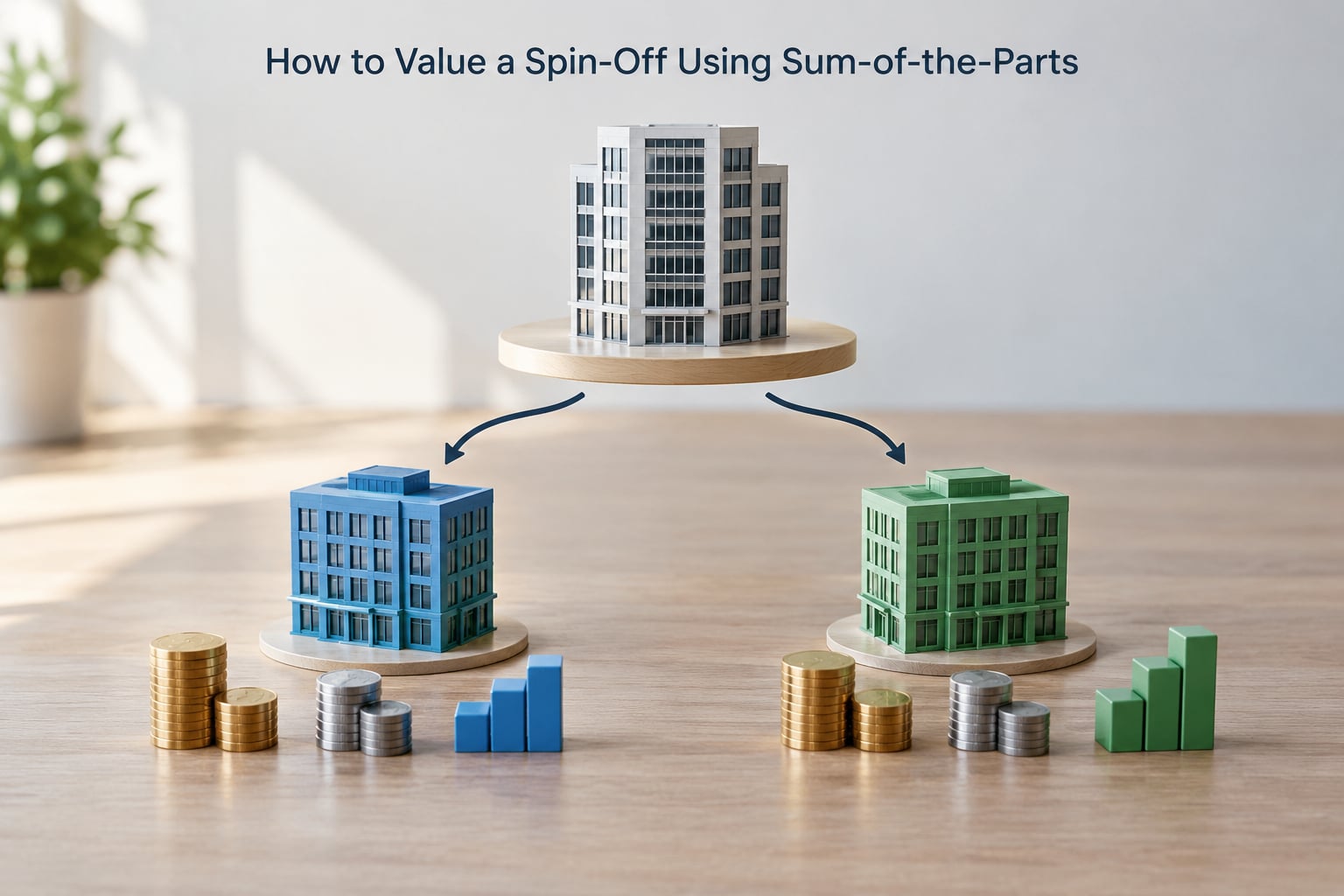
Sum-of-the-parts is the natural method here, because the whole point of the separation is that the parts deserve different treatment. You forecast each business separately, price each one, add the results, then subtract everything that belongs to shareholders only after the addition.
The process has four steps:
- Forecast each segment standalone. Revenue, operating margin, capital spending and working capital needs for the business you are valuing, on its own assumptions rather than the parent’s blended ones.
- Price each forecast. For mature, predictable cash flows, use an earnings or cash flow multiple drawn from comparable pure-play companies. For volatile commodity output, model the cash flow across the cycle rather than applying a multiple to one good year.
- Add the parts. Sum the enterprise values of every business the parent owns, including the one being separated.
- Subtract the claims. Deduct net debt, pension and lease obligations, separation costs, taxes triggered by the structure, and any minority interests. What remains is equity value, which you divide by shares outstanding.
The subtraction step is where most estimates go wrong. Everyone agrees on the enterprise values and then quietly uses a net debt figure from a press release that was written before the final debt allocation settled.
How to Value a Spin-Off with Discounted Cash Flow
A discounted cash flow model answers a narrower question: what are the future cash flows of the separated business worth on their own? It suits businesses where the forecast period matters more than the current multiple, and it forces you to state your assumptions where a screen shows you.
Build it in this order. Start with standalone free cash flow, meaning operating cash flow after capital spending and after the tax the separated entity will actually pay, not the tax it paid inside the parent. Choose a discount rate that reflects the risk of that specific business rather than the parent’s blended cost of capital, since the parent’s diversified cash flows no longer protect it.
Then set a terminal assumption. For a business with a long reserve life or a contracted revenue stream, a conservative perpetuity works. For a depleting asset, use an explicit forecast that ends when the asset does, because a perpetuity would flatter it badly.
Test the result against at least three scenarios: a downside case with weaker prices or output, a base case, and an upside case. If your equity value only works under the upside case, you have not found a value, you have found a hope.
Finally, compare your equity value per share with the price at which the shares actually trade once distribution is complete. The gap tells you whether the market is applying a conglomerate discount, a scarcity discount, or simply a liquidity discount because coverage is thin.
Debt, Cash, Taxes, and Separation Costs
These four categories cause more valuation errors than the modelling does. Each one is buried in a footnote rather than a headline, and each one moves the answer more than a percentage point of multiple does.
- Allocated debt. A facility written for the whole group may be split by formula, by agreement or by what the lender will tolerate. Check for change-of-control provisions that could repay a loan on the distribution date.
- Excess cash. Cash left at the parent belongs to the parent’s shareholders, not the separated business. Cash swept across can belong to the separated business but only under agreed conditions.
- Stranded costs. Overhead the parent absorbs after the business departs is a permanent reduction in parent value and belongs in your sum-of-the-parts.
- Transition spending. Duplicated systems, consultants and severance run for several quarters and hit the new entity’s cash flow before the savings appear.
- Tax leakage. A distribution that fails the conditions of Section 355 can become taxable to shareholders as a dividend, which changes the after-tax comparison entirely.
- Working capital. A business that grew inside a group may have been financed by group-level payables. On a standalone basis it needs its own funding.
- Guarantees and pensions. Parent guarantees of the new entity’s debt, and any unfunded pension obligations allocated to it, are equity claims in disguise.
Worked Example: Valuing a Mining and Metals Spin-Off
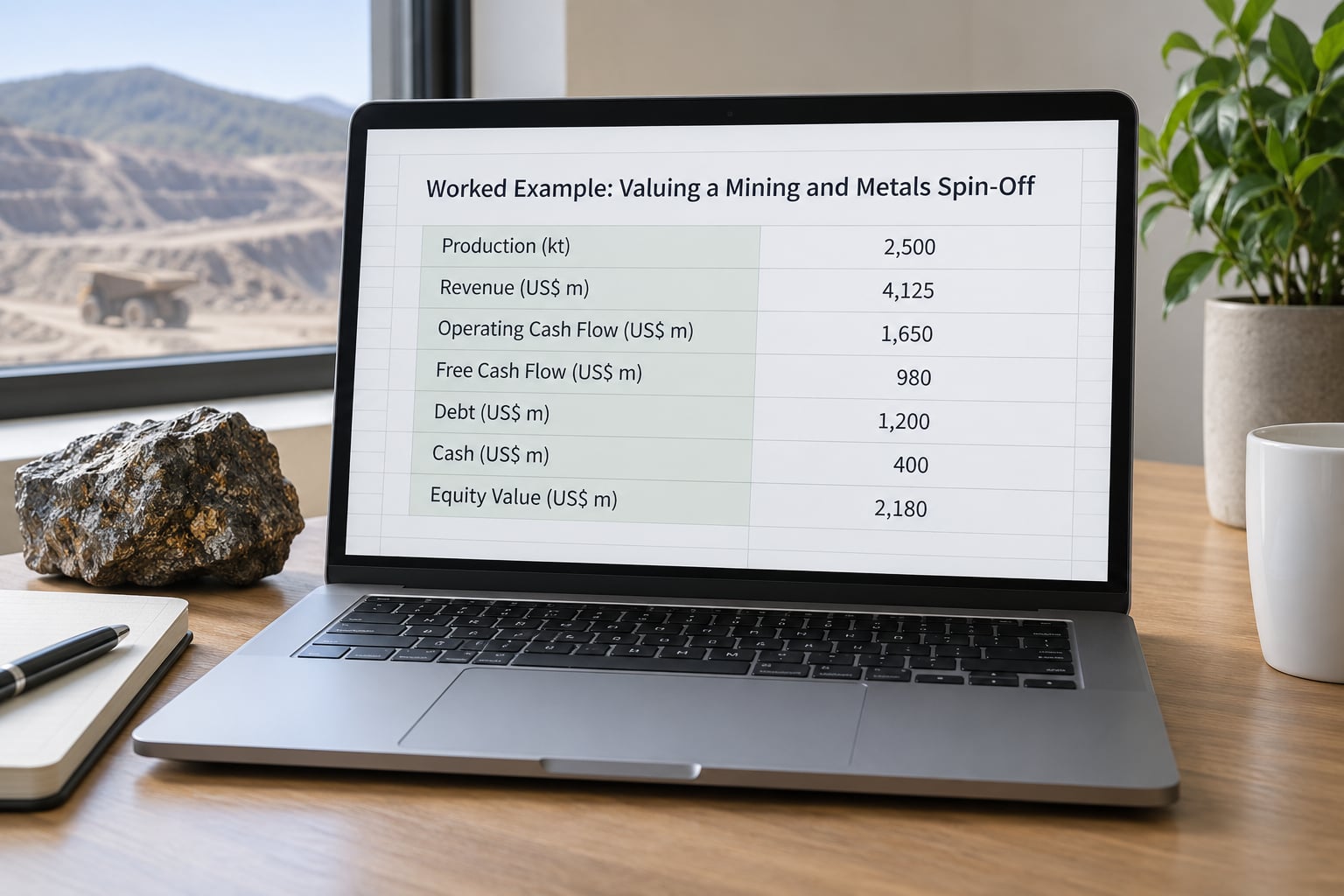
Here is an illustrative example with invented numbers, so you can see the order of operations. A diversified parent separates its copper division into a new listed company. The copper division produces 120 million pounds a year at a realised price of 3.20 dollars per pound, on revenue of roughly 384 million dollars.
Standalone operating costs leave a margin of about 18 percent, so operating income sits near 69 million dollars. Maintenance and expansion capital spending runs at 95 million dollars a year, well above depreciation, which is normal for a growing mine and the single most important fact in the valuation.
Cash taxes at a 25 percent effective rate and working capital needs bring free cash flow to roughly negative 20 million dollars in the first forecast year, turning modestly positive as output ramps. A discounted cash flow on that profile, with an eight percent discount rate and no perpetuity beyond the modelled mine life, produces an enterprise value in the region of 450 million to 600 million dollars.
Now the claims. The division carries 180 million dollars of allocated debt and holds 25 million dollars of cash, so net debt is 155 million. Stranded corporate costs of roughly 12 million dollars a year are capitalised at the discount rate, about 150 million dollars of present value. Add a 40 million dollar provision for transition spending and the equity value lands somewhere between 105 million and 255 million dollars.
With 60 million shares outstanding, that is roughly 1.75 to 4.25 dollars per share. The wide range is the honest answer, and it is a useful reminder: in a capital-intensive business, assumptions about capital spending and commodity prices move the valuation more than any reasonable change in discount rate.
Common Valuation Mistakes and Market Traps
Double counting value. If you value the separated business separately and then add the parent’s market capitalisation, you have counted it twice. Work out which side of the balance sheet you are measuring before you add anything.
Carrying the parent’s multiple across unchanged. A conglomerate’s blended earnings multiple reflects diversification that the new company no longer has. Applying it to the separated business either inflates or deflates the answer depending on direction.
Ignoring stranded costs. If the parent keeps the overhead, the value released is smaller than the sum of the parts suggests.
Valuing cyclical earnings at the peak. Mining, shipping and refining businesses earn outsized margins in the good part of the cycle. Capitalising peak earnings produces a number that cannot repeat.
Treating guidance as data. A forward outlook from management is an input to a scenario, not a forecast to model around. Build your own and use theirs as a check.
Reading value into the distribution ratio. One new share for every five parent shares is a mechanical allocation, not a valuation. It carries no signal about whether the separated business is cheap.
On the trading side, index funds that held the parent must sell the new entity to keep their tracking, and that forced selling often lands on distribution day. Whether that pressure creates a buying opportunity is a separate question, and one that depends on how much of the new entity’s register is passive.
A Practical Spin-Off Valuation Checklist
Use this sequence for a current or historical separation. It takes a few hours and produces something you can defend.
- Read the information statement or Form 10 end to end, including the risk factors.
- Pull three years of pro forma statements and note any restatement.
- Reconstruct standalone free cash flow for at least two years, adjusting for group-level items that will not continue.
- Identify every obligation that travels with the business: debt, leases, pensions, guarantees, tax exposures.
- Estimate stranded costs at the parent and capitalise them.
- Price the business two ways, once on comparables and once on discounted cash flow.
- Run a downside, base and upside case and record the assumption behind each one.
- Compare your equity value per share with the traded price and note where the gap comes from.
- Write down what would change your mind, such as a price move, a guidance revision or a change in the debt allocation.
Frequently Asked Questions
Is a spin-off the same as a dividend?
No. A dividend is a cash payment funded from earnings or cash on hand, so the company’s cash balance falls when it pays. A spin-off transfers a business into a separate company and distributes that company’s shares, so no cash moves and the parent keeps its assets. You hold two securities afterwards instead of one plus a payment.
How do investors receive shares in a spin-off?
Pro rata, based on the distribution ratio the board approves. Hold 500 parent shares and the ratio is one new share per five parent shares, you receive 100 shares on the distribution date. The ratio and the record date appear in the separation document and in notices from your broker.
Can the parent company still control a spun-off business?
Usually not, because a spin-off is designed to leave the parent with no controlling stake and to give shareholders two independent companies. Control is the usual condition for tax-free treatment under Section 355. A parent may keep a small non-controlling holding for a period, but it does not direct the board.
What is the difference between a spin-off value and a sale price?
A sale price reflects what a buyer would pay today, which usually includes control and the buyer’s synergies. A spin-off value is what the business is worth on standalone cash flows, with no control premium and no synergy contribution. When you value a spin-off you are valuing a minority stake in a company run for its own shareholders.
Should a spin-off be valued using the parent company’s PE ratio?
Not directly, because the parent’s blended multiple reflects diversification that no longer exists after the separation. Use the parent’s multiple only as a starting reference, then value the separated business against pure-play comparables with similar end markets, capital intensity and cyclicality, and cross-check with a discounted cash flow.
How long does it take for a spin-off to create shareholder value?
There is no fixed timetable. The separation announcement often produces an immediate re-rating, and forced index selling tends to weigh on the new entity in the first weeks after distribution. Whether that value holds depends on how quickly the standalone cost base is absorbed and whether the business earns its cost of capital without group support.
Conclusion: Start With Standalone Economics
Do one thing first: reconstruct the separated company’s standalone cash flows and obligations before you compare any method with the market price. Everything after that, the multiples, the discount rate, the terminal value, is adjustment.
This is general information about how separations and valuation work. Rules, tax treatment and market practice vary by country and change over time, so nothing here is individualized investment advice, and no method guarantees a particular result.