
A reverse stock split is a corporate action where a company consolidates several existing shares into one, cutting the number of shares outstanding and multiplying the per-share price by the same ratio. Your total value, your ownership percentage and the company’s market capitalization stay exactly where they were.
That is the whole mechanic in one sentence. Everything else people argue about is a question of intent: why the company did it, and what it says about the business underneath.
I have walked through enough of these with readers to know the shock is always the same. Somebody opens their brokerage app, sees their share count drop by a factor of ten and their price per share jump by a factor of ten, and assumes something dramatic happened overnight. Nothing did. The screen just got rearranged.
This guide covers what happens in a reverse stock split mechanically, what it does to your tax position, what happens to your options, and how to tell a routine corporate housekeeping action from a genuine warning sign. Last reviewed October 2026.
Table of Contents
- What Happens in a Reverse Stock Split?
- How a Reverse Stock Split Works Step by Step
- What Happens to Your Shares, Price, and Ownership?
- What Happens in a Reverse Stock Split, Mechanically?
- Why Companies Announce Reverse Stock Splits
- Why a Reverse Split Can Be a Warning Sign
- How to Check Whether a Reverse Split Is Creating Value
- What to Watch After the Effective Date
- Frequently Asked Questions
- Do I lose my shares in a reverse stock split?
- Is a reverse stock split taxable?
- Do stocks usually go up after a reverse split?
- Who benefits from a reverse stock split?
- What happens to my options when a stock does a reverse split?
- Should I sell before a reverse stock split?
- What to Do First When You See a Reverse Split
What Happens in a Reverse Stock Split?
In a reverse stock split, the company combines a set number of old shares into a smaller number of new shares. A 1-for-10 split turns every 10 shares you own into 1 share, and the price per share is multiplied by 10 to compensate.
It is the mirror image of a forward split. In a 2-for-1 forward split, 1 share becomes 2 and the price is halved. Both actions are presentation changes: the pie stays the same size, only the slices are cut differently.
Three things happen immediately when a reverse split takes effect:
- Fewer shares outstanding. The company’s share count is divided by the ratio.
- Higher nominal price per share. The price is multiplied by the same ratio, purely by arithmetic.
- No change to total value. Market capitalization, your position value, your ownership percentage and earnings per share all stay put.
That last line is the one worth repeating, because it is the point that gets lost in the headlines. A stock that jumps from 50 cents to 5 dollars has not become a different company. It has the same value, expressed with one-tenth as many shares.
How a Reverse Stock Split Works Step by Step
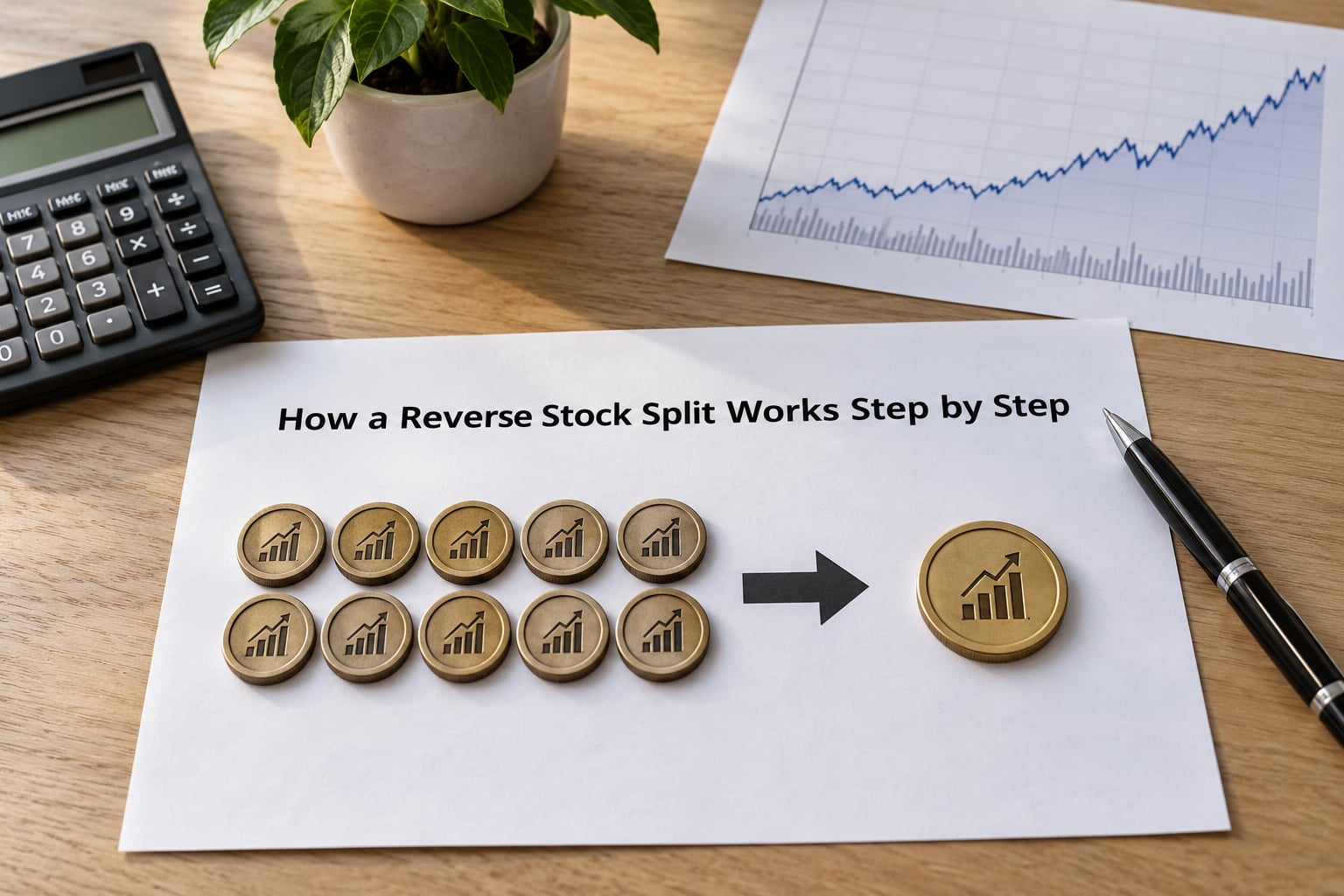
Step one is the announcement. The board of directors approves a ratio and a date, then files the details publicly. Companies disclose the plan through a press release and a Form 8-K, and the ratio is written in a way that confuses people the first time they see it.
Read it backwards. In a 1-for-10 reverse split, you receive 1 new share for every 10 old shares you hold. The share count divides by 10 and the price multiplies by 10. A 1-for-20 works the same way, only more aggressively.
Step two is the record date, which sets who is counted in the share count being consolidated. Step three is the effective date, when the company’s transfer agent actually rewrites the share register and the exchange resets the quoted price.
Step four is the adjustment itself, and it is worth understanding who does what. The company reduces shares outstanding. The exchange does not decide the new price; the opening price on the effective date is set by buyers and sellers reacting to the new supply. The theoretical price is the old price multiplied by the ratio, and in practice the first print often lands close to it.
Step five is the brokerage conversion. Your broker’s system receives the corporate action notice, divides your position by the ratio, and credits you the new share count. You do not click anything. The one exception is fractional shares, which are covered below.
Here is the arithmetic in plain numbers. Hold 1,000 shares of a company trading at 50 cents, total position value 500 dollars.
After a 1-for-10 reverse split you hold 100 shares. The theoretical price is 5 dollars each. 100 shares at 5 dollars is still 500 dollars. The company has 90 percent fewer shares in existence and the price reads 10 times higher, and not one dollar of value was created.
What Happens to Your Shares, Price, and Ownership?
Your position gets smaller in share count and larger in price per share, and it is worth the same. Ownership percentage is unaffected because your slice of the pie and the size of the pie both shrank by the same factor.
| Measure | Before 1-for-10 split | After 1-for-10 split | Changed? |
|---|---|---|---|
| Shares held | 1,000 | 100 | Yes, down 10x |
| Share price | 50 cents | 5 dollars | Yes, up 10x |
| Position value | 500 dollars | 500 dollars | No |
| Company market cap | 20 million dollars | 20 million dollars | No |
| Shares outstanding | 40 million | 4 million | Yes |
| EPS | 4 cents | 40 cents | Yes, scaled with price |
| Your ownership | 0.0025 percent | 0.0025 percent | No |
| Cost basis per share | 62 cents | 6.20 dollars | Yes, scaled |
| Total cost basis | 620 dollars | 620 dollars | No |
EPS moves only in appearance. If a company earns 1.6 million dollars on 400 million shares, that is 4 cents per share. After the split it earns the same 1.6 million dollars on 4 million shares, or 40 cents per share. Any multiple you compute from price and earnings lands in exactly the same place.
What Happens in a Reverse Stock Split, Mechanically?
On the effective date, most brokers pause trading in the symbol while the position is adjusted. Quotes can look stale or briefly show an odd price, and that is normal processing noise rather than a trade. When trading resumes, the order book has been rebuilt around the new share count.
One detail catches people out: a 1-for-10 split turns 1,000 shares into 100, but 150 shares becomes 15. Any leftover that cannot be expressed as a whole share is handled as a fractional share, and most brokers either keep the fractional position or pay cash in lieu of it. Cash in lieu is where tax trouble can start, and it is covered in the tax section below.
Pending orders are the other thing to check. A stop order written when the stock traded at 50 cents may be cancelled or rewritten by the broker at a materially different price, and a stop-loss percentage no longer means the same thing on a share costing 10 times as much. Review anything resting in the order book before the effective date rather than after.
Ticker symbols often change too, usually with a new suffix, and the CUSIP changes with the ratio. If a position seems to vanish from your watchlist after a split, this is usually why. Search the CUSIP or the company’s investor relations page, not the old ticker.
Why Companies Announce Reverse Stock Splits
The most common reason is listing compliance. Nasdaq and NYSE both require a minimum closing bid price, and the Nasdaq rule is 1 dollar for 30 consecutive business days. A company trading below that faces a deficiency notice, a 180-day cure period, and a hearing if it cannot resolve the problem. A reverse split is the quickest mechanical way to get back above the threshold.
Historically the minimum has also been cited as a reason, since the threshold used to sit at higher levels. The current requirement is lower, but the psychology of a sub-1-dollar stock still deters some institutional mandates, and a lot of firms will not open a position in a security quoted below 5 dollars.
Other stated reasons are less dramatic. Reducing administrative costs makes sense when the transfer agent fees are charged per share and the company has hundreds of millions of them outstanding. Consolidating ahead of a spin-off can leave each piece trading at a price analysts can model. Some companies use a reverse split to unwind dilution from years of convertible debt, warrants and stock-based compensation.
Exchange-traded funds do it too, and for a similar reason. The Global X SuperDividend ETF did a 1-for-3 reverse split, and the SPDR S&P Oil & Gas Exploration & Production ETF did a 1-for-4. A fund trading under a low nominal price can lose listings and see odd-lot trading push real liquidity off the screen.
Worth saying plainly: a split does not change the business. It does not add revenue, cut debt, or fix a product that nobody wants. When a company lists a reason that is not listing compliance, ask what the reason is worth in dollars.
Why a Reverse Split Can Be a Warning Sign
A company does not usually choose to consolidate its shares from a position of strength. The trigger is almost always a sustained decline in price, often combined with falling trading volume that makes the quote look artificially high on a handful of trades.
That is why reverse splits cluster in small-cap and micro-cap stocks, in beaten-down biotech names waiting on a trial readout, in real estate companies carrying too much debt, and in firms repeatedly issuing shares to fund operating losses. In each case the split is a symptom rather than the disease.
The financing link matters. A company that has been selling shares to raise cash is diluting existing holders, and a reverse split changes the arithmetic of the share count without changing the number of shares it may need to issue. It can make an equity raise look tidier on a chart. It does not make the dilution smaller in ownership terms.
Repeated splits are a harder signal than a single one. A company that has done two or more over a few years is telling you the first one did not fix the underlying problem, since the price drifted back down toward the threshold and the company had to repeat the medicine.
Balance the other way. Reverse splits have legitimate uses that have nothing to do with distress, including spin-off separations, index eligibility, cap-table cleanups before a down round, and simplifying a convoluted capital structure after a restructuring. The split itself is never proof of financial trouble. The stated reason and the trend behind it are the evidence.
How to Check Whether a Reverse Split Is Creating Value
Work through these in order. Most reverse split announcements are cosmetic, and the ones that are not usually look very different once you have the filings open.
- Find the actual document. The press release is a summary. The Form 8-K and any proxy statement carry the ratio, the record date, the effective date and the treatment of fractional shares and options.
- Get the ratio and recompute your own numbers. Divide your share count, multiply your cost basis per share, and confirm the total value is unchanged before the market reopens.
- Compare price to the 52-week range before the split. A split from 50 cents after a 90 percent decline is a company that lost most of its value and is dressing up the remainder.
- Check the cash, not the chart. Look at operating cash flow, debt maturity schedule and interest coverage. This is the part that tells you whether the company can survive the next four quarters.
- Count the dilution. Look for warrants, convertible notes and stock-based compensation in the filings, and check how many new shares are outstanding compared with a year earlier.
- Read the volume. Average daily dollar volume tells you whether you can exit a meaningful position without moving the price.
- Ask what management said in the release, word for word. “To regain compliance with listing requirements” is a very different sentence from “to reflect the company’s improved operating performance.”
If the answer after all of that is that the company has real cash flow, manageable debt and a stated reason that holds up, the split is housekeeping. If the reason is compliance, the balance sheet is stretched and the share count has been climbing, you have your answer.
A caution on the last point. A 30-cent stock showing 5 dollars does not attract value. It attracts attention, and attention is not the same thing. Plenty of companies have reverse split their way from 5 dollars back to 50 cents over several years.
What to Watch After the Effective Date
On the first session back, expect a wide opening range. The order book has been rebuilt at a new share count, and some participants are repositioning rather than trading a view. Wide spreads and sharp intraday moves in the first hours are common and tell you very little about the business.
Charts need adjusting. Most platforms restate history using the new ratio, so a chart that suddenly shows a tenfold jump at the split line is a display artifact rather than a one-day gain. If yours does not adjust, compare the pre-split and post-split prices yourself before drawing any conclusion.
On your tax side, a plain reverse split is not a taxable event. The cost basis per share scales up by the ratio and the total basis stays the same, and your holding period carries over untouched, so long-term stays long-term. The exception is cash in lieu of fractional shares, which is a disposition of the fractional piece. The IRS treats a fractional share disposed of in a split as sold, and the gain or loss is calculated on that small piece. One reader on r/tax described being surprised by a realized loss after a penny stock’s split left her with a fraction that was cashed out.
If your broker carries cost basis as N/A on the 1099-B, that is usually a data handoff problem after a ticker or CUSIP change, not a lost record. Ask the broker to re-report with the correct basis, and keep your own pre-split records until it is fixed.
On options and warrants, the contracts are adjusted rather than cancelled. The clearing house raises the deliverable or the multiplier so the economic size of each contract stays similar, and the strike price is multiplied by the same ratio. A 1-for-4 split turns 50 option contracts with a 10 dollar strike into 50 contracts with a 40 dollar deliverable, depending on the adjustment method specified. The mechanics are set out in the OCC memo for that specific action, and it is worth reading it, because the details differ by split type. A holder of XOP options ahead of its 1-for-4 split posted on r/stocks asking exactly this question and got no clear answer in the thread.
Margin requirements can shift, because the minimum equity per share rises with the price. Cash accounts holding fractional shares may see a small cash adjustment that shows up as a separate line.
Over the following months, watch the fundamentals rather than the nominal price. Revenue trend, cash burn, debt service and share count are the useful signals. Reverse-split stocks as a group tend to underperform the broader market over the following year, but the split is rarely the cause. It is usually a marker of companies that were already losing ground.
Frequently Asked Questions
Do I lose my shares in a reverse stock split?
No. Your broker converts your position automatically at the stated ratio, so 1,000 shares in a 1-for-10 split become 100 shares. You do not need to do anything, and the total value of your holding is the same before and after. The only time shares genuinely disappear is when a fractional remainder is cashed out, and even then the cash equals the value of the fraction.
Is a reverse stock split taxable?
A plain reverse split is not a taxable event. Your cost basis per share is multiplied by the ratio, your total cost basis stays the same and your holding period carries over. The exception is cash received in place of a fractional share, which the IRS treats as a sale of that fraction. That can produce a small gain or loss and a Form 1099-B entry.
Do stocks usually go up after a reverse split?
No, and the post-split price is not evidence of a gain. The higher nominal price is arithmetic, not buying pressure. What the split really signals is that the company had been trading below a listing threshold, and companies that do this tend to keep underperforming. Judge the stock on cash flow, debt and dilution, not on the jump in the quoted price.
Who benefits from a reverse stock split?
Existing shareholders keep the same economic ownership, so nobody gains directly. Indirectly, the company benefits by staying listed, which preserves access to capital and index inclusion, and by cutting per-share transfer agent costs. Some argue retail sentiment prefers higher-priced shares. That last effect is real in surveys and hard to measure in practice.
What happens to my options when a stock does a reverse split?
Open contracts are adjusted rather than cancelled. The clearing house typically raises the deliverable so each contract still represents the same dollar exposure, and the strike price is multiplied by the same ratio as the split. Some splits use a share deliverable instead of a multiplier. The OCC adjustment memo for your specific symbol sets out which method applies.
Should I sell before a reverse stock split?
The split itself gives you no reason to sell, because your value and cost basis are identical either way. Sell for the reasons you would sell any other holding: the thesis is broken, the balance sheet cannot support it, or your position is larger than you can carry. Do not sell because the price crossed a nominal threshold, and do not buy because the share count looks small.
What to Do First When You See a Reverse Split
Read the Form 8-K, not the social media post. The filing gives you the ratio, the record date, the effective date, and the treatment of fractional shares and options.
Then do the arithmetic before the market reopens: divide your share count, multiply your cost basis per share, and confirm your total value is unchanged. If it is not, something is wrong with the ratio you are reading.
After that, look at the company rather than the chart. Operating cash flow, debt maturities, share count trend and average daily volume tell you whether this is housekeeping or a company running out of road. Citigroup’s 1-for-10 in 2011 and AIG’s 1-for-20 in 2009 were emergency moves during a crisis, and both companies went on to survive it. Most penny-stock reverse splits do not have a story that ends well.
Finally, treat the higher nominal price as what it is: a formatting change. Nothing in what happens in a reverse stock split makes the business worth more, and the split is a fact about the share count, not a verdict on the company.
This is general information about how corporate actions work, not investment advice. Rules, listing standards and tax treatment vary by country and state and change over time, so check the company’s own filings and your accountant before acting on your tax position.