
A stock split is a corporate action that divides every outstanding share into a larger number of shares at a proportionally lower price. A 2-for-1 split turns 100 shares at USD 200 into 200 shares at USD 100, and the total value of the holding stays exactly the same. So does the answer to the question in your search: the split itself barely matters. The reasons behind it, and the way it reshapes your share count, cost basis and options, matter a lot more.
I get the same message from readers who spot a split in their broker alert and immediately wonder whether they should buy before it, sell before it, or ignore it. The honest answer is that you do nothing, and the arithmetic takes care of itself.
Everything below is general education, not financial advice. Tax and account treatment varies by country and by your specific situation, so check your own filing position or ask a qualified adviser before acting on anything you read here.
Last updated: October 2026
Table of Contents
- What Is a Stock Split?
- How Does a Stock Split Work?
- What Is a Reverse Stock Split?
- Does a Stock Split Matter for Investors?
- Does a stock split matter? What actually changes
- What Changes After a Stock Split?
- Does a Stock Split Affect Your Portfolio Value?
- Can a Stock Split Affect Options and Trading?
- Why Do Companies Announce Stock Splits?
- How to Evaluate a Stock Split Announcement
- Frequently Asked Questions
- Is it good to buy before or after a stock split?
- Do stocks usually go up after a split?
- What is the downside of a stock split?
- What happens to my call options after a stock split?
- Is a forward stock split a taxable event?
- Do reverse splits mean a stock is in trouble?
- Conclusion
What Is a Stock Split?
A stock split is a corporate action in which a company divides its outstanding shares into more shares at a proportionally lower price per share, leaving market capitalization and the total value of every holding unchanged. A 2-for-1 split doubles the share count and halves the price. Think of a pizza cut into twice as many slices: more slices, smaller slices, same pizza.
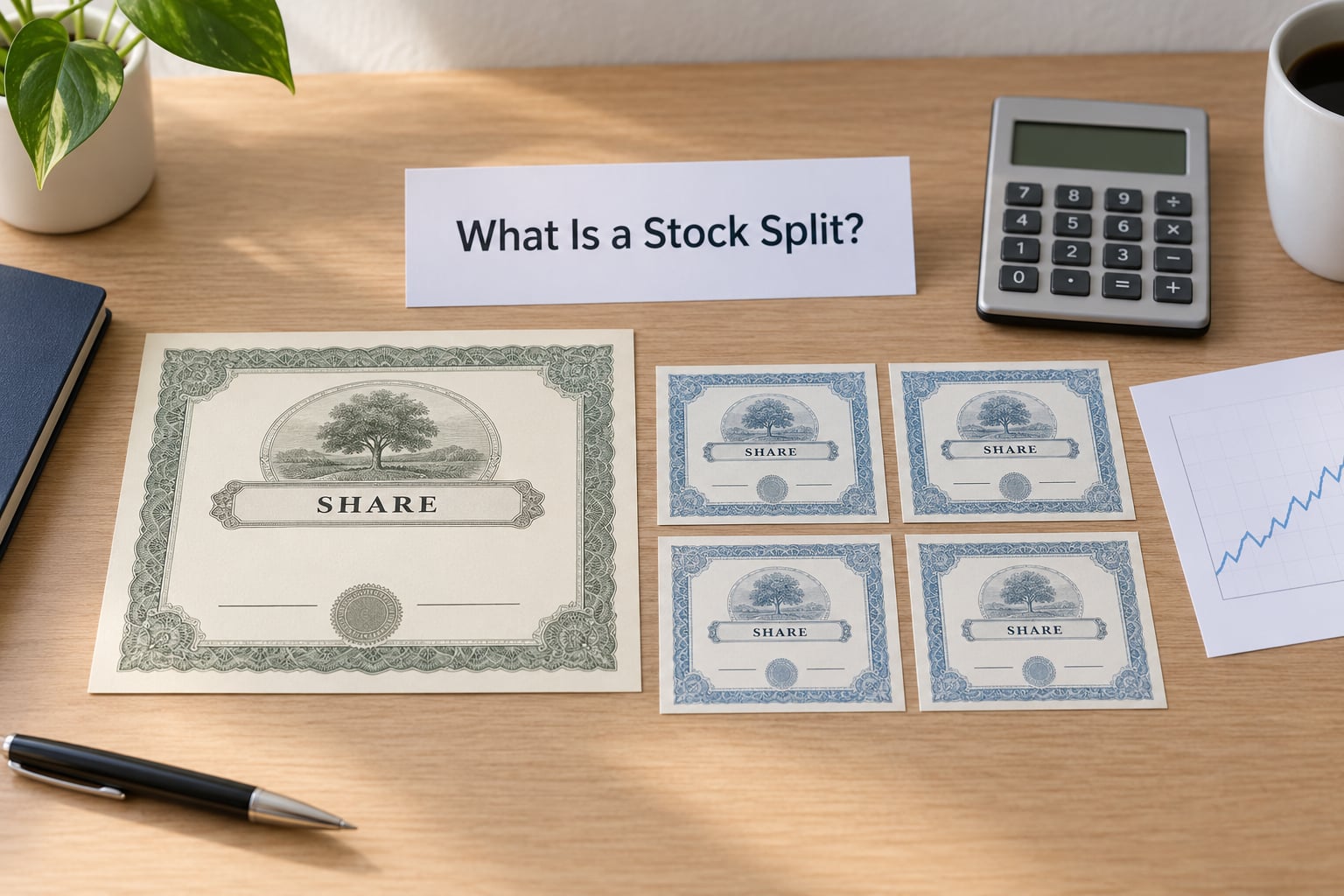
Here is the arithmetic, holding everything else constant. Start with 100 shares priced at USD 200 each.
| Split ratio | Shares after | Price per share | Total value |
|---|---|---|---|
| No split | 100 | USD 200 | USD 20,000 |
| 2-for-1 | 200 | USD 100 | USD 20,000 |
| 3-for-1 | 300 | USD 66.67 | USD 20,000 |
| 4-for-1 | 400 | USD 50 | USD 20,000 |
Read the last column twice. It never moves. That is the whole trick, and it is also why the split is legally implemented as a stock dividend: the company pays out additional shares rather than buying any back.
The terminology confuses people even after they understand the math. A stock split and a stock dividend are different events with different tax consequences, yet many companies describe their splits in SEC filings using dividend language, and the two phrases get used interchangeably in the wild.
How Does a Stock Split Work?
A forward split runs on a fixed ratio and a fixed calendar, and your broker does the work for you. You do not place an order, you do not approve anything, and you do not pay a fee for the extra shares.
The mechanics follow a predictable sequence. The board of directors approves the split and the authorized share count needed to carry it out. The company announces the ratio and the key dates. Shares are distributed to holders of record. On the ex-split date, your broker increases your share count and reduces the price per share by the same proportion, then restates your per-share cost basis to match.
The dates do different jobs, and mixing them up causes most of the confusion. The record date decides who receives the shares. The split date is when the additional shares are issued. The ex-split date is the first trading session at which the new, lower price applies, so it is the date that shows up on your statement.
Real splits follow the same script every time. NVIDIA executed a 10-for-1 forward split in June 2024. Amazon did 20-for-1 in June 2022, Alphabet did 20-for-1 in July 2022, Apple did 4-for-1 in August 2020 and Tesla did 5-for-1 in August 2020. Same mechanics, very different share prices.
One useful check: if your chart shows a cliff drop in price with no matching loss, that is almost always an unadjusted split. Most platforms offer a split-adjusted view that divides all historical prices by the ratio, so the line stays continuous.
What Is a Reverse Stock Split?
A reverse stock split does the opposite: it consolidates several shares into one, so the share count falls and the price per share rises by the same proportion. A 1-for-10 reverse split turns 1,000 shares at USD 0.40 into 100 shares at USD 4.00. Your total value is unchanged before the market moves.
The common reasons are defensive. Exchanges maintain minimum bid price requirements, and a stock trading under them can be moved to a different listing tier or delisted entirely, so companies consolidate to restore compliance. Loss-making firms with large share counts also reverse split to cut the administrative cost of paying transfer agent and listing fees on millions of shares. ETFs do it too, often to keep a fund trading in a normal range rather than at pennies.
There are two practical wrinkles worth knowing. Fractional shares are usually cashed out or rounded down at a set rate rather than converted, so holders with odd-lot positions can end up with a small cash payment and an adjusted share count that does not match a simple ratio. And a reverse split is frequently a distress signal, which is why retail forums treat one as bad news by default.
Notable ones include Citigroup’s 1-for-10 in 2011, AIG’s 1-for-20 in 2009 and General Electric’s 1-for-8 in 2021, all of which followed severe stress in the underlying business. Global X SuperDividend ETF executed a 1-for-3 reverse split that showed up as a surprise notification in an r/investing discussion about whether to sell, a reaction that says more about the notification than about the fund.
Does a Stock Split Matter for Investors?
Does a stock split matter for investors? Mechanically, no: it changes the number of shares you hold and the price per share, not your wealth. What matters is the reason for the split and whether the business behind it is improving, because the split carries no information the earnings release does not already carry.
Does a stock split matter? What actually changes
Four things genuinely change. Share count rises, price per share falls, cost basis per share falls by the same proportion, and the dividend per share falls proportionally so that your total cash income is unchanged. Anything you have calculated per share needs recalculating; anything you have calculated in total does not.
Three things stay put. Market capitalization, your percentage ownership of the company, and your total cost basis for tax purposes. If you own 0.5 percent of a company before a 2-for-1 split, you own 0.5 percent afterwards, because the company issued new shares to everyone proportionally, including itself through its own reserve.
The signal is the part people misread. Management splitting a stock is sometimes read as confidence that the price has room to run. That is a soft inference, not a disclosure. A company can split because the board wants a nominal price in a familiar range, and it can do the same thing on the way to a bad year. The split announcement is a rounding decision; the earnings call is where the information lives.
Empirical work is thin here. A widely syndicated piece in the Seattle Times in May 2024 cited figures that stocks had notched 25 percent total returns in the twelve months after a split was announced, against 12 percent for the broad index. Treat that as one reported study, not a rule, and note the obvious selection problem: companies announce splits when the stock has already run, which inflates the comparison.
What Changes After a Stock Split?
Sort your reaction into two piles. The mechanical pile needs five minutes of work on your spreadsheet. The judgement pile is the actual investing decision, and the split contributes almost nothing to it.
Mechanical changes, all handled by your broker:
- Share count multiplies by the split ratio.
- Price per share divides by the ratio.
- Cost basis per share divides by the ratio; total cost basis stays identical.
- Dividend per share divides by the ratio; total dividend paid to you stays identical.
- Historical prices on default charts divide by the ratio.
Unchanged: market capitalization, your ownership percentage, earnings, revenue, debt, cash flow and the business outlook. Nothing in the operating accounts moves. A split is a reformatting of the share register, not an event in the income statement.
The mental error that costs people money is treating the lower price as a lower valuation. A share at USD 30 after a 3-for-1 split is the same claim on the same company as the USD 90 share it replaced. Price per share on its own tells you nothing; the ratio of price to earnings or price to cash flow is what carries meaning.
Does a Stock Split Affect Your Portfolio Value?
No, not in any way you need to plan around. Take USD 20,000 invested in a single company at USD 200 per share: you hold 100 shares. After a 2-for-1 split you hold 200 shares at USD 100, which is still USD 20,000.
Put it the other way too. Someone who bought 1,000 shares at USD 5 before a 1-for-10 reverse split holds 100 shares at USD 50 afterwards. Same USD 5,000. Both directions cancel out, which is precisely why a split cannot create or destroy value on its own.
What does move your value is the market’s reaction to the announcement, and that happens before and after the effective date rather than because of it. Tesla shares rose more than 6 percent when its 2020 split was announced, which is the pattern traders call buying the news. Whether that gain survives the ex-split date is a separate question about the business.
There is one window where your statement can look wrong. Between the last session at the old price and the first session at the new price, some broker statements show a brief reduction in market value before the cost basis catches up. It is a display timing issue, not a loss, and it resolves within a session or two.
Can a Stock Split Affect Options and Trading?
Options are where the split gets genuinely interesting, because your contracts are modified for you by the Options Clearing Corporation rather than replaced. After a 2-for-1 split, a standard 100-share call typically becomes a 200-share call at half the strike price. Same total exposure, same break-even.
Worked example: you hold a call with a USD 400 strike on a 100-share multiplier, bought when the stock was USD 300. After a 2-for-1 split, that contract becomes a 200-share multiplier with a USD 200 strike while the stock trades around USD 150. Total cost, USD 40,000 in both cases. If your broker shows it any other way for a session, it is still adjusting.
Trading accounts have their own edge cases across the split date. Pending stop or stop-limit orders are usually adjusted for the ratio, but cancel and re-enter them yourself rather than trusting the arithmetic. Margin accounts can draw a call if the equity check runs against the old per-share price on the adjustment date, which is the exact worry raised by a trader in an r/stocks thread holding a leveraged position through a forward split. Brokers usually fix it within a day, but check your margin maintenance buffer before a known split date.
Charts deserve one more mention because it is the most repeated confusion I see. Someone opens a five-year chart, sees the price fall 75 percent overnight, and assumes they lost everything. They did not. Turn on split adjustment and the same chart is continuous. One poster on a StraightDope Boards thread described learning stock splits the way most people do, as a general-audience civics question rather than an investing one.
The accessibility argument also deserves a reality check. A cheaper share is not a cheaper company, but it does make options and fractional purchases easier to size, and that is a real convenience for small accounts. Berkshire Hathaway has never split, and the practical response to a share priced in the hundreds of thousands of dollars is fractional shares, which most brokers now offer.
Why Do Companies Announce Stock Splits?
Forward splits and reverse splits come from opposite motivations, and the direction of the split tells you which set of pressures a company is under.
Forward split motives:
- Bringing the nominal price back into a familiar trading range, often roughly USD 20 to USD 200.
- Making options contracts and fractional purchases affordable for smaller accounts.
- Supporting employee stock purchase plans and equity compensation with whole-share numbers.
- Improving perceived liquidity and order flow among retail participants.
- Signalling management confidence after a strong run in the price.
Reverse split motives:
- Regaining an exchange minimum bid price listing requirement.
- Reducing per-share administrative costs on a very large share count.
- Preserving eligibility for institutional mandates and index inclusion that exclude low-priced securities.
- Cleaning up a share count after heavy dilution.
Buffett has argued against splits for Berkshire Hathaway on the grounds that a lower nominal price invites more short-term trading and less long-term ownership, and that nothing about the business improves when the pieces get smaller. Berkshire’s Class A and Class B structure, where the Class B shares carry far more voting power, is often blamed on avoiding splits that would widen the voting gap. It is a defensible view, and it is also why fractional shares exist.
Worth noting that splits have grown rarer since 2000, which undercuts the idea that they are a required ritual. A company can sit at any price indefinitely.
How to Evaluate a Stock Split Announcement
Treat the announcement as a reason to do research, not as a trade. Seven checks cover it.
Read the terms. Note the ratio, the record date and the ex-split date. Write them down before you read any commentary about the announcement.
Go to the primary source. The company’s investor relations page and its Form 8-K under Item 5.03, which covers amendments to the articles of incorporation affecting authorized shares, carry the authoritative language. Broker alerts are usually accurate but occasionally garble ratios.
Ask what triggered it. A split after a sustained run, a split following exchange minimum bid pressure and a split alongside a restructuring are three different situations with three different meanings.
Read the same quarter’s earnings. Revenue, margins, operating cash flow and guidance tell you whether the business improved. The split does not.
Check the share count history. Heavy issuing, convertible notes and stock-based compensation can dilute you quietly, and a split does not offset that.
Look at valuation on a per-share-adjusted basis. Recalculate earnings per share and book value per share on the new share count so you are not comparing pre-split figures to post-split ones.
Handle the operational side. Cancel pending stop orders, check margin levels, confirm how your broker adjusts options positions, and check whether you hold fractional shares that could be cashed out.
None of this is investment advice, and none of it can tell you what a stock does next. It just stops you from confusing a formatting change with new information.
Frequently Asked Questions
Is it good to buy before or after a stock split?
Neither is reliably better, because the split itself is value-neutral. If you buy before, you hold more shares at a lower cost per share; if you buy after, you hold fewer shares at a higher cost per share, and the total is identical. The announcement can lift the price temporarily, which means buying in the enthusiasm often means buying the top of that move. Decide on the business first.
Do stocks usually go up after a split?
They sometimes rise on the announcement, but that is a reaction to the news, not to the split mechanics. A syndicated Seattle Times piece reported 25 percent total returns in the twelve months after a split was announced against 12 percent for the broad index, but companies tend to split after the stock has already run, which inflates that comparison. Use it as context, not a rule.
What is the downside of a stock split?
The split itself has no real downside, since no value is created or destroyed. The practical downsides are second-order: a lower nominal price can encourage short-term trading, split announcements sometimes attract enough buyers to inflate a price that later fades, and shares, options contracts and per-share figures all need recalculating, which is where mistakes happen. Reverse splits carry a different and more serious risk profile.
What happens to my call options after a stock split?
The Options Clearing Corporation adjusts your contracts rather than replacing them. After a 2-for-1 split, a standard 100-share call usually becomes a 200-share call with the strike price halved, so your total exposure and break-even point are unchanged. The same adjustment runs in reverse for a reverse split. Check your broker’s display the morning after the ex-split date if the figures look strange.
Is a forward stock split a taxable event?
Under IRS guidance, a standard forward split is not a taxable event. Your total cost basis stays the same and is simply divided across a larger number of shares, so the cost basis per share falls proportionally. A reverse split is generally not taxable either, though cash received in lieu of fractional shares can be treated as a small sale. Rules vary by country, so confirm your own position.
Do reverse splits mean a stock is in trouble?
Often they are a warning sign rather than a cause of trouble. Companies reverse split to meet exchange minimum bid requirements, to cut per-share administrative costs, or after heavy dilution, and each of those situations reflects stress somewhere in the business. Not every reverse split is fatal, but the right move is to investigate why it happened before you decide anything about your position.
Conclusion
A stock split changes the number of shares you hold and the price per share. It does not change your wealth, the company’s market capitalization or your share of ownership, and no analysis should pretend otherwise.
Start with the ratio and the ex-split date from the company’s investor relations page or its Form 8-K, then spend your attention where it belongs: on earnings, cash flow and valuation. If you hold options or use margin, handle those positions before the date. Everything else is bookkeeping your broker will do for you.