
What is dividend growth investing? It means buying companies that raise their dividend payment every year and reinvesting those rising payouts over many years, rather than chasing the biggest yield today.
You look for businesses whose earnings and cash flow are growing fast enough to support higher payments later. The payoff is an income stream that climbs over time instead of one that sits flat.
The idea is simple, but the screening is where beginners lose money. Below is the process I use: what the strategy actually is, how it differs from chasing yield, which numbers decide whether a dividend is safe, and how much capital you need to hit an income target.
Dividend amounts and yield levels change constantly, so treat every figure in this guide as an illustration of the math rather than a current quote. Rules and tax treatment also vary by country and by account type, and none of this is individual investment advice.
Table of Contents
- Key takeaways
- What Is Dividend Growth Investing?
- How dividend growth is calculated
- How Is Dividend Growth Different From Other Dividend Strategies?
- What Should Investors Look for in a Growing Dividend?
- What a dividend growth investing streak really tells you
- How Do You Evaluate a Company’s Dividend Growth?
- How Can You Build a Dividend Growth Portfolio?
- How much capital does a target income need?
- What Are the Main Risks of Dividend Growth Investing?
- Is Dividend Growth Investing Right for You?
- Frequently Asked Questions
- Is a higher dividend yield better than dividend growth?
- How long should I hold dividend growth stocks?
- Do I have to reinvest my dividends?
- How do I avoid dividend traps?
- Should retirees use dividend growth investing?
- How much capital do I need to earn a steady monthly dividend?
- Conclusion
Key takeaways
- Dividend growth investing targets the rate of increase in the dividend per share, not the dividend yield.
- A long streak of annual increases is the most-cited trust signal, but a streak alone does not prove the payout is affordable.
- Payout ratio and free cash flow coverage tell you whether the dividend can survive a downturn.
- Reinvesting the distributions compounds both share count and income per share.
- Growth usually comes with a lower starting yield, which is why most people build the position over years rather than overnight.
What Is Dividend Growth Investing?
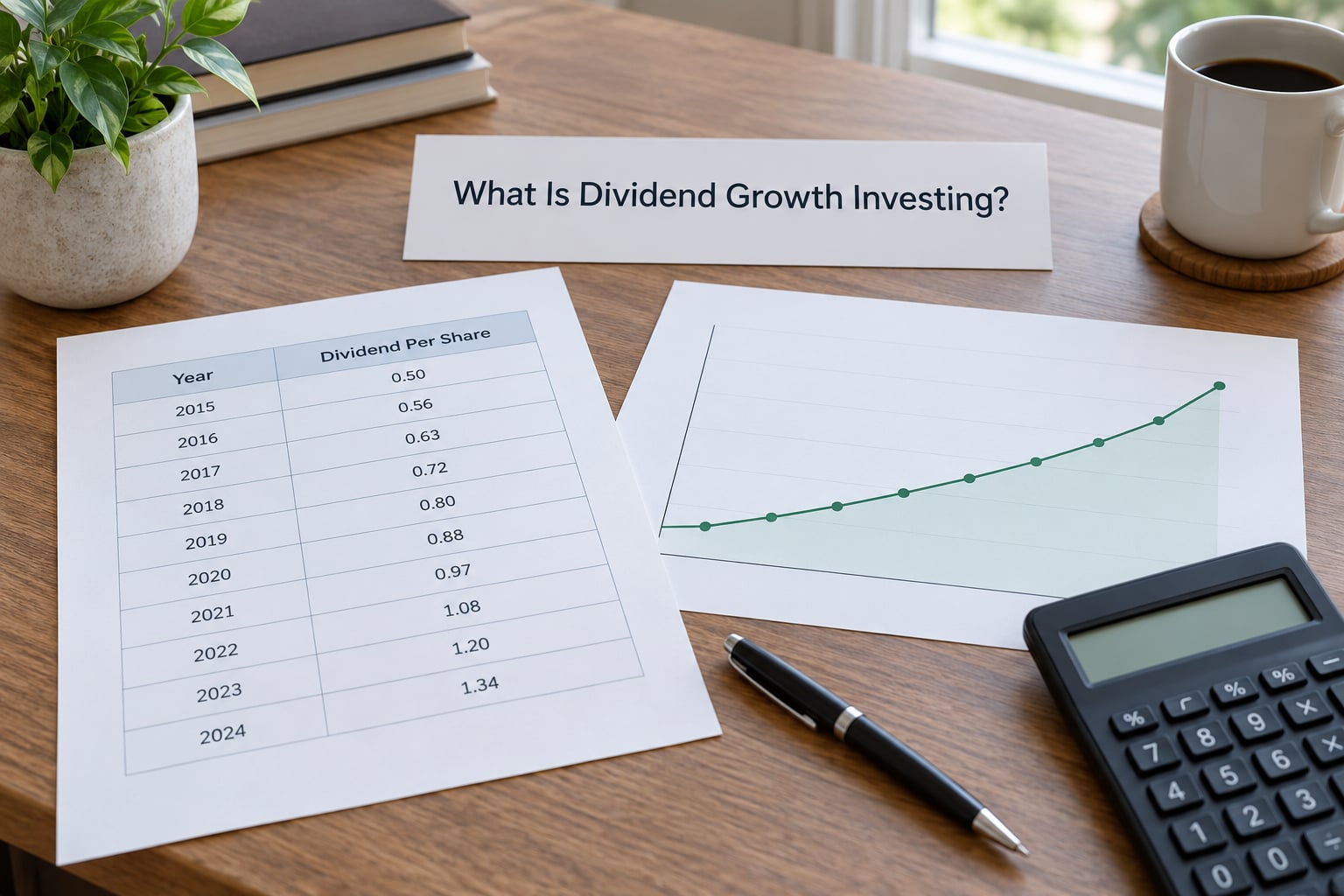
Dividend growth investing is an investment strategy focused on buying shares in companies that consistently increase their dividend payments year after year, then reinvesting that income rather than spending it. The defining feature is the slope of the dividend line over time, not the size of any single payment.
Take a fictional example. Suppose a company pays a dividend of 1.20 per share ten years ago and pays 2.00 today, and the dividend rose in every one of those years. That steady climb is dividend growth. The same company might trade at a very low yield today because its share price has run ahead, and that is fine, because the payout is still rising in dollar terms.
How dividend growth is calculated
The dividend growth rate is a compound annual growth rate, the same math you would use for an account balance that grows over time:
Dividend growth rate = (Ending dividend / Beginning dividend)^(1 / number of years) – 1
Using the numbers above: (2.00 / 1.20) = 1.667, raised to the power of one tenth gives roughly 1.052, minus one equals a 5.2% annual dividend growth rate. A seven percent grower that raised its dividend from 1.00 to 1.97 over the same ten years would show a much steeper slope on the worksheet.
Rates get quoted over three, five and ten year windows, and all three matter. The three year rate tells you what is happening recently, the five year rate smooths out one-off jumps, and the ten year rate is closer to a trend you could actually plan around.
How Is Dividend Growth Different From Other Dividend Strategies?
Dividend growth, high-yield income and dividend capture all produce cash, but they optimise for different things and carry different risks. The clearest way to see the difference is to compare what each approach targets.
| Approach | Main objective | Typical company | Biggest risk | Who it fits |
|---|---|---|---|---|
| Dividend growth | Rising income over time | Mature, profitable, low debt, strong reinvestment record | Slow start, low yield in the early years, valuation risk | Long-horizon investors building income gradually |
| High-yield income | Largest cash payment now | Utilities, telecom, banks, energy, real estate vehicles | Dividend cut, cyclical earnings, trapped capital | Investors who need income immediately and accept risk |
| Dividend capture | Short-term price capture around the ex-dividend date | Any dividend payer | Taxes, transaction costs, price drop after the ex-date | Institutional and short-horizon traders |
| Value-oriented dividend | Cheap price plus a payout | Deep value industrials, financials, energy | Value trap, dividend is the last thing left to cut | Investors with time to wait out a slow re-rating |
The worked difference matters more than the definitions. Suppose you put 10,000 into each of two baskets. One holds a grower yielding 4% today with an 8% annual dividend growth rate; the other holds a high yielder at 10% with a flat payout. In year one, the grower pays 400 and the high yielder pays 1,000, which is exactly why beginners bail out early.
Ten years later, the grower’s dividend per share has grown to about 4.32, so the same 10,000 now pays roughly 4,320 in annual dividends, assuming the shares were reinvested along the way. The high yielder still pays about 2.50 per share on a 25,000 position, or roughly 1,000 a year. The grower started behind and finished far ahead, and the crossover point is usually somewhere around year seven or eight.
Forum discussions on dividend investing keep circling that same gap. On the Mustachian Post forum, one long-running thread described a portfolio built with roughly 90% of its names picked specifically for dividend growth rather than current yield. The recurring complaint in r/dividends is the opposite one: that a 2% starting yield feels impossible to live on while still working.
What Should Investors Look for in a Growing Dividend?
A rising dividend only counts if the company can keep paying it through a bad year. Six measures tell you whether a dividend is durable rather than borrowed from the balance sheet.
- Payout ratio. Dividends per share divided by earnings per share. A payout under 60% leaves a wide margin for a downturn; above 80% and the dividend becomes the first thing management defends by cutting spending or borrowing.
- Free cash flow coverage. Compare the dividend with operating cash flow minus capital spending. Earnings can be flattered by accounting; cash is harder to argue with.
- Earnings stability. Ten years of flat or rising earnings per share matters more than one strong year.
- Debt load. Interest expense eats the cash that funds dividends. Low leverage and interest coverage above roughly three times give a dividend room to breathe.
- Return on equity. A sustained return above 15% usually signals a competitive moat, which is what allows a company to raise prices faster than costs.
- Consistency of increases. Consecutive annual increases are the single most-cited trust signal in dividend investing.
A higher dividend yield is not automatically better. Yield is simply the annual dividend divided by the share price, so it rises when a price falls, which is exactly what happens to a company heading for a cut. Forum investors call that pattern a yield trap, and one Early-Retirement.org poster put the rule plainly: a dividend is only good if it is sustainable.
What a dividend growth investing streak really tells you
| Tier | Requirement | What the streak tells you |
|---|---|---|
| Dividend Challenger | 25 consecutive years of increases | A long tested record, but a shorter one than the top tiers |
| Dividend Aristocrat | 25+ consecutive years of increases | Management has kept its word through at least one full recession cycle |
| Dividend King | 50+ consecutive years of increases | Multiple management teams and several economic cycles of discipline |
Streak length is useful, and it is not sufficient. Streaky screens produce false positives, because a company can raise its dividend during a temporary earnings spike and then cut it two years later. Read the streak alongside the payout ratio, not instead of it.
How Do You Evaluate a Company’s Dividend Growth?

Here is the repeatable process I run before any name goes on a watchlist. It takes about twenty minutes per company once you know where to look.
- Pull the dividend history. List the annual dividend per share going back at least ten years and mark every increase and every cut.
- Calculate the growth rate over three, five and ten years. Use the compound formula above. A high five year rate with a low ten year rate usually means a one-off raise, not a trend.
- Compare the payout with earnings and cash flow. Recalculate the payout ratio using the latest full year and check whether operating cash flow covers the dividend after capital spending.
- Examine debt and capital spending. Heavy borrowing or a large capital programme can absorb the cash that funds the dividend.
- Check for share buybacks. Buying back shares shrinks the share count, which lifts dividend per share even when total cash paid out stays flat.
- Ask whether the next raise is affordable. If earnings are growing slowly and the payout is already above 70%, the growth rate is likely to fade.
- Price it. A great business bought at a stretched multiple can still underperform for years.
One warning that almost no beginner knows: a trailing dividend growth rate can look excellent while a cut announced mid-year has already broken the streak. Trailing figures lag the news by up to twelve months, so read the current declaration, not just the history.
How Can You Build a Dividend Growth Portfolio?
A workable dividend growth portfolio spreads names across sectors, checks that growth and valuation are not pulling in opposite directions, and lets the position compound. Most of the practical difficulty is discipline, not analysis.
- Spread across sectors. Early retirees on these forums frequently end up with a portfolio of utilities, banks and telecom because those are the names that come up most often. Concentration in one rate-sensitive sector turns a steady income plan into a sector bet.
- Balance growth with valuation. Pair a faster grower with a slower, steadier name so the portfolio is not priced entirely on the expectation of continued expansion.
- Reinvest until you need the cash. A dividend reinvestment plan buys fractional shares on a schedule, which is convenient but also removes the decision from you. Many investors prefer the manual version so they can reinvest at chosen prices rather than automatically on every pay date.
- Rebalance on a schedule. Once a year is plenty. Growing positions can quietly take over a portfolio.
- Size for income, not for excitement. Knowing how much capital your income target requires keeps the arithmetic honest.
How much capital does a target income need?
The table below shows the starting capital required at three different starting yield levels. A higher starting yield means a smaller pot today but less growth later; a lower yield means more capital now and a faster-rising income stream.
| Annual income target | At 1.5% starting yield | At 2.5% starting yield | At 4.0% starting yield |
|---|---|---|---|
| 6,000 per year | 400,000 | 240,000 | 150,000 |
| 12,000 per year | 800,000 | 480,000 | 300,000 |
| 30,000 per year | 2,000,000 | 1,200,000 | 750,000 |
| 60,000 per year | 4,000,000 | 2,400,000 | 1,500,000 |
These amounts are illustrative and ignore taxes, fees and inflation. Each line assumes you invest the full amount today and take no further contributions.
If you would rather not pick individual names, dividend-focused exchange traded funds and mutual funds give you a basket in one purchase and handle the reinvestment for you. The trade-off is that you give up the ability to screen out the names you dislike, and you pay an annual expense ratio instead of trading commissions.
What Are the Main Risks of Dividend Growth Investing?
The strategy is not risk free. The main exposures are cuts, concentration, valuation and the assumption that yesterday’s streak guarantees tomorrow’s payments.
Dividend cuts. A cut is usually the first visible sign of trouble, which makes the streak a lagging signal rather than a warning system. Cyclical high-yield names cut hardest in recessions.
Economic downturns. Recessions hit every sector, including the well-run ones. Growth stocks lose less in a downturn because investors pay for the recovery, so a dividend growth portfolio can underperform a total-return portfolio through a full cycle.
Interest rate changes. Higher rates push investors toward income, which supports dividend stocks, while utilities and REITs carry more debt and get squeezed when borrowing costs rise.
Sector concentration. Owning five utilities is a rate bet wearing a dividend costume.
Valuation risk. Paying a premium multiple for a durable grower is reasonable, but paying any price for quality is how investors end up waiting a decade for a return.
Automatic reinvestment at the wrong price. Reinvesting every pay date means buying more shares when prices are high. Oversized positions after a run are exactly when you least want to add.
Two practical risk checks help: confirm the dividend is covered by free cash flow in the worst of the last three years, and check the top five positions do not share the same rate sensitivity.
Is Dividend Growth Investing Right for You?
Dividend growth investing fits investors with a long horizon who want income to grow over decades and who can tolerate several years of flat or falling share prices along the way. It suits accumulation first and income later, which is the reverse of how most people meet dividends.
It is less suitable if you need meaningful income in the next five years. At a 1.5% to 2.5% starting yield, you would need a very large portfolio to live on the distributions alone, and that gap is the single most common source of frustration described in dividend forums.
It is also less suitable if you expect to move money on short notice. Capital gains tax rates and the treatment of qualified dividends differ by country and account type, and a plan that depends on never selling is fragile. Check the rules where you live, and remember that fees and taxes quietly reduce the compounding the strategy depends on.
A workable compromise is to hold dividend growth companies as the income-producing core and add growth-oriented holdings alongside them, which is the split one poster on the HumbleDollar forum described as dividend growers plus a growth fund for ballast.
Frequently Asked Questions
Is a higher dividend yield better than dividend growth?
Usually not. In what is dividend growth investing, the target is the rising payment itself, not the headline yield, which jumps when a price falls and often signals trouble ahead. A 2% yield that increases every year can overtake a 9% yield that stays flat within a decade. Judge safety with payout ratio and cash flow coverage.
How long should I hold dividend growth stocks?
Longer than most people expect. The compounding works through rising dividends per share and a growing share count, and both need time. Many dividend investors hold individual names for five to ten years or longer. Selling on a short horizon usually costs more in tax and transaction friction than the yield ever earned, so treat the position as long-term ownership of a business.
Do I have to reinvest my dividends?
No. Reinvesting maximises compounding, which matters most during the accumulation years. Once you begin drawing income, reinvesting a portion usually keeps the payment rising while you still take cash. Manual reinvestment gives you control over the price you pay, because automatic plans buy on every pay date regardless of valuation.
How do I avoid dividend traps?
A dividend trap is a high yield attached to a business that cannot sustain it. Check three things: the payout ratio against earnings and free cash flow, whether earnings per share are growing, and how the dividend was funded, from operations or from debt. A streak that began during an earnings spike and ended in a cut is the classic pattern to watch for.
Should retirees use dividend growth investing?
It works well in the later stage of a retirement plan because the income base keeps rising with inflation. The risk is concentration, since retirees often accumulate the same rate-sensitive sectors they bought during their working years. Spread across sectors, check that the top positions are not all utilities or banks, and keep a growth-oriented allocation to fund future raises.
How much capital do I need to earn a steady monthly dividend?
Divide your annual target by your portfolio’s starting yield. At a 2% yield, generating 1,000 a month requires about 600,000 of invested capital, while a 3% yield requires roughly 400,000. These figures are illustrative and ignore tax and fees. A lower starting yield demands more capital now but produces a faster-rising income stream later.
Conclusion
Dividend growth investing is a long-horizon strategy built on one question: does this company raise its dividend every year, and can it keep doing so? That is a different question from whether the yield looks attractive today, and it is the question worth doing the work for.
Start by writing down what your income target actually is, because the arithmetic sets everything else. Then take five companies with long increase records, calculate the three, five and ten year dividend growth rates, and check each payout against earnings and free cash flow. Spread whatever survives across sectors, reinvest during the years you are still accumulating, and review once a year.
Aim for income that rises with the cost of living rather than a large cheque in the first year. Dividend growth investors who succeed are the ones who kept buying quality businesses through flat decades, not the ones who picked the biggest number on a screener.